
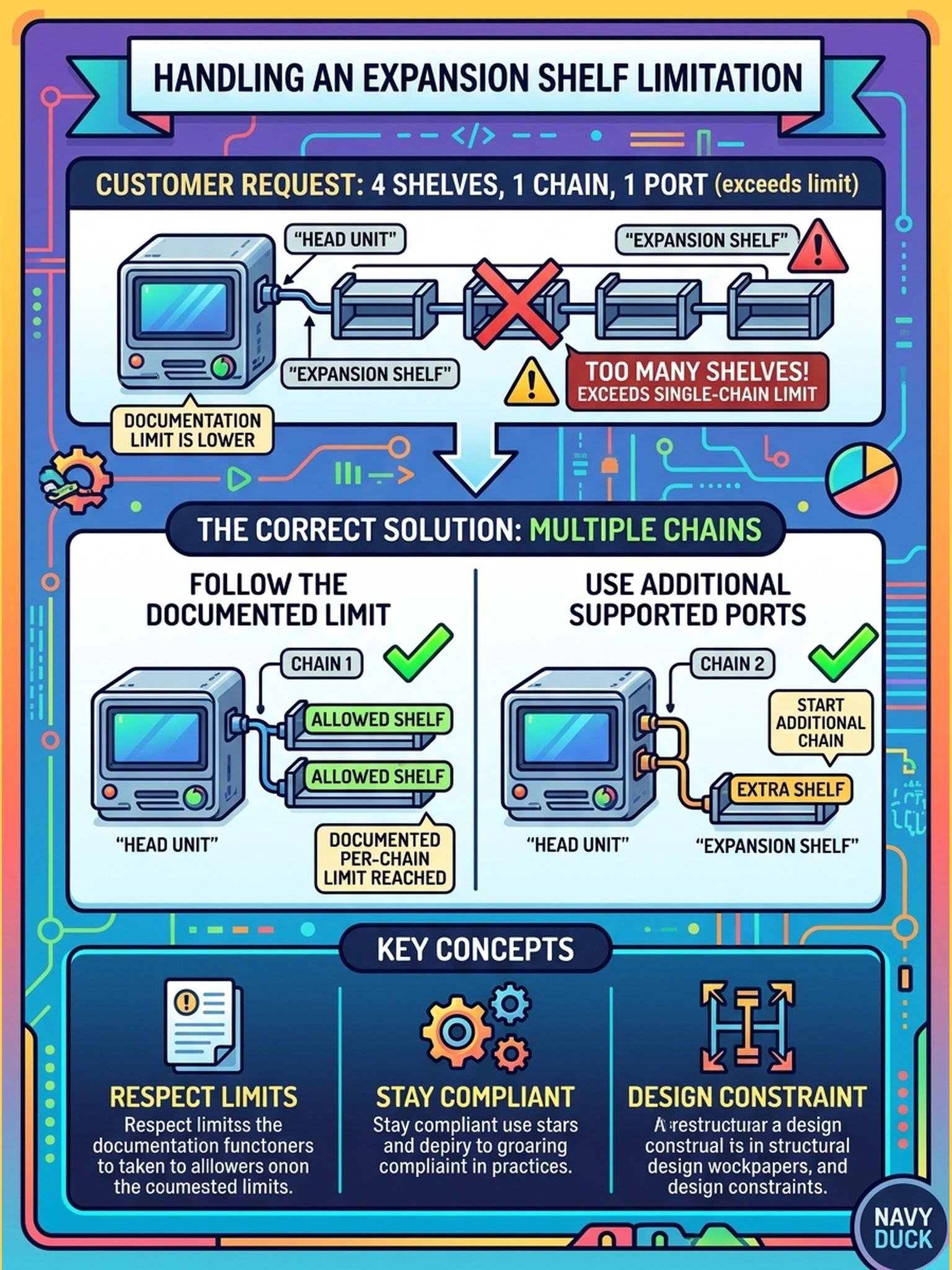
The customer wants four expansion shelves on a single chain from one head port, but the platform's documentation allows fewer shelves per chain on this model. How should the installer handle that request?
Select an answer to reveal the explanation.
Short Explanation
A chain limit in the docs is a guardrail, not a speed bump. Wanting four shelves on one chain doesn't change the engineering — so you run two happy chains instead of one overloaded one. Respect the limit, add the extra chain, and keep the documentation on your side.
Full Explanation
A per-chain shelf limit reflects the electrical and logical budget of a storage interconnect chain — signal quality, addressable enclosure count, and failover behavior, all validated and supported only up to the documented depth. When documentation allows fewer than four shelves per chain, the correct handling of the customer's request is to honor the limit: fill chains to the allowed depth and carry the extra shelves on an additional chain from the next supported port. 'Install it and see' fails by concept: an over-deep chain may enumerate at install yet drop members intermittently in production, putting the failure inside a backup window rather than at commissioning. 'Three is close enough' fails by concept because supported configurations do not carry undocumented tolerance margins; working is not the same as supported. The short-cable argument fails by concept: cable length affects a fraction of the chain's loss budget and cannot buy headroom for an extra shelf. Exam caveat: customer preference versus a documented hardware limit always resolves in favor of the limit, with the additional-chain alternative. Operational check: draw the chains to the documented per-chain depth before cabling, count shelves per chain against the documentation, and verify chain start ports in the enclosure view at bring-up.