
Two expansion shelves must chain to the head, and a tech starts plugging into whichever ports sit closest to each shelf. Why must the chain follow the prescribed start port and order instead?
Select an answer to reveal the explanation.
Short Explanation
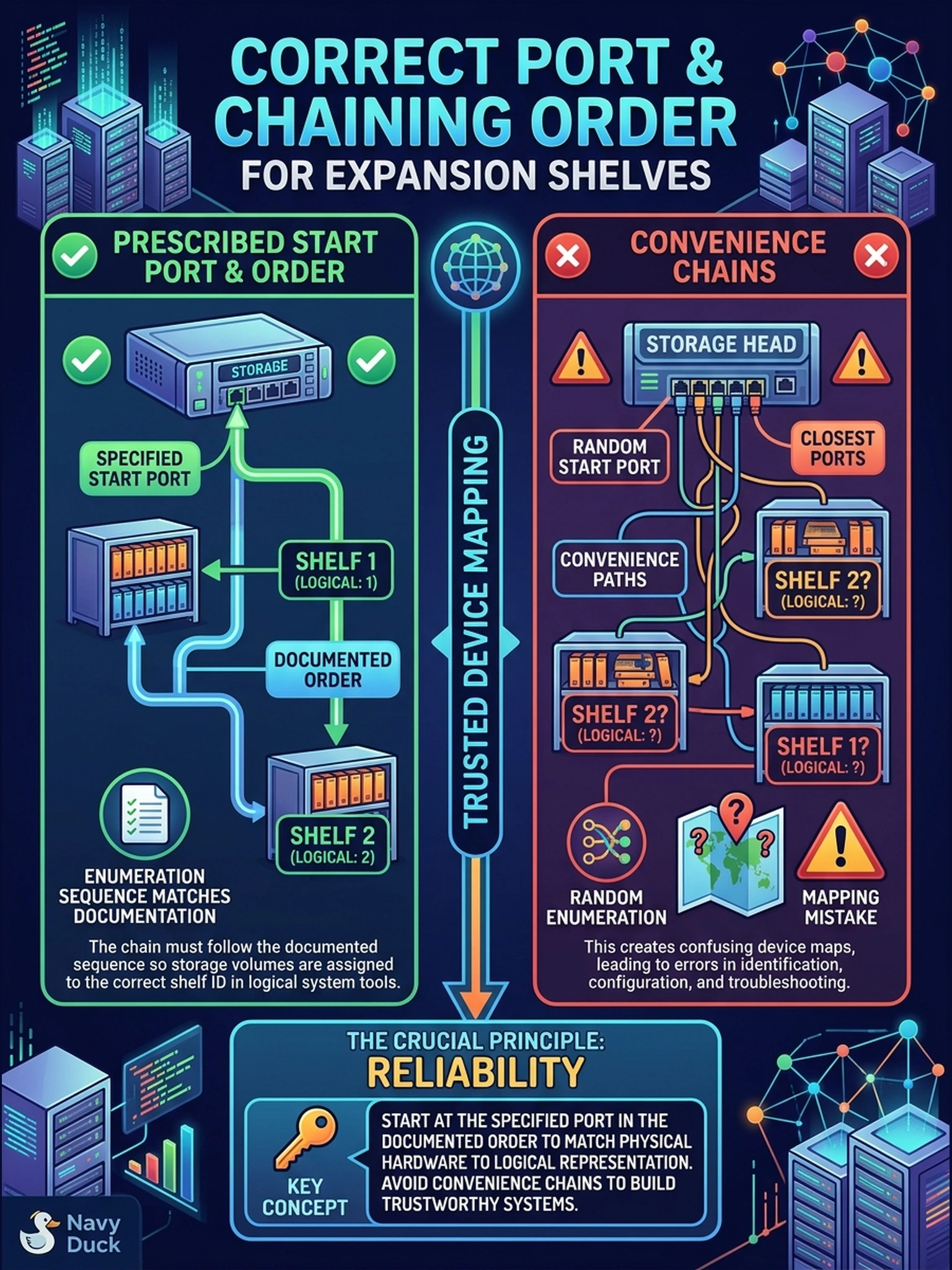
Here's the deal: the closest port is the laziest answer, not the right one. The chain has a documented start port and a documented order, and when you cable to that map your enclosure view tells the truth later. Cable to the map, not to convenience.
Full Explanation
Shelf chaining follows a documented topology: a designated start port on the head, a defined shelf order, and designated receive ports on each shelf. That prescription matters because the software's enclosure view is interpreted against the same map — support procedures, drive-replacement workflows, and expansion guidance all assume 'chain position one' means the same thing physically and logically. Plugging by convenience still enumerates the shelves, but it scrambles the correspondence: the diagram and the rack disagree, so every later reader of the diagram starts from a wrong premise, and crossed physical runs make tracing worse. The cluster-reservation, management-port, and 'order is irrelevant' arguments each fail by concept: the designated ports and sequence exist precisely to make enclosure identity predictable, and a haphazard chain produces a functioning system with an untrustworthy reference. Exam caveat: a chain cabled out of order is not 'done' simply because every shelf appears — acceptance compares order against documentation. Operational check: at first boot, read the enclosure view top to bottom and confirm each reported shelf matches its position label and the chain diagram.