
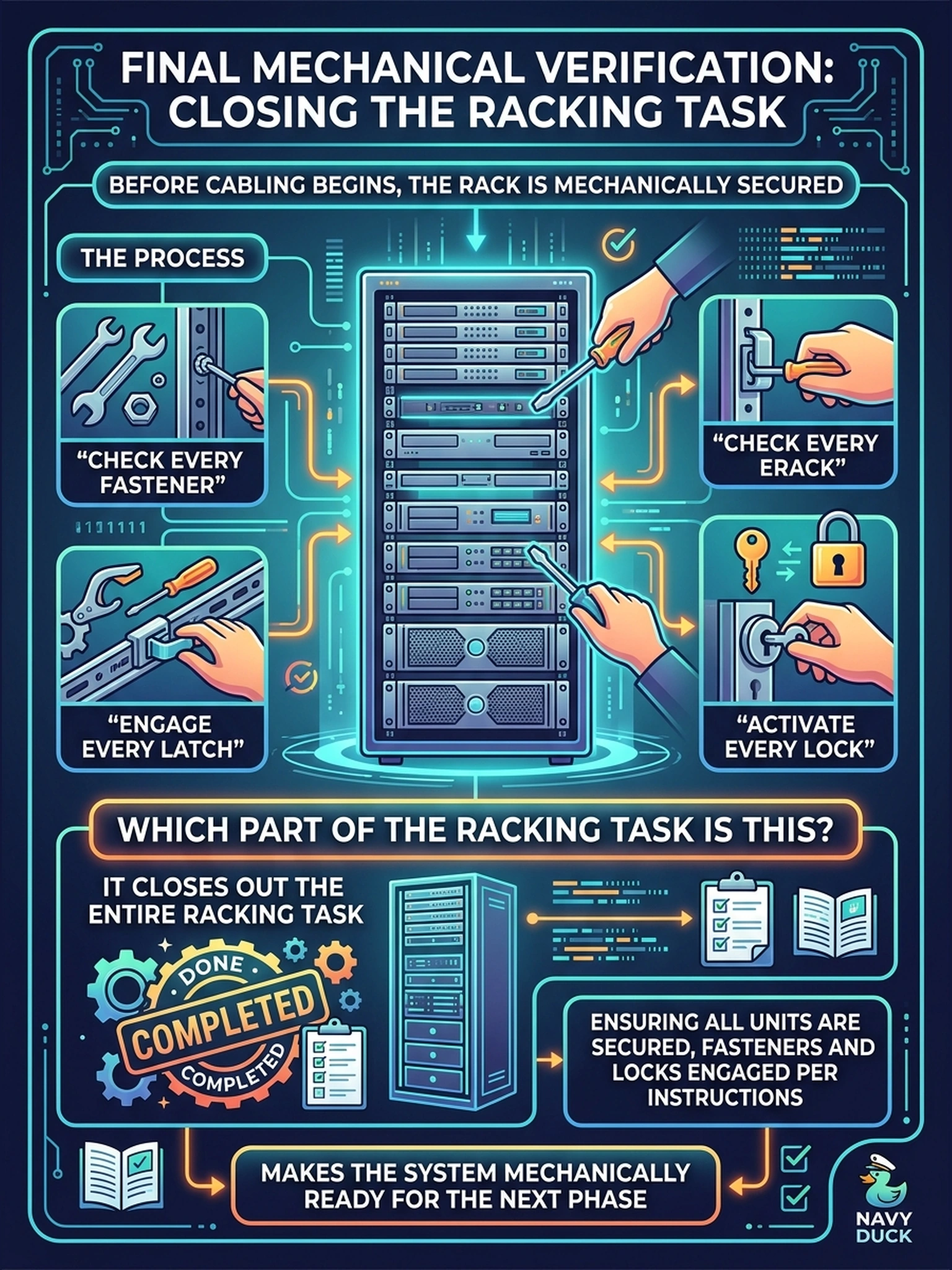
Before any cable enters the rack, the lead runs a pass checking every fastener, latch, and lock across the whole head-and-shelf stack. Which part of the racking task does this close out?
Select an answer to reveal the explanation.
Short Explanation
Think of it like a pilot's walkaround: everything important gets one more deliberate look before flight. Every screw, latch and lock across the stack gets touched and confirmed before a single cable goes in — because rework behind dressed cables costs you triple what it costs you now.
Full Explanation
Racking has a verification gate, not just an endpoint. The final mechanical pass walks the stack confirming that every chassis fastener is present and tightened, every rail latch is engaged, every lock feature has clicked, anti-tip hardware is fitted where specified, and the whole assembly is rigid against the rack. It happens before cabling for two practical reasons: a unit that needs wrenching behind dressed cables turns into two jobs, and cables apply pull and tension forces to units that must already be secured to resist them. The cosmetic inspection matters at handover but does not confirm mechanical condition. The loose-hardware sweep is genuine housekeeping and is worth doing, but it is not what certifies the units themselves as mounted. Rack bonding surveys are a facilities grounding activity, not a racking closeout defined by the installation instructions. Exam caveat: when a question asks how the racking task 'completes,' the answer is mechanical verification per the instructions — not power-on, not cabling readiness. Operational check: walk the stack unit by unit — fastener torqued, latch engaged, lock confirmed — sign that gate off, then begin cable routing.