
In a shared rack, live production gear sits right beside the work area, and a technician props a loaded chassis's corner against the neighbor's bezel to free both hands. Which working-around-live-equipment rule is being broken?
Select an answer to reveal the explanation.
Short Explanation
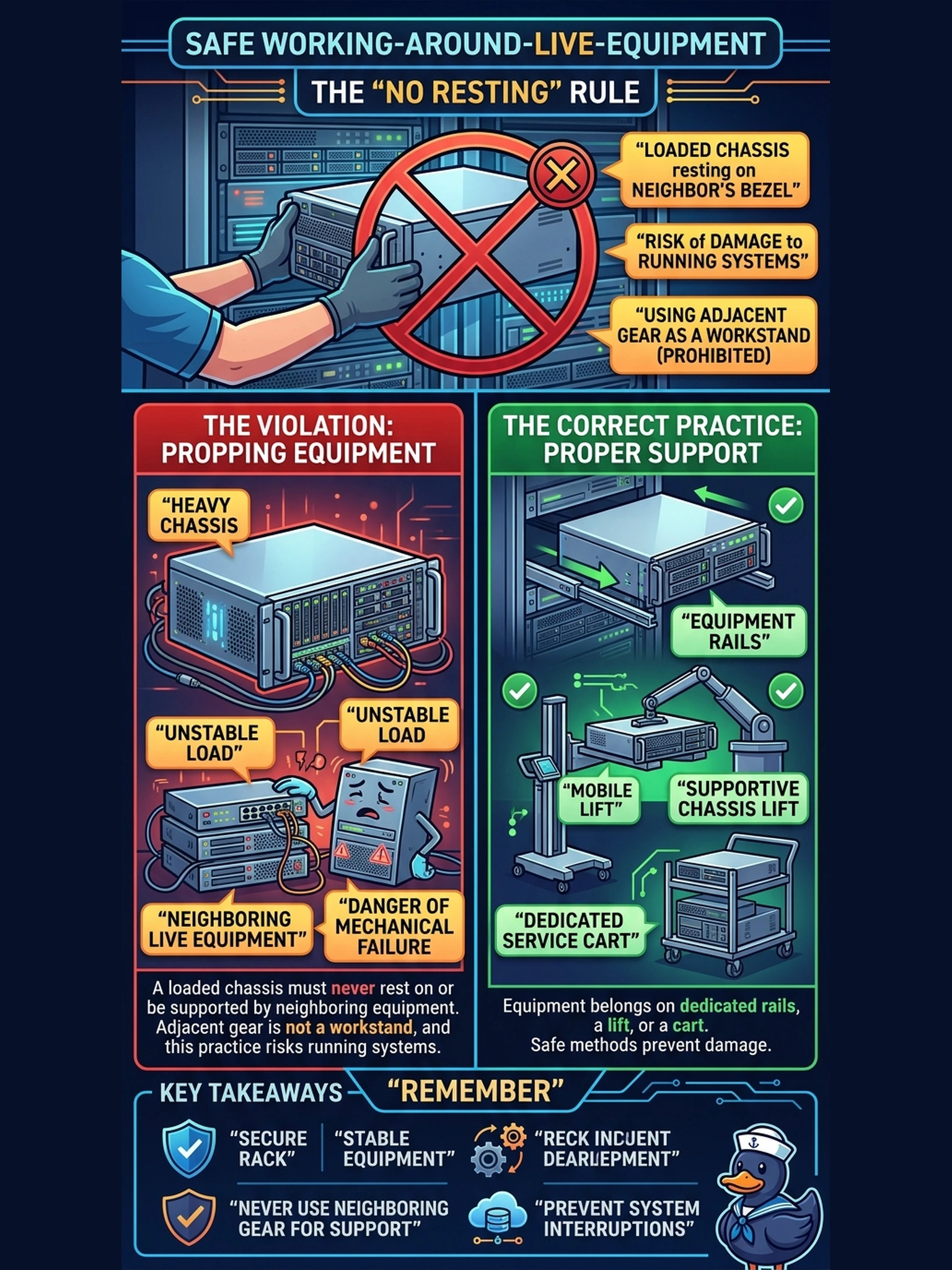
In a rack full of live systems, the neighbor's bezel is an alarm waiting to go off. A loaded chassis needs real support — rails, a lift, or a cart — because one lean can crack plastic, press a button, or shake a running array awake. Plan where the weight goes before you're carrying it.
Full Explanation
Shared racks concentrate risk: a loaded chassis is heavy, and its corner load on a neighboring system's bezel can crack the faceplate, press a control, deform a latch, or transmit shock into a running drive or a seated card — any of which turns an installation into a production incident. The rule is to treat adjacent live equipment as fragile and unsupported: the chassis is carried to its rails and supported on those rails, a mechanical lift, or a cart for its entire path, never braced on or leaned against what shares the rack with it. Powering the neighbor down is not the tested rule — working carefully beside live equipment is precisely why these handling rules exist, and wholesale shutdown for every install is not required. An antistatic bag protects components from ESD and carries no structural load; 'bezel as a rest point' inverts the design intent — bezels are removable covers, not load-bearing surfaces. Exam caveat: a scenario mentioning live or production gear is cueing the candidate to protect the existing environment. Operational check: before any lift, identify what supports the unit at every point of its path — rails, lift, or cart — and confirm nothing in that path relies on neighboring hardware.