
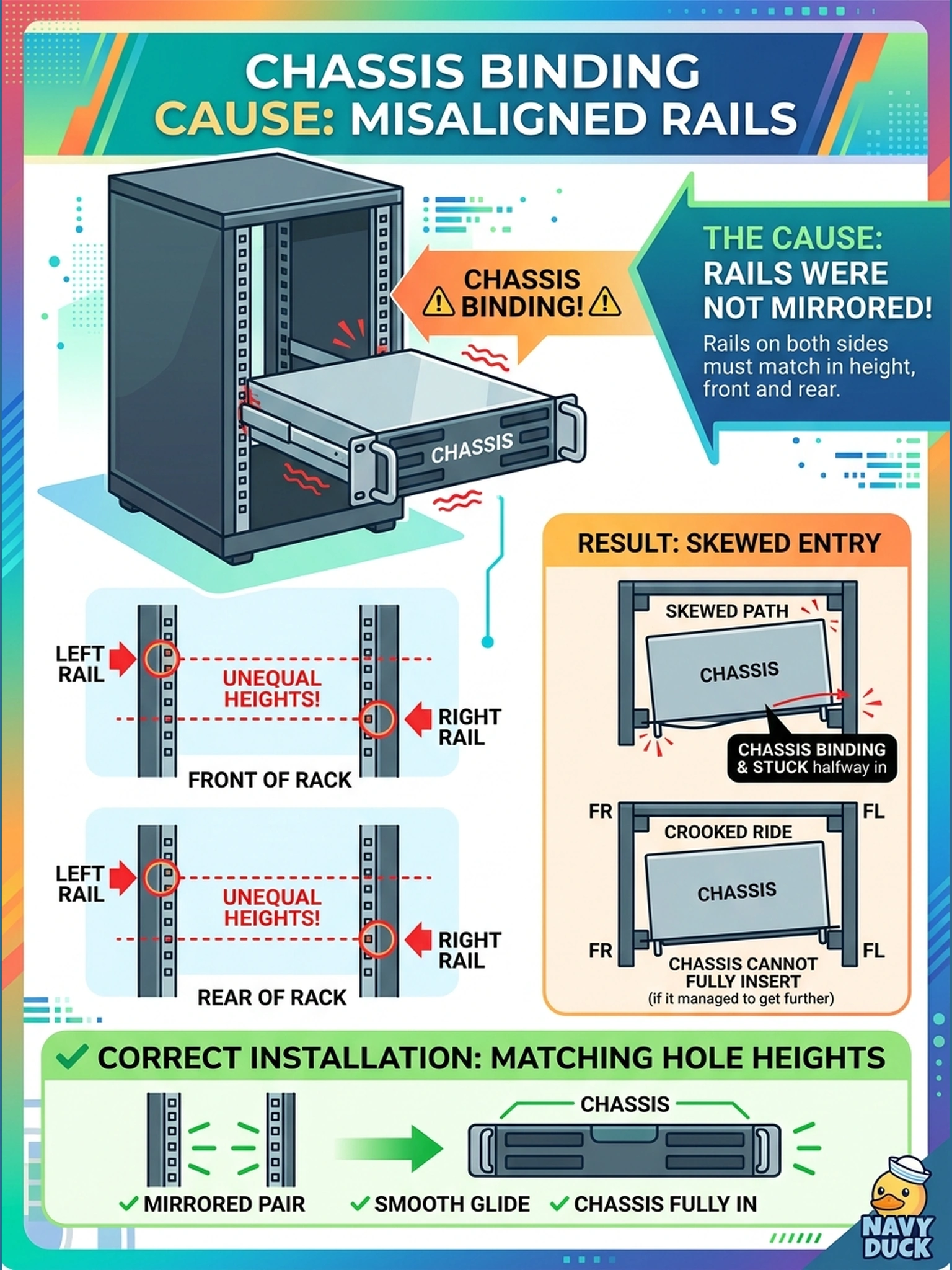
While a chassis is being slid in, the team finds the left rail sits one hole higher than the right, and the chassis binds halfway in. What was wrong with the rail installation?
Select an answer to reveal the explanation.
Short Explanation
Think of it like a drawer on mismatched slides: it runs crooked and jams long before it closes right. Rails are a matched pair — same height front to back, same height side to side — and a one-hole offset is the rack's way of saying 'measure me again.' You fix the rails, you don't force the box.
Full Explanation
A rail kit is engineered as a matched pair installed at identical heights on corresponding hole positions front and rear, so the chassis rides parallel tracks. When the left rail sits a hole higher than the right, the chassis enters at a slight yaw: one side arrives ahead of the other, and the unit binds against rail locks, guides, or the opposite rail. The fix is to back the unit out completely, re-measure both sides against the same hole positions front and rear, correct the rails, and try again. The anti-tip bracket, where used, prevents the rack from tipping when a unit is extended; it plays no role in chassis tracking, so its absence does not explain one-sided binding. Two-person lifting versus a lift is a safety and ergonomics question — fatigue, not a consistent one-hole offset. Hole profile (square versus rounded-square) governs which fastener hardware fits; it does not skew one rail relative to the other. Exam caveat: a 'binds halfway' question wants stop-and-verify against the rails' alignment; the root cause lives one step upstream of the chassis. Operational check: before the next unit goes in, measure or sight both rails — front-to-back and left-to-right should land on matching holes at identical heights.