
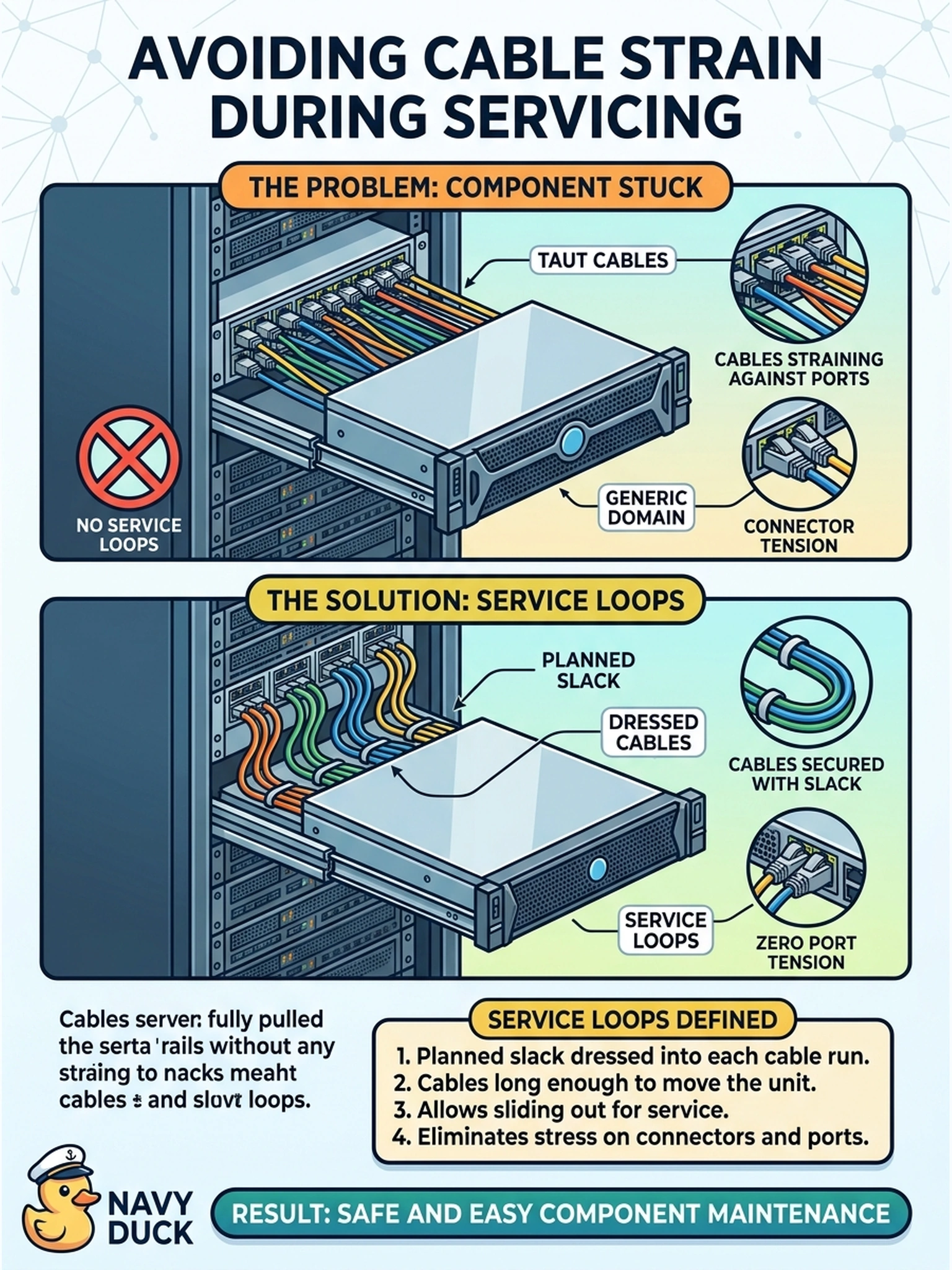
To reseat a component, a technician pulls a fully cabled Data Domain head partway from the rack; every rear cable is pulled taut, and the connectors are straining against their ports. What was missed when the cables were installed?
Select an answer to reveal the explanation.
Short Explanation
Here's the trick: your cables should let the hardware come out to visit you. Leave service loops at each end, because taut cables turn a routine reseat into a yanked port or a connector pulled half out. If a unit can't slide out without dragging the whole back of the rack with it, redress before you call it done.
Full Explanation
Service loops are deliberate slack dressed into a cable run — a loop held in a manager or hook — so the unit can travel to its service position while the cable simply pays out. A run installed taut between a moving chassis and a fixed port turns every inch of extension into force applied at the connector: strain on the port, tension on the jacket, and a credible path to a cracked socket, a half-backed-out connector, or an intermittent link that shows up later under load. Install-time dressing therefore plans a service loop at both ends per the rack's cabling guidance, sized so the unit reaches its full service travel with zero connector load. The manual-support proposal fails by concept: holding the chassis handles its weight but not the tension, which still lands on the ports. 'Longer cables everywhere' fails by concept as well: unplanned excess becomes coiled slack that snags and blocks airflow — a dressed loop is finite, managed slack. The internal cable arm is an invented device; a correctly dressed unit is expected to extend without unplugging anything. Exam caveat: 'cables dressed per the documentation' implies service loops; taut is never correct dressing. Operational check: extend each unit to its service stop at install and watch every connector — no cable should move a connector.