
A fully loaded Data Domain head plus three shelves is scheduled into an older rack that already carries core switches and two aging arrays, over carpet tile on a concrete slab. What must happen before this equipment is loaded into the rack?
Select an answer to reveal the explanation.
Short Explanation
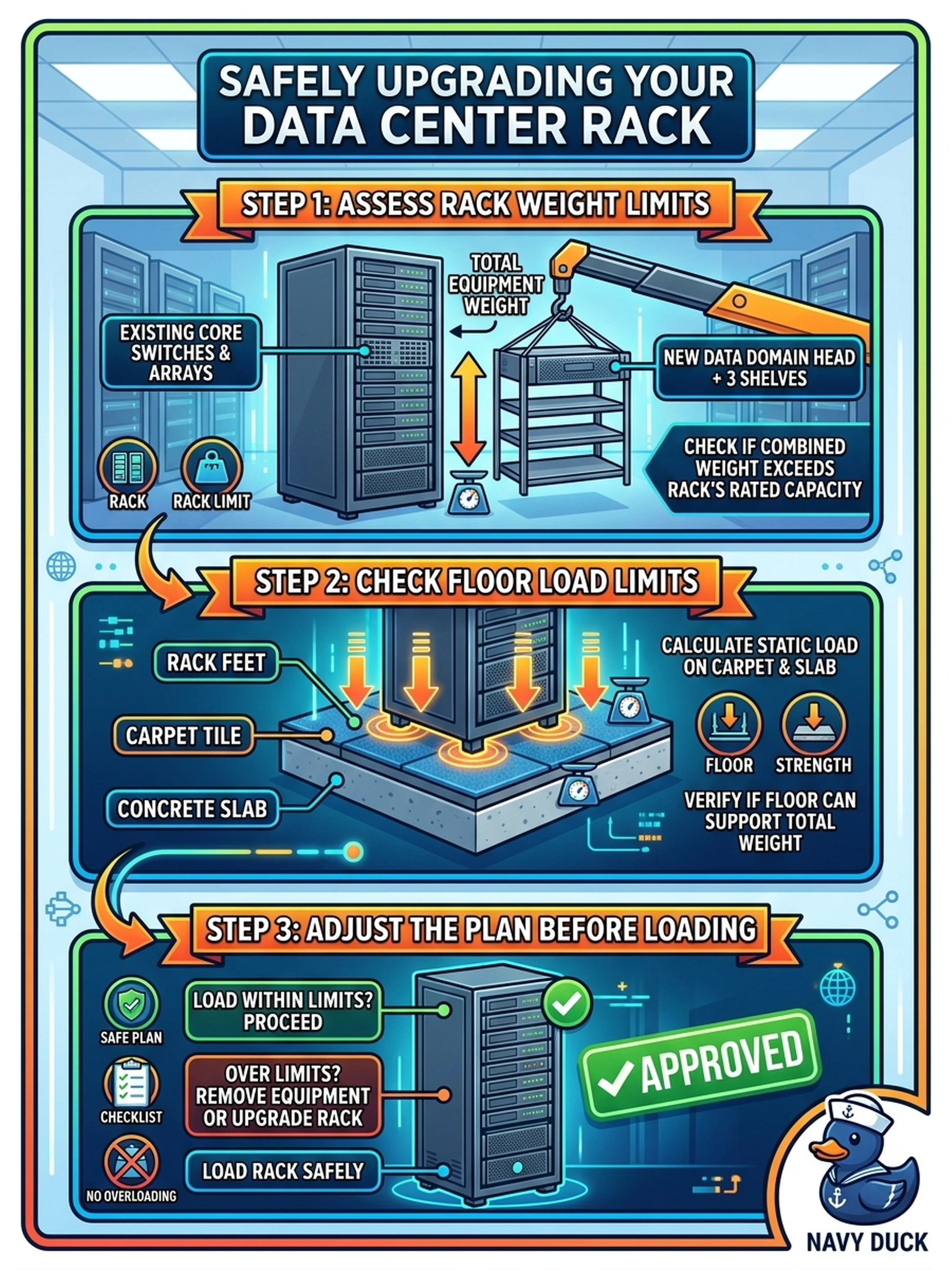
Racks don't complain when you overload them — floors do, and all at once. Do the math on paper first: what the rack holds today, what you're adding, and what the rack and floor are actually rated to carry. The numbers go in before the metal does, and you sleep better for it.
Full Explanation
Weight is a planning quantity, not a discovery. A loaded Data Domain head plus multiple shelves is a heavy stack, and a rack already carrying core switches and older arrays may sit near or past its rated static load and past the floor's distributed and concentrated load limits. The proper sequence is arithmetic before lifting: total the documented weights of planned plus existing equipment, compare against the rack's rating and the floor's limits, and if the numbers do not fit, redistribute across racks or relocate the stack before anything moves. The top-down racking proposal is backwards — raising heavy mass lifts the center of gravity and increases tip risk; standard practice puts heavier units low. 'Enterprise-grade means one universal rating' is fiction: ratings are published per rack model and configuration. Deferring to facilities after installation documents an overload instead of preventing one, which is paperwork, not a control. Exam caveat: 'older rack' or 'existing equipment' in a scenario signals that a load assessment is the tested concept. Operational check: record per-unit weights from the installation documentation, add existing loads, compare to the rack nameplate and the site floor plan, and carry the arithmetic in the install record.