
An install crew racks and cables three expansion shelves straight from their shipping crates. Before applying power, one engineer walks the front of every shelf pressing each drive carrier to confirm it is in and latched. What is the purpose of that pass?
Select an answer to reveal the explanation.
Short Explanation
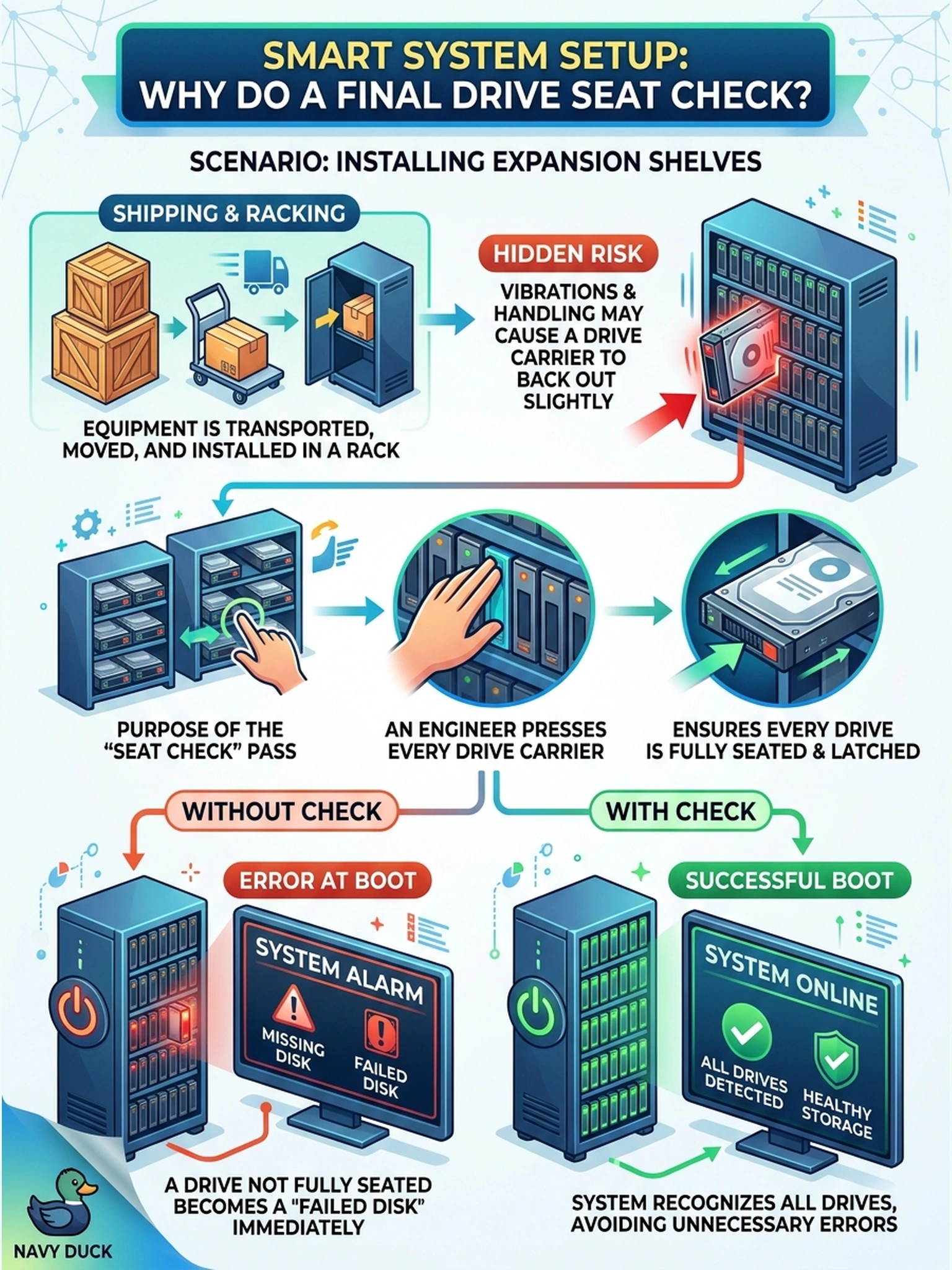
Boxes get bounced in transit, and a proud drive carrier is a silent disk failure waiting to be discovered. Five minutes of press-and-latch checks across every shelf saves you a support case, a service part, and an awkward call about missing capacity. Touch before you power on — your future self will thank you.
Full Explanation
Shipping is physical: pallets tilt, carriers get nudged, and a drive that was not fully latched at the factory can arrive partway out of its slot. A carrier that is not fully seated makes no contact, so the system boots with the drive absent; at best that is a confusing missing-disk event, at worst it is a degraded or failed member of a protected disk group discovered during a backup window. A pre-power pass that presses each carrier home and confirms latch engagement verifies the hardware survived handling — it is a check on physical transport, not distrust of manufacturing. The serial-inventory rationale confuses two jobs: serial capture works from the packing list and does not require pressing anything. Exercising latches for break-in fails by concept — latch mechanisms have no wear-in requirement. Firmware comparison cannot happen by looking at a carrier; revisions are read after the system is up and managed. Exam caveat: 'verify after handling' applies to every enclosure that was physically moved, including any shelf that was not shipped directly to the site. Operational check: walk each shelf front, press every carrier until it latches, count carriers against the packing list, and only then apply power.