
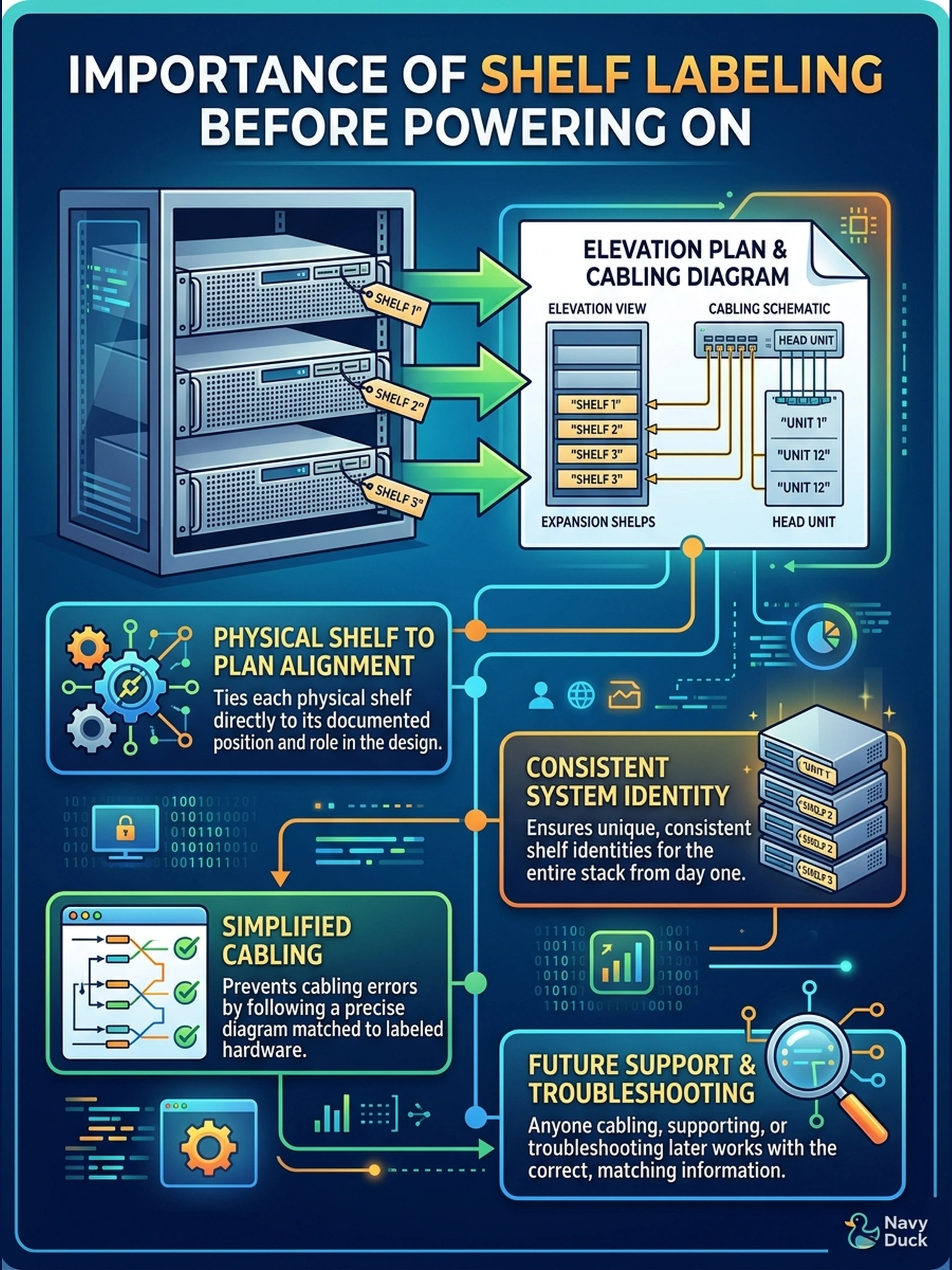
Three identical expansion shelves are racked for one Data Domain head, and before powering anything on the tech labels each shelf with its planned position number from the elevation drawing. What does that labeling accomplish?
Select an answer to reveal the explanation.
Short Explanation
Three identical boxes are three guessing games waiting to happen. A position label tied to the elevation drawing turns 'which one is shelf 2?' into a thirty-second answer instead of a cable trace — and you'll thank yourself at 2 a.m. during a future support call.
Full Explanation
Identical shelves are distinguishable only by the documentation around them. A position label that matches the elevation drawing gives each shelf a durable identity: the cabling pass knows which cable map applies to it, the dressing pass follows the documented chain order, and a support engineer six months out can ask for 'shelf 2' and get a meaningful answer. The label does not change hardware behavior — enclosure enumeration comes from the physical interconnect topology, not from ink on a bezel — but it keeps the physical stack and the documented plan in one-to-one correspondence, which is what makes the plan trustworthy. 'Software reads the labels and numbers enclosures accordingly' fails by concept: enclosure identity comes from chain position and ports, not visual markings. Serial-number assignment is likewise independent of labels; serials live in the hardware itself. 'Convenience for later moves' undersells the purpose — labels earn their keep on the very first cabling pass. Exam caveat: labeling is scored as part of installation documentation, not as cosmetic tidiness. Operational check: before power-on, stand in front of the rack and match every label to the elevation drawing and the chain order on the cable map — three sources, one identity.