
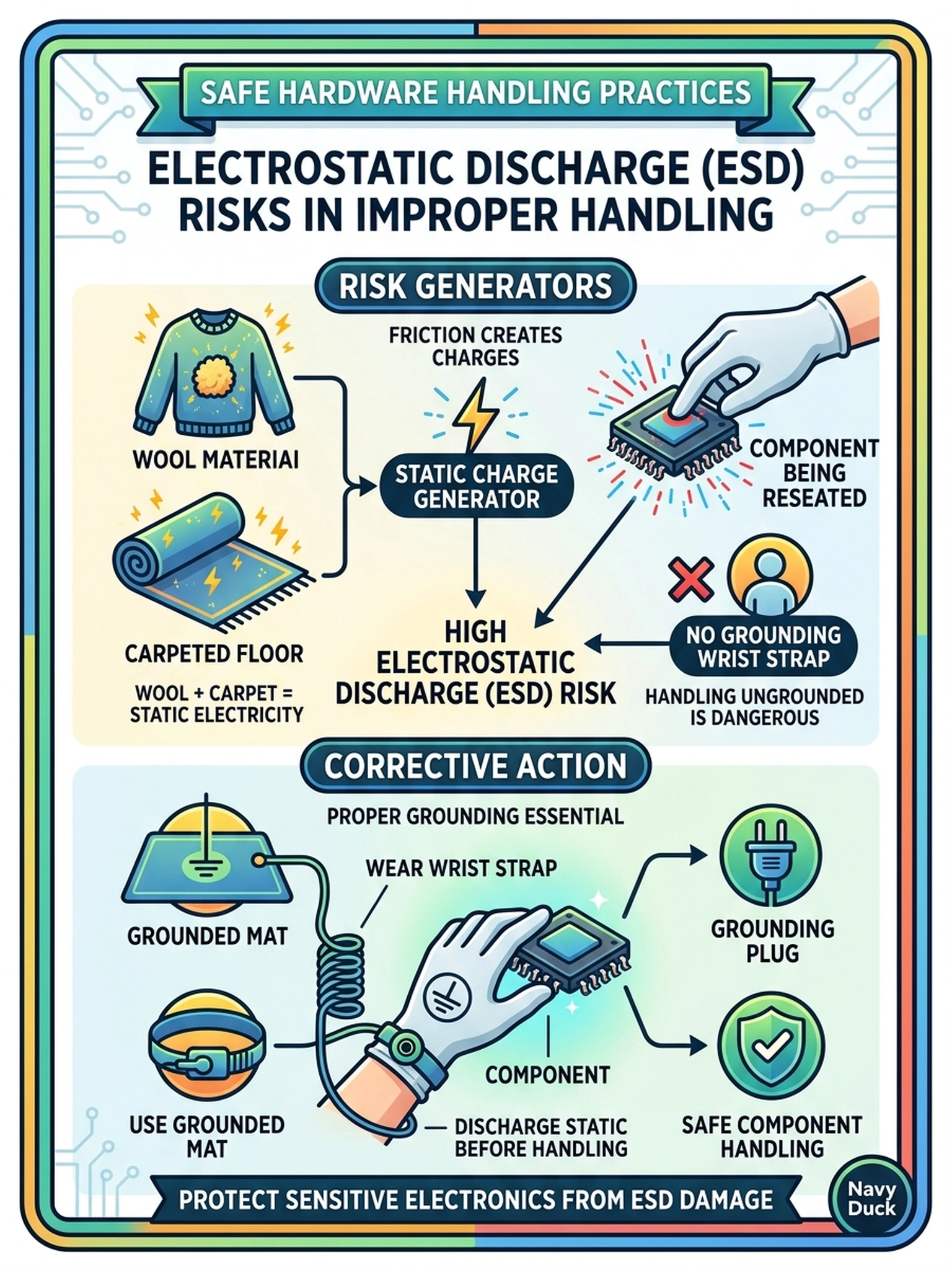
An engineer wearing a wool sweater kneels on carpet and pulls a component out of a Data Domain shelf to reseat it, with no wrist strap or grounded mat anywhere nearby. What is wrong with this handling?
Select an answer to reveal the explanation.
Short Explanation
Think of static as a hidden sparkler: wool plus carpet is a charge machine, and that card can't tell you it got zapped until weeks later. Ground yourself with a strap before your fingers ever touch the board — ESD precautions apply to every handling, install included.
Full Explanation
Electrostatic discharge happens when a charged body touches a sensitive device and the charge jumps through it. A wool sweater on carpet is among the most effective charge generators found in offices and closets, and the handler can carry thousands of volts while feeling nothing at all. The cards and interconnects inside a Data Domain system are ESD-sensitive; damage is either immediate — the part dies on the spot — or latent, a weakened part that fails weeks into production, which is why handling rules apply to every handling event, including a reseat during installation. The correct practice is a grounded wrist strap or an equivalent grounding method for person and component, with synthetic clothing and carpet contact avoided. The low-humidity exception fails by concept: humidity reduces probability, it never eliminates charge, and no speed of handling drains a body's charge. The used-parts theory fails because discharge damage depends on the event, not the part's age. Straps-for-drives-only is backwards — exposed logic carries less physical protection than enclosed drive media. Exam caveat: any option making ESD practice conditional on care or time is wrong. Operational check: before touching a component, attach the strap, verify its connection, and follow the instructions' grounding points.