
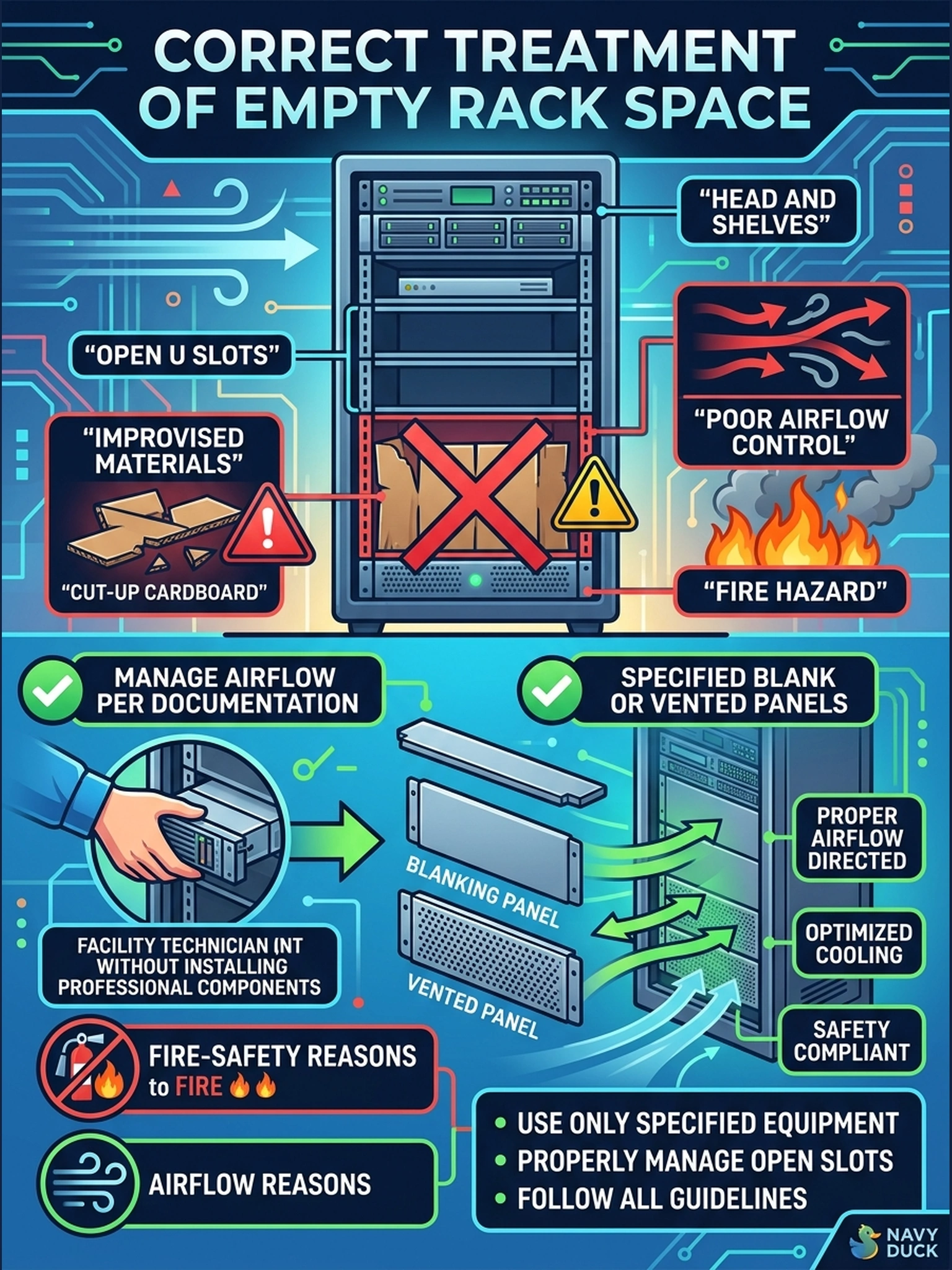
After the head and shelves are installed, the rack has open U slots, and the customer's facilities tech stuffs them with cut-up cardboard 'to direct airflow.' What is the correct treatment of empty rack space?
Select an answer to reveal the explanation.
Short Explanation
Here's the deal: airflow is a plumbing problem—cold air is your water and every gap is a leak. Blanks and vented panels exist because the documentation knows which gaps need which, and cardboard is a fire hazard moonlighting as cooling. Use the parts that were engineered for the job.
Full Explanation
Cooling relies on a controlled front-to-back path: cold air enters chassis fronts and exhausts rearward, and empty U slots corrupt it by shorting supply air to the rear or starving downstream intakes. The documentation therefore specifies closure—solid blanking panels where the design calls for them, vented panels where metered flow is required. Improvised materials fail on two independent concepts: fire safety, since combustibles not listed in the installation instructions are prohibited; and aerodynamics, since the fit and porosity of random material make airflow unpredictable—the measured behavior of a designed panel is its entire point. 'Any filler works' fails at that same aerodynamic concept: a blank's engineered openness and seal are the feature, not the covering of the hole. Leaving slots open fails by concept because uncontrolled openings create recirculation and hot inlets, like gaps around a window frame in winter. The raised-floor theory fails because this equipment ingests air through front intakes; underfloor cooling cannot rescue a starved front. Exam caveat: which slots get solid versus vented panels depends on the site's cooling design—the exam tests the rule 'as documented, never improvised.' Operational check: walk the rack's front elevation, verify every empty U carries its specified panel, and remove improvised material before handover.