
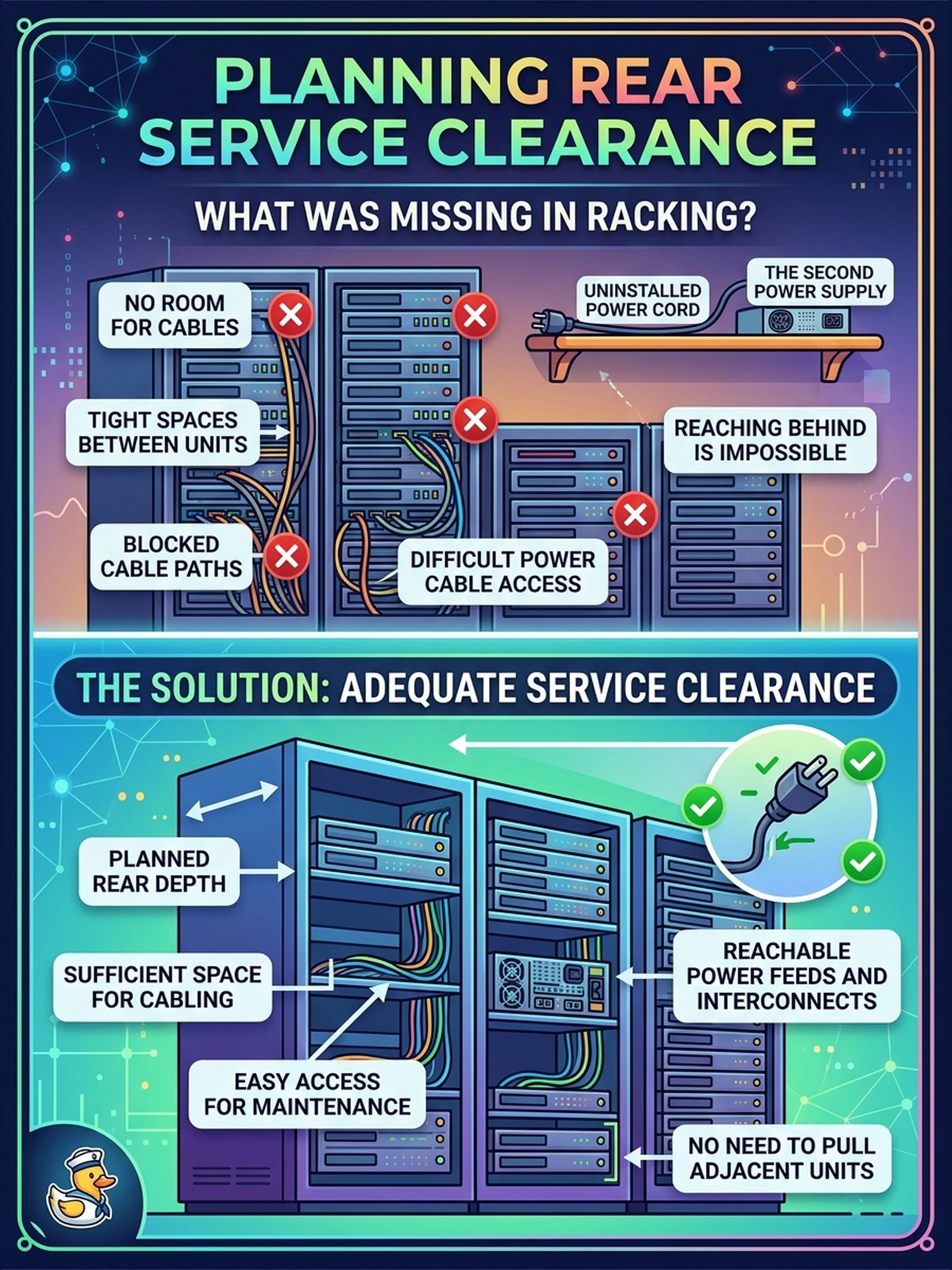
Cabling the second power supply of an upper shelf means reaching behind a neighboring chassis at the rear, and there is no room to route the cord. What should have been planned during the racking?
Select an answer to reveal the explanation.
Short Explanation
Every installer who has ever crammed a cord behind a full rack has promised to leave more room next time. The second power feed isn't optional, so the room to reach it has to exist on day one—you plan the rear view while the rack is still empty, not after it's full.
Full Explanation
Each redundant power supply connects to its own source so the system survives a lost feed or supply, so both cords on both PSUs of every shelf must reach a PDU—and be unpluggable by a hand later—meaning rear clearance is planned during racking around connector positions, bend radius and grip space. Declaring shelves maintenance-free at the rear fails by concept: power supplies and their cords on a shelf are field-replaceable items, and an unreachable PSU turns a routine swap into pulling and re-racking live equipment. Connecting only the first supply fails the redundancy design outright—running a dual-supply appliance on one feed keeps the single point of failure the second supply exists to remove. Detouring an oversized cord around neighbors fails too: cable length and path are planned properties, and slack bundles behind adjacent chassis obstruct airflow and snag during unrelated service—a symptom of the planning gap, not a fix. Exam caveat: exact clearance dimensions come from the installation guide for the specific models; the exam tests the planning habit—A and B feeds reachable, both PSUs connected, hands behind every connector—rather than a number. Operational check: on the rack plan, trace each PSU's path to its assigned PDU position, confirm a hand can grip and unplug each connector and each PSU can slide out, and adjust U positions before mounting.