
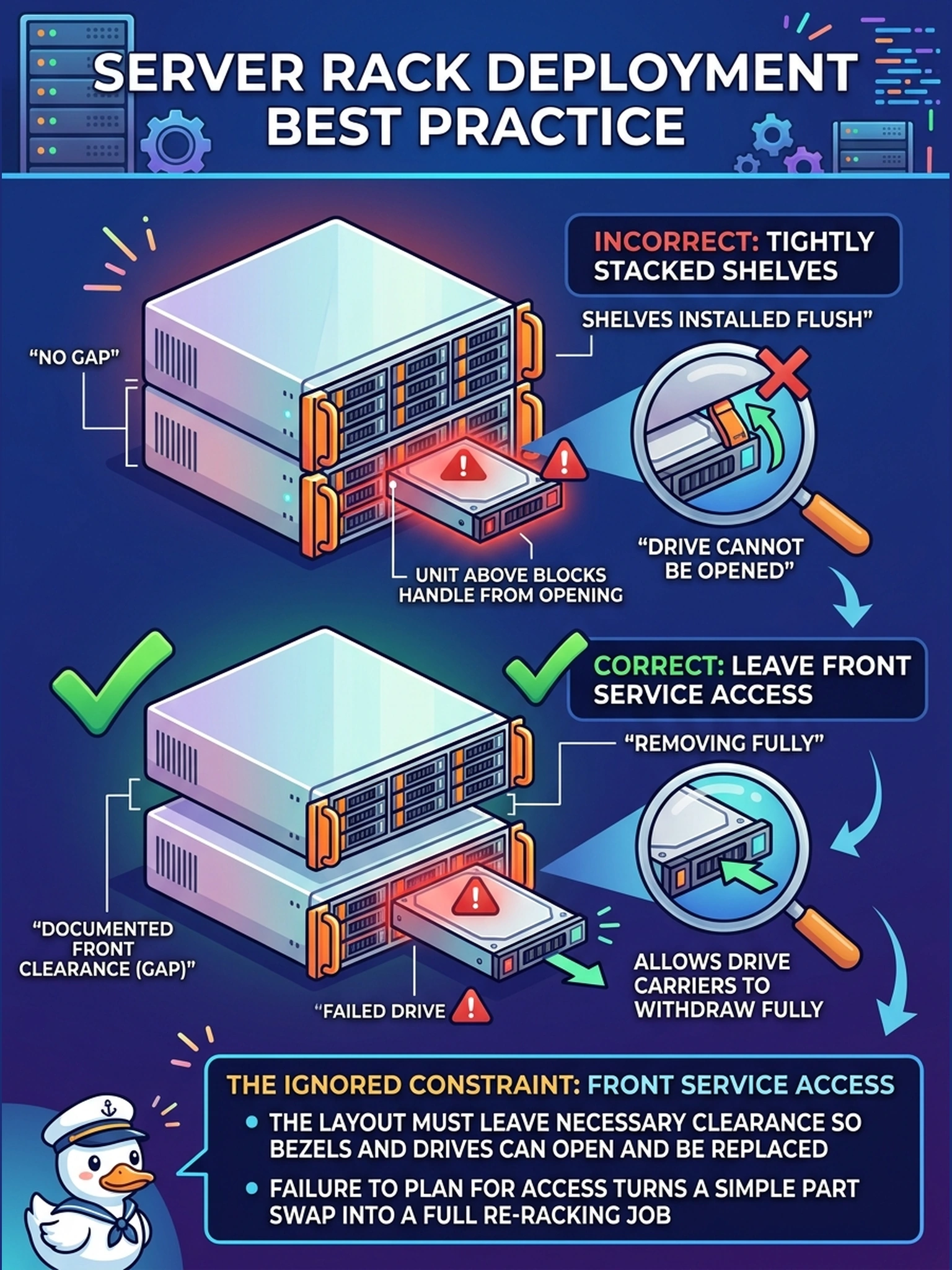
Expansion shelves were stacked flush with no gap, and now a failed drive in the lower unit cannot have its carrier opened because the unit above blocks the handle. What constraint did the original stacking ignore?
Select an answer to reveal the explanation.
Short Explanation
Think of it like building a parking garage with no room to open a car door. Flush stacking looks tidy today, and you won't notice the cost until a drive fails at two in the morning and the whole rack becomes the problem. Give the fronts the room the documentation asks for.
Full Explanation
Hot-swap drive carriers are a front-service design: the carrier swings and slides out through the front, so the layout must preserve the documented front envelope—the swing arc and withdrawal path—for every unit with field-replaceable drives. Flush stacking violates that envelope invisibly until the first fault, when a five-minute drive replacement becomes removing and re-racking a loaded shelf. Side-access reasoning fails by concept: carriers open forward by design; inventing a lateral path misreads the hardware. Claiming hot-swap makes the gap cosmetic conflates two independent requirements—hot-swap says the shelf stays powered during replacement, it says nothing about a carrier door swinging through the chassis above. The PDU answer fails because rear power distribution cannot relocate a service point at the front of the shelf. Exam caveat: some documentation permits tight stacking where carriers still clear—the exam rewards checking the documented envelope, not eyeballing. Operational check: before committing the elevating plan, verify each position holding drive media against the required front clearance, confirm by opening a carrier or consulting the guide's dimension, and note the clearance on the plan.