
The customer insists the head unit be racked above both expansion shelves because its status lights face the aisle. What determines the final stacking order?
Select an answer to reveal the explanation.
Short Explanation
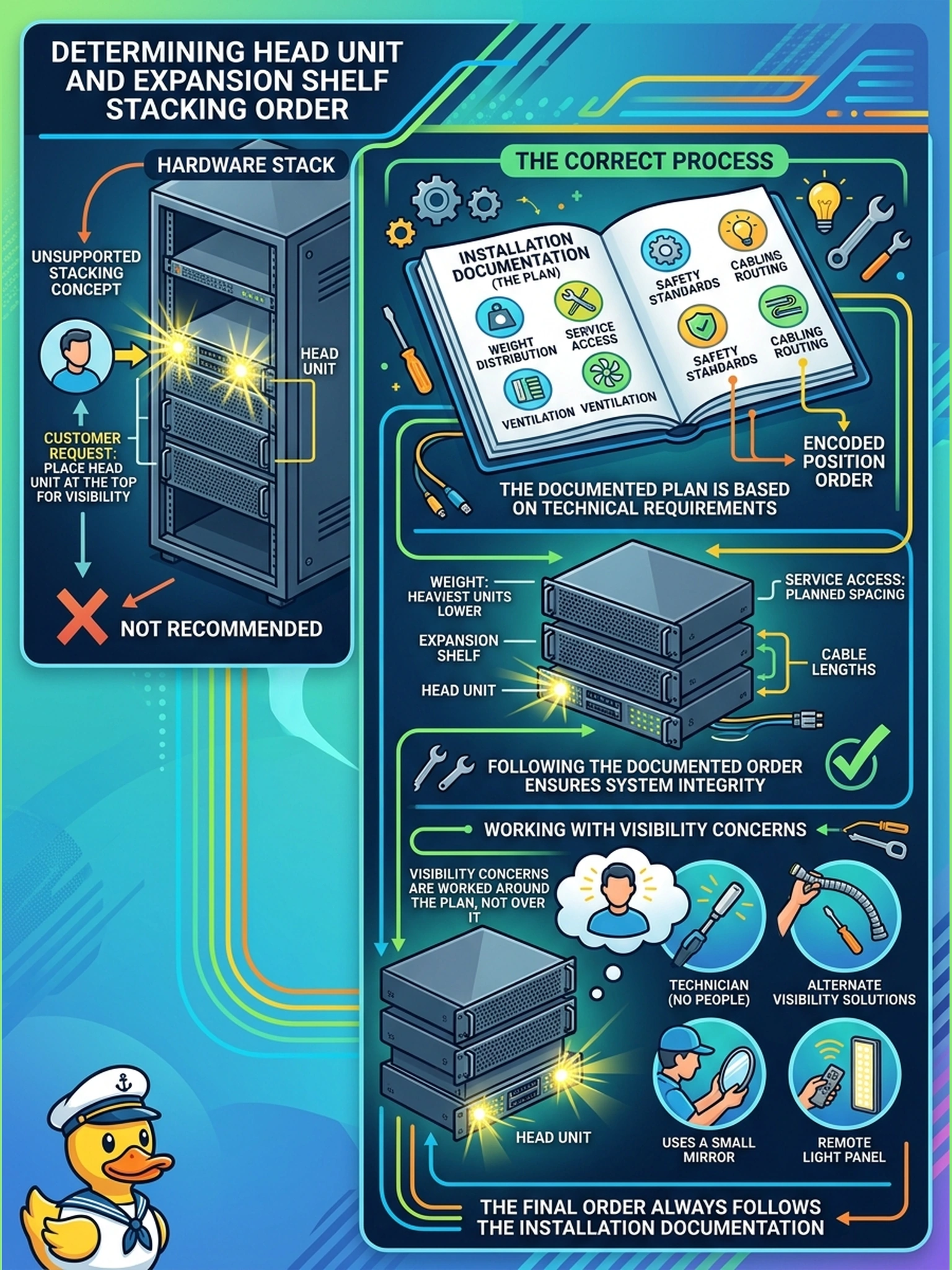
Here's the deal—the documentation says which unit goes where, and it isn't for looks. Those reasons are weight and service access, not the view from the aisle. You can help the customer read status remotely, but the documented order comes first.
Full Explanation
Where the head and shelves sit follows the installation documentation because the prescribed order encodes several constraints at once: loaded shelves low for stability, defined stacking so interconnects behave as tested, and service access for drive and power-supply work. Visibility or aesthetic preferences are legitimate inputs that get accommodated around those constraints, not through them. Customer preference winning by ownership fails by concept: documented requirements travel with the appliance, and an eye-level slot is not a documented basis. Letting cable reach dictate positions inverts planning: lengths are chosen to serve the documented layout; the shortest run must not become the layout's author. Free-form stacking secured on rails fails because bolting each unit well says nothing about rack-level properties—a high center of gravity or an unopenable carrier remain problems that placement order controls. Exam caveat: status visibility is available remotely through the management interface; deviating from documented placement needs approval through the proper channel. Operational check: read the documented position order, restate it as U positions on the elevating plan, and confirm weight-lowest and service-clearance rules are satisfied before mounting.