
An elevating plan places the fully loaded expansion shelves at the top of the rack 'to save the good lower holes for future gear.' Which physical rule does that plan violate?
Select an answer to reveal the explanation.
Short Explanation
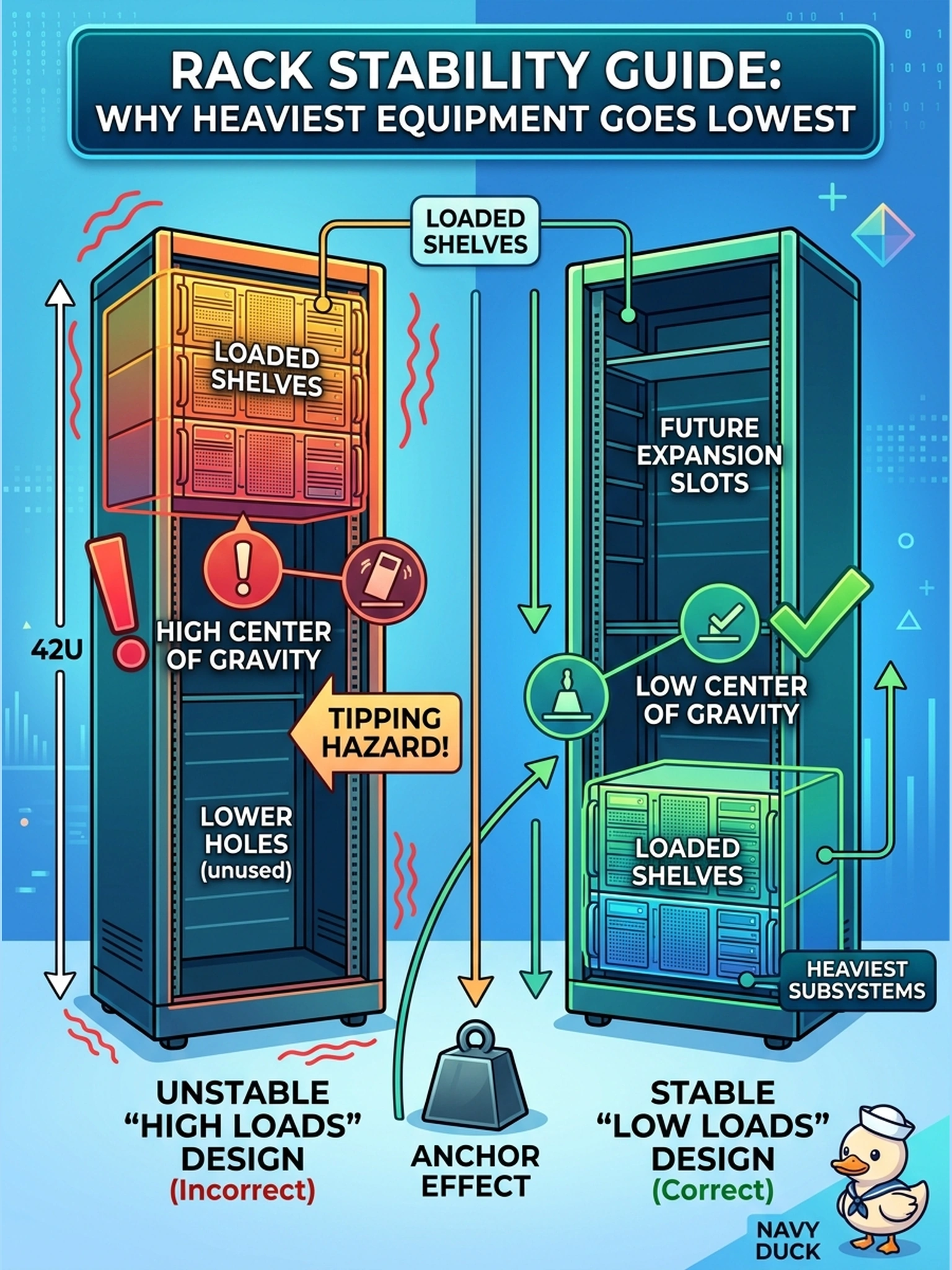
Think of a rack like a tall bookshelf nobody anchored—load the encyclopedias up top and see what happens on a bad Tuesday. Heavy shelves go at the bottom because a low center of gravity is physics, not preference, and those good lower holes are the ones that carry your weight.
Full Explanation
A fully loaded expansion shelf is the heaviest subsystem of a Data Domain deployment, and elevating guidance mounts the heaviest items lowest so the rack's center of gravity stays near the floor; a rack loaded high becomes unstable exactly when it matters—during an impact, a shift or a move—and a tipping rack means injury risk and equipment loss. Raised floors change nothing: tiles are rated for the vertical load a rack imposes, not for the overturning moment top-heavy mass creates during an upset. The airflow argument is backwards by concept: dense hardware high in the rack interrupts the front-to-back airflow corridor the cooling design assumes rather than acting as a helpful chimney. Reversing the rule outright—lightest units low, bottom reserved for cabling—invents a convention with no physical basis: cable management occupies vertical runners beside the rack units, not the load-bearing bottom positions, and empty U space belongs up top or behind blank panels. Exam caveat: moving a loaded rack is unsafe regardless of stacking—the documented answer is emptying it first, not clever sequencing. Operational check: look at the elevating plan and ask what the heaviest loaded subsystem is and where it sits; put loaded shelves at the bottom, confirm the rack's anti-tip provisions, and only then open the rail kit.