
The installation checklist has blanks for hostname, the management addressing choice between static and DHCP, and the DNS and gateway entries. The on-site engineer plans to 'pick sensible values at bring-up.' What does the checklist intend by having these filled from the design document beforehand?
Select an answer to reveal the explanation.
Short Explanation
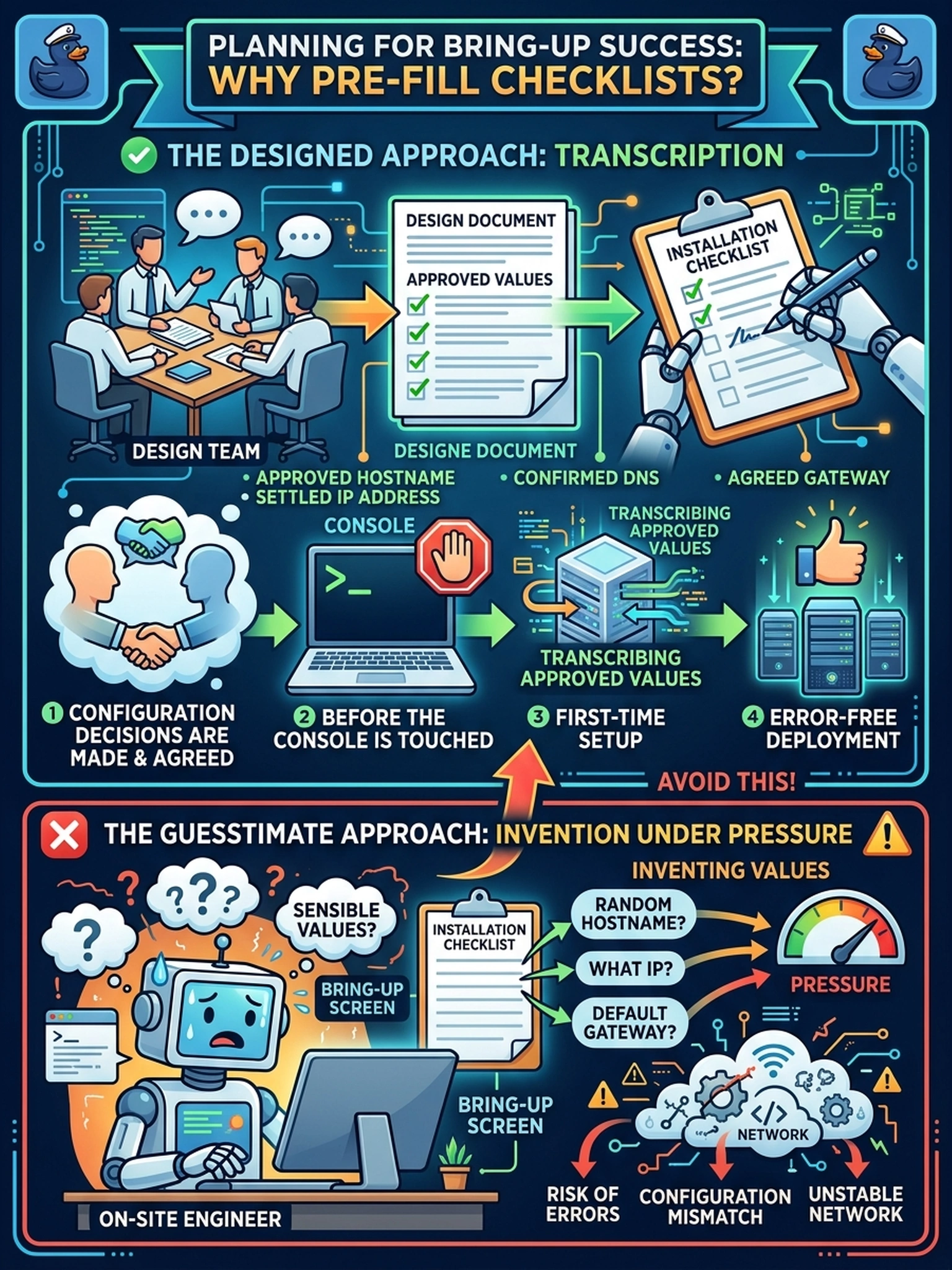
Think of the checklist as the script and bring-up as the performance. Every value pre-filled—hostname, static address or DHCP, DNS—is a decision made calmly instead of improvised in front of a watching room. Improvise once and it becomes your outage story forever.
Full Explanation
Bringing up management networking consumes exactly the values the design defines—hostname, addressing method, address, mask, gateway and DNS—and the checklist turns bring-up from decision-making into transcription. Pre-agreed values prevent the classic failures: a hostname that collides with the customer's naming standard, or an address from a conflicting range because its reservation was never confirmed. Picking values live fails by concept because each value is a shared contract—DNS records, firewall rules and monitoring entries are owned by teams outside the server room. Treating the fields as billing paperwork fails because they are configuration inputs; bookkeeping treatment is how they get skipped and the values end up improvised anyway. Claiming the entries lock the customer out misreads a baseline: the checklist records an agreed starting point, and designs evolve later through change control, not installer fiat. Automatic application fails plainly—DD OS does not read paper; a human types the values, and the checklist only guarantees they were chosen deliberately. Exam caveat: production management interfaces are normally statically addressed while DHCP appears in lab staging; follow the design document. Operational check: before opening the console, verify every blank holds an approved value and confirm the reserved management address is free before configuring it.