
The customer's rack uses square mounting holes, and the rail kit's hardware list shows screws that mate with cage nuts—yet the box contains screws and no cage nuts. What does the checklist's mounting-hardware step call for?
Select an answer to reveal the explanation.
Short Explanation
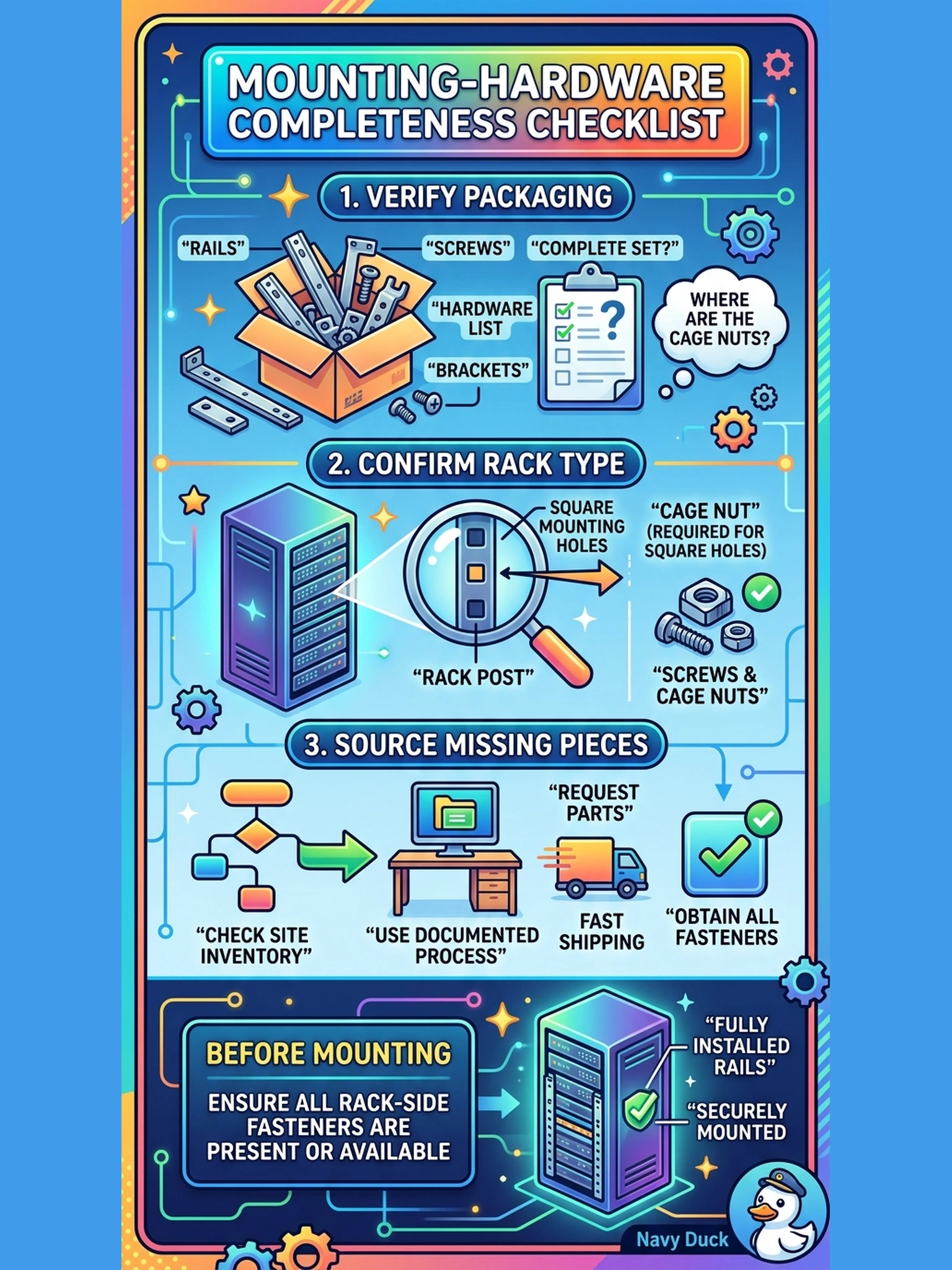
Cage nuts are the unsung heroes of the square-hole rack—no cage nut, and the screw has nothing to grab. The checklist counts rack-side fasteners for a reason: find the missing parts while you can still order them, not mid-lift with a loaded chassis. Check the hardware list before the packing gets recycled.
Full Explanation
Square-hole racks require cage nuts or clip nuts as the mating thread for equipment screws, so the mounting-hardware verification covers both sides of the joint: the kit's screws and the rack's fasteners. The hardware step enumerates everything the mount needs, so a gap becomes a small procurement action instead of a stall in front of an open rack. Driving screws into unthreaded square holes fails by concept: a screw bearing on sheet metal it was never designed to grip gives no reliable connection, and a rail loaded through uncertified fasteners cannot be assumed to carry the chassis's rated weight. Improvising from the site bin fails because thread size, nut style and flange shape must match both the screw and the post; 'close enough' hardware is the variable the hardware list exists to eliminate, however interchangeable the families look. Declaring cage nuts outside the checklist fails because the checklist's job is to enumerate dependencies of the mount—if completing it requires a part the rail box omits, that is a checklist item, not a personal supply matter. Exam caveat: many racks ship with cage nuts pre-installed—completeness means available at the mounting rows, not in the rail kit. Operational check: count the cage nuts needed for every planned mounting hole against what the posts already carry, match nut style to the kit's screw thread, and resolve any shortfall before the chassis is unpacked.