
At unboxing, the power cords included with the appliance end in a connector type the customer's PDUs don't have, and someone reaches for a third-party adapter. What should the installation checklist's power section have caught, and what is the right response?
Select an answer to reveal the explanation.
Short Explanation
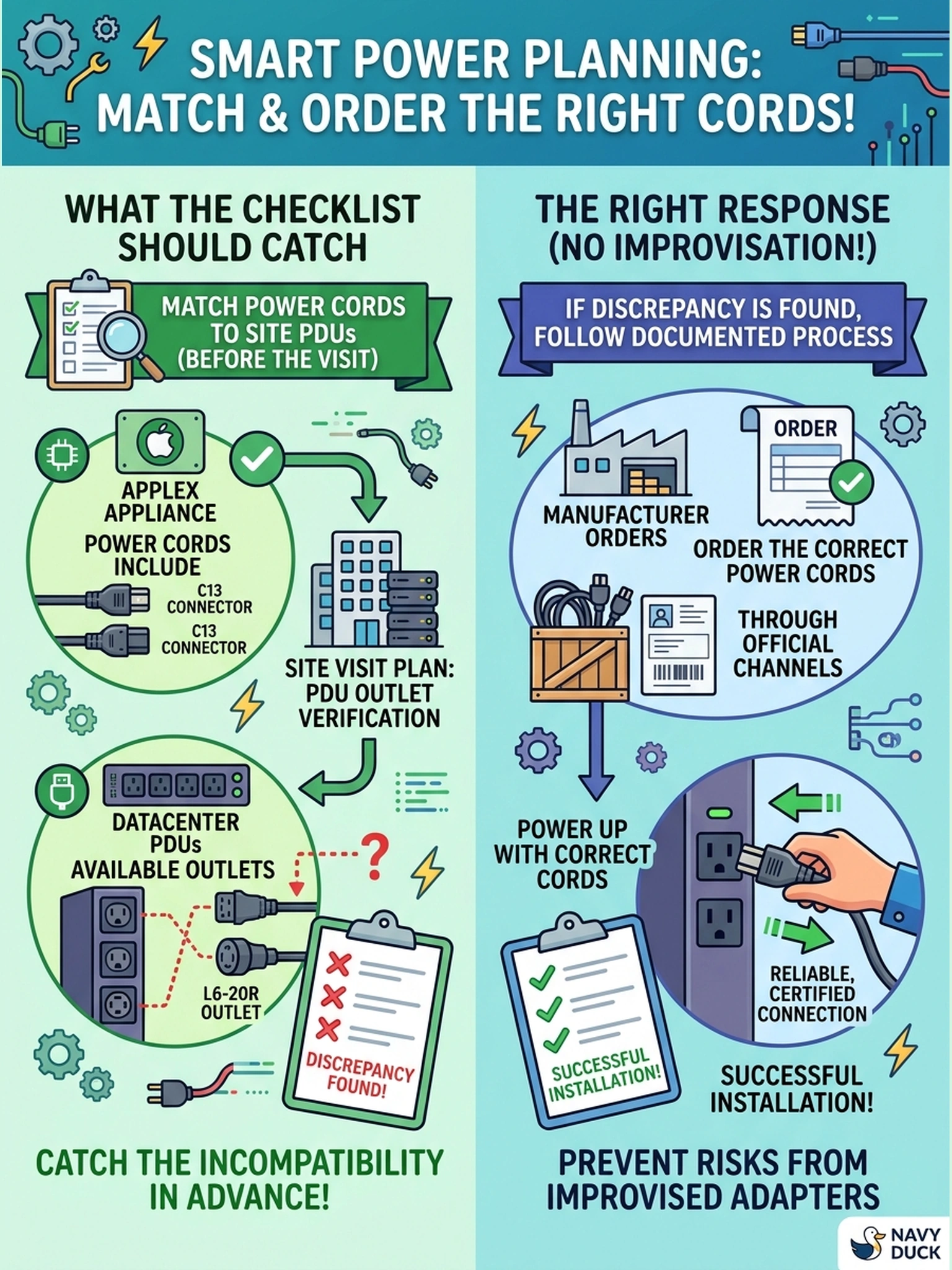
Here's the deal: a power cord is part of the system, not packing material. The checklist has you match plug to outlet before the truck arrives, because adapters improvised at the dock are a fire-code argument waiting to happen. Order the right cords and be boring about it.
Full Explanation
PDU connector types vary by region and design, so the installation checklist verifies cord connectors against site PDU outlets precisely so the correct cords are ordered before the engineer arrives. A mismatch found at unboxing is a procurement gap with a documented resolution path, not an on-the-spot engineering decision. Third-party adapters fail by concept: the certified power path—cord gauge, rating and retention—is part of the equipment's compliance, and improvised adapters in a datacenter power chain are exactly what facility standards prohibit. Replacing the power supply units fails because PSUs are selected for the appliance's power budget and redundancy design; swapping supplies to fix a plug shape treats the wrong component. Extension strips fail too—portable multi-socket leads are banned in datacenter power chains regardless of how the appliance behaves on one. The connector field is a verification item, not a note-taking convenience; skipping it produced today's surprise. Exam caveat: some sites standardize on one PDU connector family and expect matching cords with the order—the checklist surfaces that expectation early. Operational check: compare the checklist's power-connector entries against a photograph of the target PDU outlets, confirm cord part numbers for both PSU feeds, and attach them to the order notes before the install visit.