
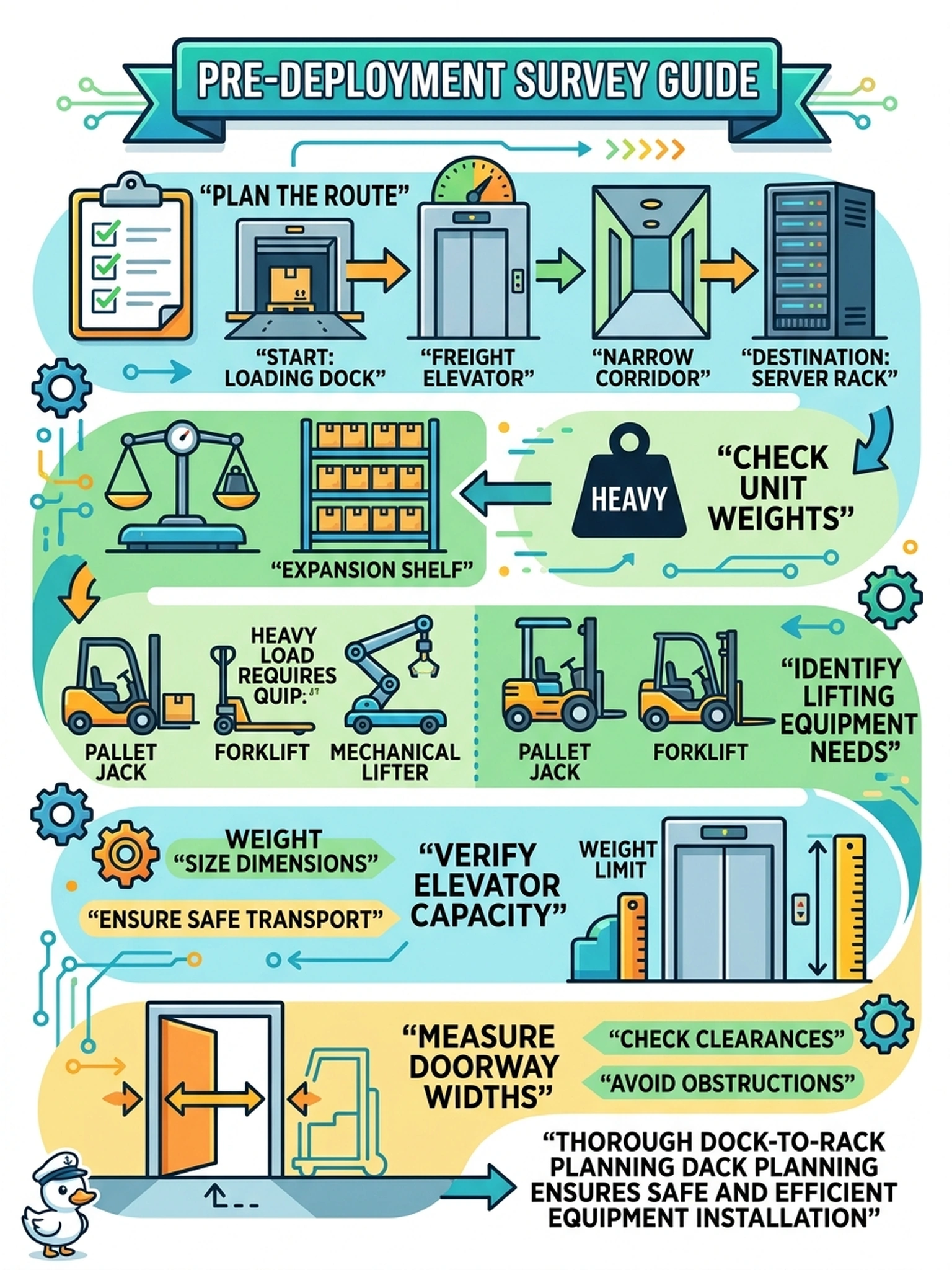
A fully loaded expansion shelf is far too heavy for one person to carry, and the path from the loading dock crosses a freight elevator and a narrow corridor door. When and how should this be handled?
Select an answer to reveal the explanation.
Short Explanation
Think of it like moving a piano into a fourth-floor flat—you measure the staircase before you buy the piano. A loaded chassis is a two-person-plus-lifter object, and your survey should walk the whole route: elevator ratings, door widths, turning space. A surprise at the dock on Tuesday is simply a cost you failed to prevent on Monday.
Full Explanation
Delivery-path planning belongs in the pre-deployment survey because weight and dimensions do not change between dock and rack: a fully loaded expansion shelf exceeds single-person handling limits, and the route must support the equipment as moved, including mechanical lifting aids, freight-elevator load rating, doorway widths, turning clearances and floor loading along the path. Verifying these before shipment prevents arrivals that stall at the dock while rentals and extra movers are hunted down. Relying on standard carrier service fails as a concept because standard freight delivery typically ends at the receiving dock, with inside delivery a separately arranged service. Considering only the racked weight misses the hazard, because the risk lives in the dock-to-rack transit before rails exist to spread the load. Believing one technician can tilt and slide a loaded chassis fails because handling guidance treats such lifts as two-person or mechanical-lift tasks, and shortcuts cause injuries and dropped assets. Exam caveat: shipping weight and installed weight are both published and differ, because shelves ship with packaging and rails. Operational check: walk the route with a tape measure and the hardware guide, record every choke point with its number, and attach the route plan to the order before it ships.