
During the site survey, facilities shows the engineer the target rack, which has two PDUs fed from a single circuit. What power verification belongs in the pre-deployment checklist before the system ships?
Select an answer to reveal the explanation.
Short Explanation
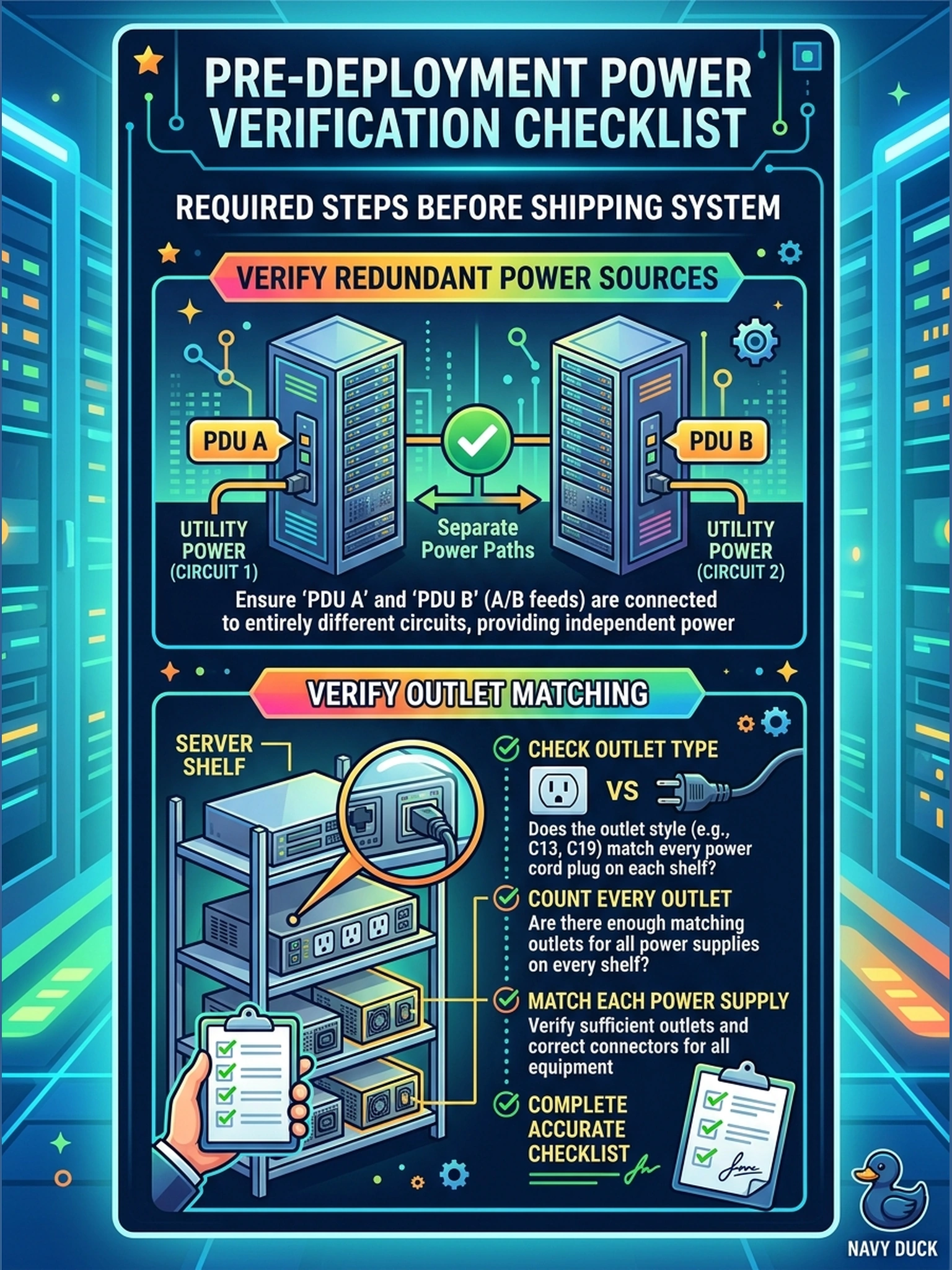
Two power cords plugged into the same circuit is just one circuit wearing a disguise. You want A and B feeds from genuinely separate circuits, plus an outlet count and connector check against every power supply and cord landing in that rack. Catch the mismatch now, not on install day with a screwdriver in your hand.
Full Explanation
Redundant power protects only against failures it is wired to survive: two feeds from physically distinct circuits, one to each PDU, so a failed circuit, breaker or PDU still leaves the system energized. Before shipping, the engineer must confirm the site can actually deliver that condition, because the surveyed rack with both PDUs on one circuit is a single point of failure that a second cord cannot fix. The same verification counts outlet types and quantities against every power supply and cord for each shelf, since connector mismatches otherwise surface during installation. Claiming appliances need only one feed fails by concept because production storage is designed for feed-level redundancy, and a hot-swappable supply is not the same thing as a surviving power source. Recommending a shared circuit inverts the intent of A/B design, because a common upstream failure takes both feeds down together. Accepting one spare outlet on the promise of adapters fails because adapter chains add failure points and are themselves flagged by installation guidance. Exam caveat: each expansion shelf typically carries its own dual supplies, so cord and outlet counts scale with the full component list. Operational check: photograph the PDUs, list every power supply and cord against a named outlet, and confirm circuits A and B are distinct at the panel.