A convolutional layer applies the exact same filter weights as it slides across every position of an input image, rather than learning a completely separate set of weights for each location. What benefit does this parameter sharing provide?
Select an answer to reveal the explanation.
Short Explanation and Infographic
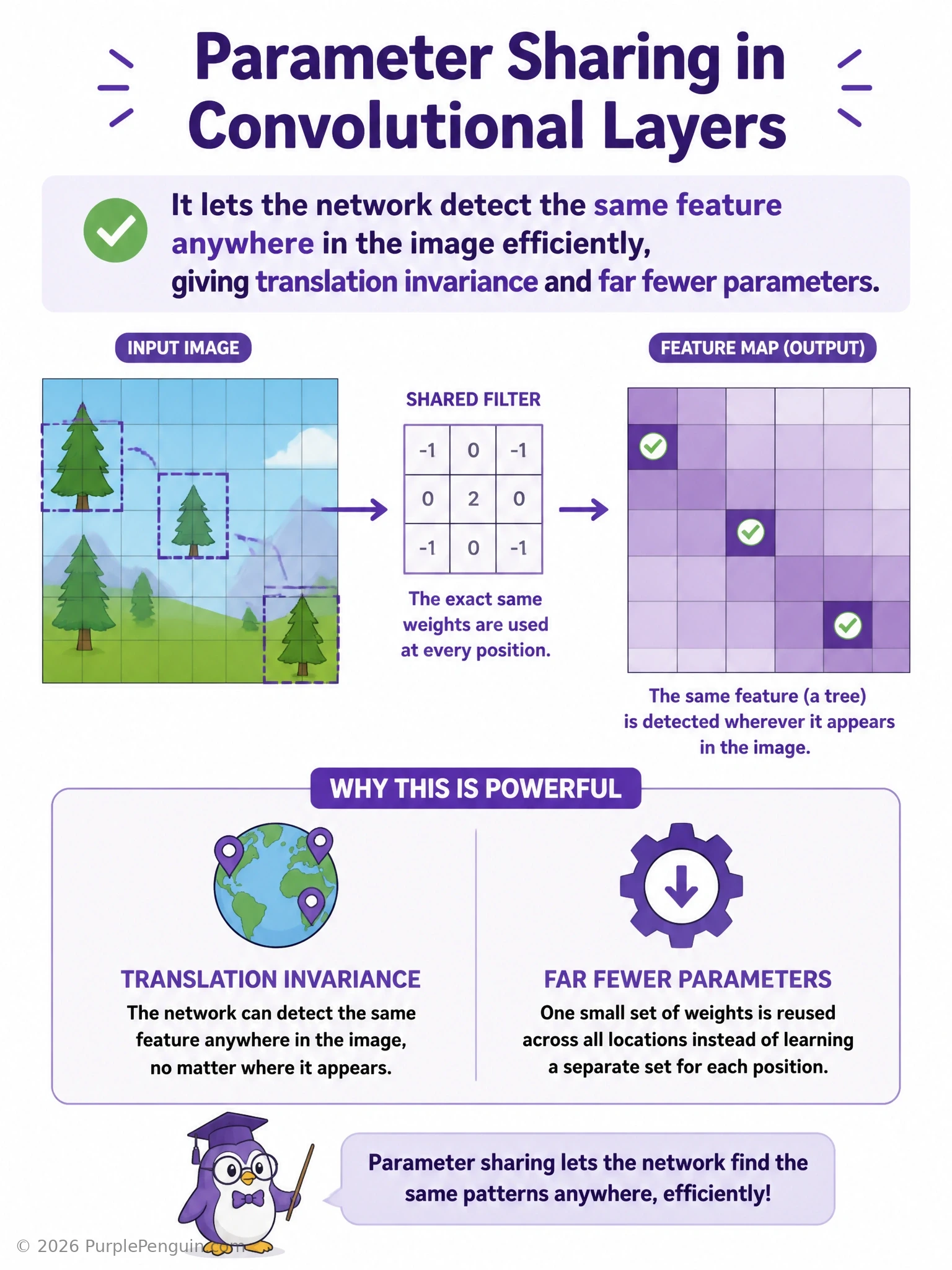
Parameter sharing is one of the smartest tricks in a CNN's design. By using the same small filter everywhere across the image instead of a separate set of weights at every location, the network learns to recognize a feature, say, a diagonal edge or a particular texture, once, and then it can spot that same feature no matter where it shows up in the image. That's translation invariance, in a nutshell. And as a bonus, you get a massive reduction in the number of parameters compared to a fully connected layer that would need unique weights per pixel position. It's not a magic overfitting cure, you can still overfit a CNN, it just tends to need fewer parameters to reach comparable performance. It doesn't force every feature map to be the same size either, pooling and stride choices control that. And you still need an activation function after the convolution to introduce nonlinearity, parameter sharing doesn't remove that requirement.
Full explanation below image
Full Explanation
Parameter sharing is a core architectural principle of convolutional neural networks in which a single filter's weights are reused (applied identically) at every spatial location as it slides across the input, rather than learning an entirely independent set of weights for each position. This design choice yields two major benefits. First, it dramatically reduces the number of trainable parameters compared to what a fully connected layer processing the same input would require, since a filter with, say, 3x3xC weights is reused across potentially thousands of spatial positions rather than requiring a unique weight for every input-output pixel pair; this makes CNNs far more parameter-efficient and easier to train with limited data relative to an equivalently sized fully connected network. Second, and just as important, parameter sharing confers translation invariance (or more precisely, translation equivariance at the feature-map level, which combined with pooling contributes to invariance): because the same filter is used everywhere, a feature the filter has learned to detect, such as an edge, corner, or texture pattern, can be recognized regardless of where it appears in the image, rather than the network needing to relearn that same pattern independently for every possible location, which would be both wasteful and would generalize poorly to objects appearing in new positions.
The distractor claiming parameter sharing guarantees a network will never overfit is incorrect because, while parameter sharing does reduce parameter count and can help mitigate overfitting relative to a comparably sized fully connected network, it provides no absolute guarantee against overfitting; CNNs can and do overfit, particularly with insufficient training data, excessive model capacity elsewhere in the network, or too many training epochs, and standard regularization techniques like dropout, weight decay, and data augmentation are still commonly needed. The distractor claiming parameter sharing forces every feature map to have identical spatial dimensions is incorrect because feature map dimensions are governed by separate hyperparameters, namely the input size, filter size, stride, and padding settings, not by parameter sharing itself; different convolutional layers in the same network routinely produce feature maps of different spatial sizes as the network progresses through stride and pooling operations. The distractor claiming parameter sharing eliminates the need for an activation function is incorrect because parameter sharing pertains only to how filter weights are applied across spatial positions during the linear convolution operation; a nonlinear activation function, such as ReLU, is still required after the convolution to introduce the nonlinearity necessary for the network to learn complex, non-linear mappings, and omitting it would collapse the network's expressive power regardless of how weights are shared.
A helpful memory aid: parameter sharing means a CNN only has to learn what an edge looks like once, and can then apply that same 'edge detector stencil' everywhere across the image, which is both far cheaper in parameters and inherently robust to where in the image that edge happens to appear.