Summarized in a single sentence, what is the central idea underlying reinforcement learning as a field?
Select an answer to reveal the explanation.
Short Explanation and Infographic
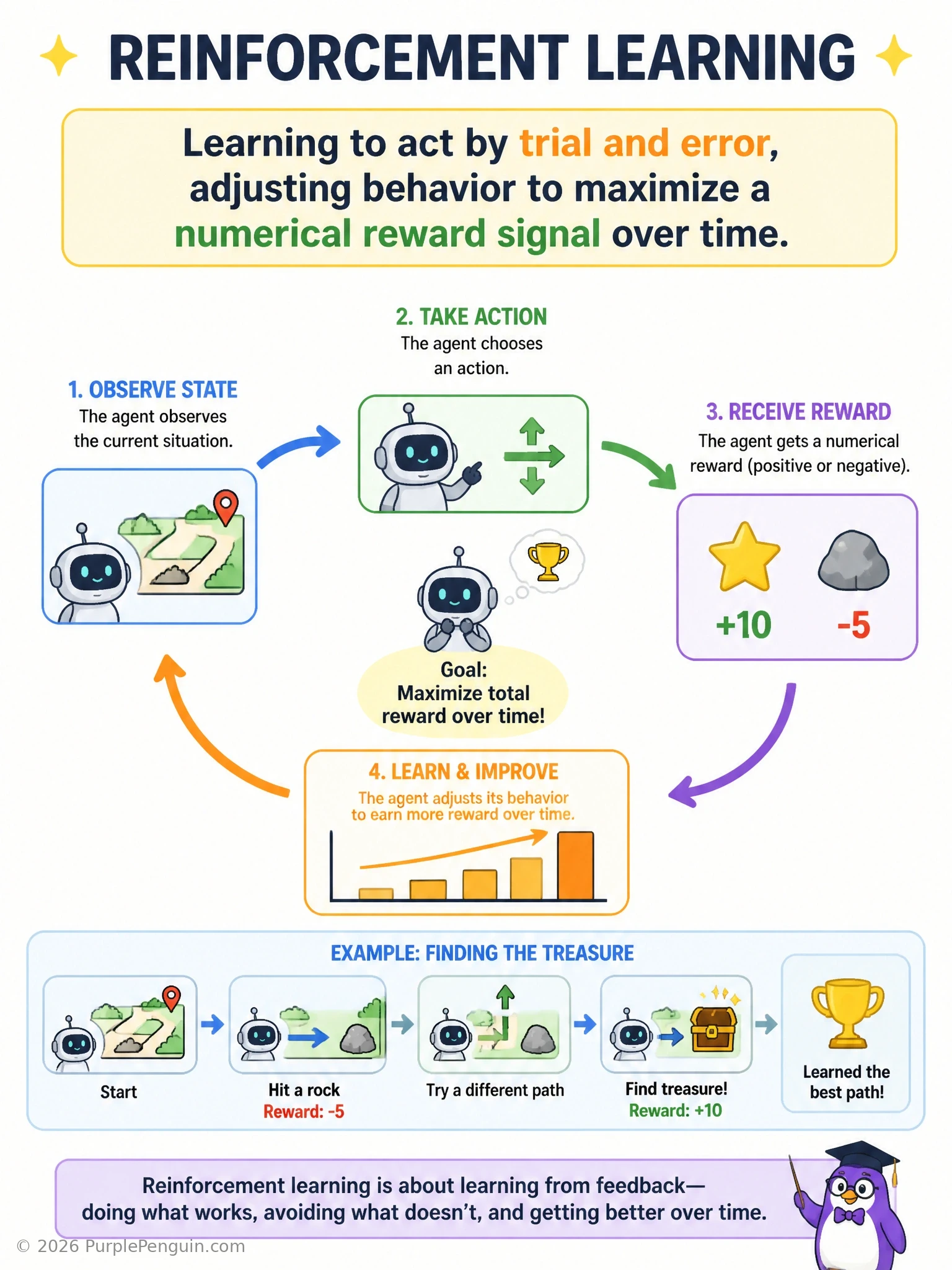
If you had to boil reinforcement learning down to one sentence, it's this: learn by doing, and get better through trial and error, guided entirely by a reward signal you're trying to maximize over time. There's no answer key, the agent tries actions, sees what reward or penalty comes back, and gradually shapes its behavior to rack up as much cumulative reward as possible, that's the whole game. Minimizing a supervised loss on labeled data is describing supervised learning instead, a different paradigm built around ground-truth labels rather than reward signals. Finding hidden structure in unlabeled data with no reward at all describes unsupervised learning. And reducing dimensionality while preserving variance describes a technique like PCA, useful in preprocessing or representation learning, but it has nothing to do with an agent acting in an environment to maximize reward.
Full explanation below image
Full Explanation
At its core, reinforcement learning is the study and practice of how an agent should learn to take actions within an environment through trial and error, using feedback in the form of a numerical reward signal, in order to maximize cumulative reward over time. This central idea is formalized through the framework of a Markov Decision Process, in which an agent observes a state, selects an action according to some policy, transitions to a new state, and receives a reward reflecting the immediate desirability of that transition; the agent's objective is to learn a policy, a mapping from states to actions, that maximizes the expected sum of (often discounted) future rewards. Crucially, the agent is not told the correct action to take in any given situation; instead, it must discover effective behavior by exploring the consequences of different actions and gradually exploiting what it has learned works well, continually refining its policy or value estimates based on the reward feedback it receives from its own experience.
The supervised-loss-minimization distractor is incorrect because that describes supervised learning, where a model is trained on a fixed dataset of input examples paired with correct, ground-truth output labels, and learning proceeds by minimizing a loss function that measures the discrepancy between the model's predictions and those known labels; there is no environment, no sequential decision-making, and no reward signal involved, fundamentally different from the trial-and-error, reward-maximizing framework of reinforcement learning. The hidden-structure-in-unlabeled-data distractor is incorrect because that describes unsupervised learning, exemplified by clustering or density estimation techniques, which seek to uncover patterns or groupings within data that has no labels and, notably, no reward signal or notion of sequential actions at all; reinforcement learning's defining feature, a reward-driven feedback loop from an agent's own actions, is entirely absent from this description. The dimensionality-reduction distractor is incorrect because that describes techniques like principal component analysis (PCA) or autoencoder-based compression, which aim to represent high-dimensional data in a lower-dimensional space while retaining as much informative variance as possible; while dimensionality reduction can be a useful preprocessing or representation-learning step that might be combined with an RL system (for instance, to compress high-dimensional state observations), it is not itself the defining idea of reinforcement learning, nor does it involve reward maximization through action selection.
A useful memory aid: reinforcement learning can be summarized as 'learn from consequences, not from an answer key,' capturing the essence of an agent that improves its behavior over time purely by acting, observing the rewards its actions produce, and adjusting to maximize that reward signal into the future.