A neural network with an input layer, three hidden layers, and an output layer has no loops or connections feeding backward between layers during a forward pass. What key characteristic does this describe?
Select an answer to reveal the explanation.
Short Explanation and Infographic
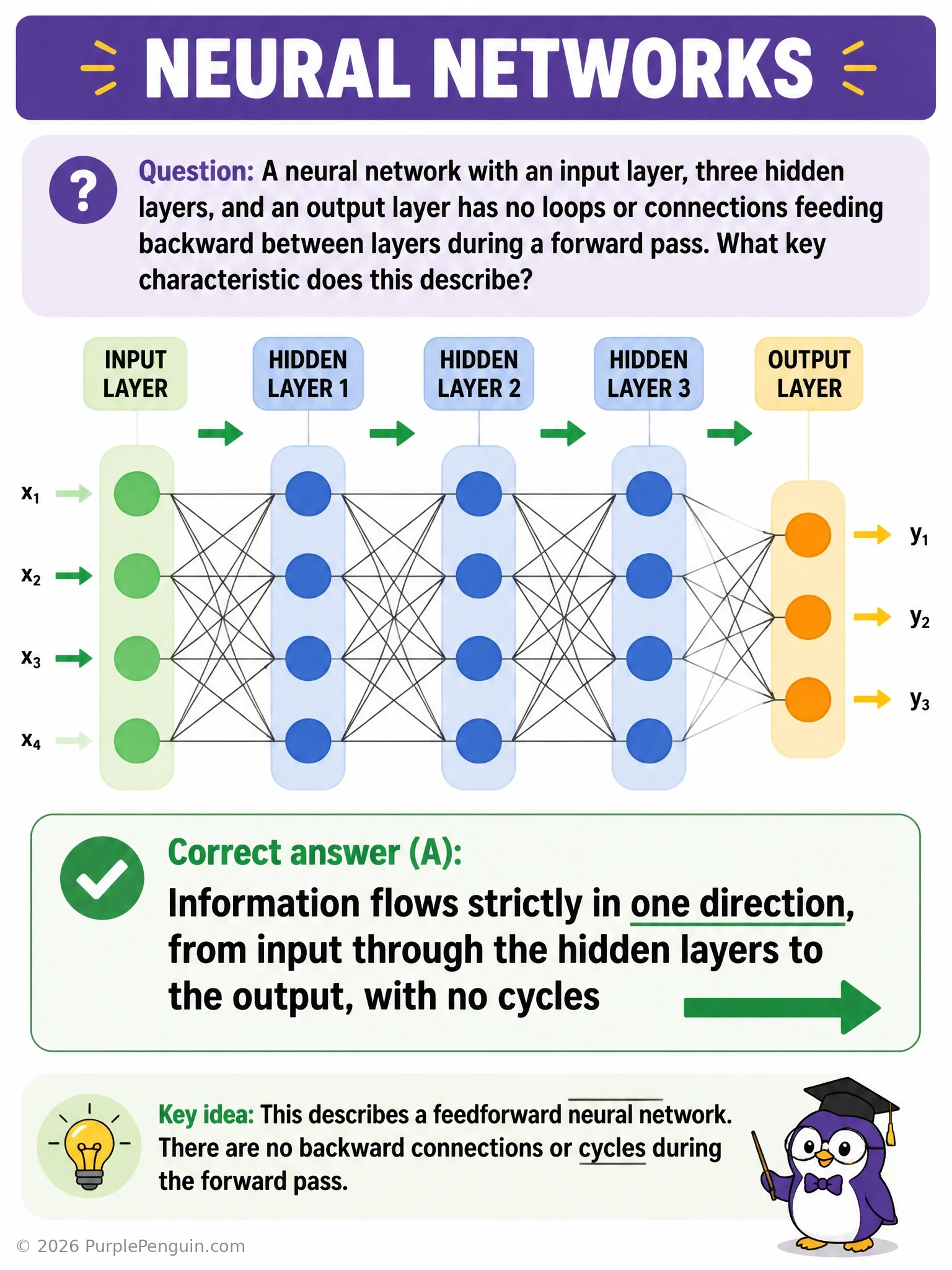
That's simply describing a feedforward neural network, or FFNN. The defining trait is right in the name, information flows forward, and only forward, starting at the input layer, passing through however many hidden layers you've stacked, in this case three, and finally reaching the output layer, with absolutely no loops or connections going backward within a single forward pass. Contrast that with a recurrent network, which does maintain a hidden state that persists and updates across time steps or sequential inputs, that's not what's being described here since there are no loops at all. Depending on both past and future inputs within a sequence describes something like a bidirectional RNN, again a fundamentally different, sequence-aware architecture. And feedforward networks are trained all the time with supervised objectives, like classification and regression, so that last option just isn't true.
Full explanation below image
Full Explanation
A feedforward neural network (FFNN) is defined by the property that information moves strictly in one direction: from the input layer, through one or more hidden layers, to the output layer, with no cycles, loops, or connections that feed information back from a later layer to an earlier one within a single pass. Each neuron in a given layer receives inputs only from the layer immediately preceding it (in a fully connected, or dense, configuration) and computes an output that is passed forward to the next layer, culminating in the network's final output. Networks with an input layer, three hidden layers, and an output layer arranged this way are a straightforward example of a deep feedforward network, sometimes called a multilayer perceptron (MLP) when composed of fully connected layers. This strictly forward, acyclic structure makes such networks well-suited to tasks where each input example can be processed independently of any others, such as standard classification or regression on tabular or fixed-size vector data, since there is no mechanism for information from one example to persist or influence the processing of a subsequent, separate example.
The distractor describing a persistent internal hidden state that updates across sequential inputs is incorrect because that describes recurrent neural networks (RNNs), LSTMs, and GRUs specifically, architectures explicitly designed with feedback loops that allow information to be carried forward across time steps within a sequence; a feedforward network has no such recurrent state and processes each input independently, with no memory of prior inputs. The distractor describing dependence on both past and future inputs within the same sequence is incorrect because that describes bidirectional architectures, such as bidirectional RNNs or bidirectional transformer encoders, which explicitly process a sequence in both directions to let each position's representation be informed by both earlier and later elements; a plain feedforward network has no notion of sequential order or bidirectional context at all, since it isn't processing sequences in this sense to begin with. The distractor claiming feedforward networks can only be trained with unsupervised objectives is incorrect because feedforward networks are commonly and successfully trained using supervised objectives, such as cross-entropy loss for classification or mean squared error for regression, and are one of the most standard architectures used in supervised learning; describing them as restricted to unsupervised training misrepresents how they are actually used in practice.
A useful memory aid: a feedforward network is a one-way street, data flows forward from input to output with no U-turns, no loops, and no memory of previous inputs, which is exactly what distinguishes it from recurrent architectures that explicitly maintain and update state as they process a sequence over time.