A marketing team wants to generate entirely new, realistic-looking product photos in various settings that were never actually photographed, to use in ad campaigns. Which architecture is best suited to this image-generation task?
Select an answer to reveal the explanation.
Short Explanation and Infographic
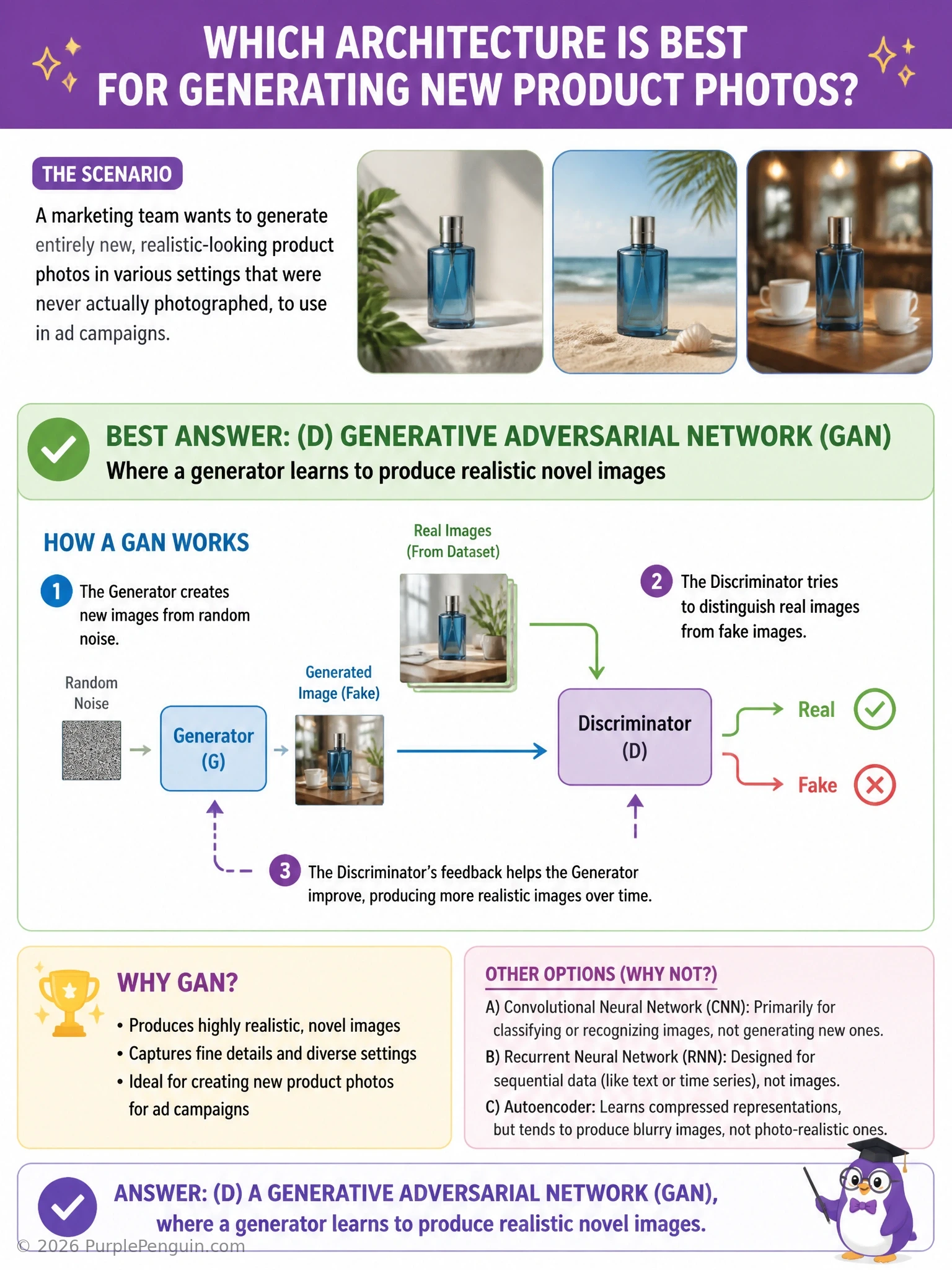
For generating brand-new, realistic images that never existed, a GAN is the classic and go-to choice. The generator network learns to turn random noise into convincing product photos, while a discriminator keeps pushing it to get more and more realistic by trying to catch the fakes, and that adversarial back-and-forth is what makes GANs so good at producing diverse, novel, high-fidelity images from scratch. An RNN predicting pixels in raster-scan order is a real technique, autoregressive image models exist, but it's slow and not the standard tool reached for here, and it's not what's being described as the strong, established option in this scenario. A support vector machine is a classifier, not a generator, it draws decision boundaries, it doesn't create new images. And a random forest on hand-engineered features is a classical machine learning classifier too, again built for prediction and classification tasks, not image synthesis.
Full explanation below image
Full Explanation
Generative Adversarial Networks (GANs) are the architecture best suited to generating new, realistic images that do not correspond to any real photograph in the training set, which is exactly the marketing team's use case of creating novel product imagery for advertising. A GAN consists of a generator network, which learns to map random noise vectors into realistic-looking images, and a discriminator network, which is trained to distinguish real training images from the generator's synthetic outputs. These two networks are trained simultaneously in an adversarial process: the generator continually tries to fool the discriminator, while the discriminator continually improves at spotting fakes, and this competitive dynamic drives the generator to produce increasingly photorealistic and diverse images over the course of training. Modern variants, such as StyleGAN and its successors, can produce high-resolution, highly realistic synthetic images and have been widely used in commercial contexts, including advertising, fashion, and product visualization, precisely because they can generate novel, plausible images conditioned on desired attributes or styles.
The RNN-based raster-scan pixel prediction distractor is incorrect in this context because, while autoregressive image models like PixelRNN or PixelCNN do exist and can technically generate images pixel by pixel, they are notoriously slow at generation time (since each pixel typically depends sequentially on previously generated pixels) and are not the standard, practical choice for producing high-quality photorealistic images at scale for a task like ad-campaign imagery; GANs (and, more recently, diffusion models) are far more common and effective for this purpose. The support vector machine distractor is incorrect because SVMs are discriminative classifiers designed to find a decision boundary that separates categories of labeled data; they have no generative mechanism for producing novel images and are entirely unsuited to a data-generation task like this one. The random forest distractor is incorrect for the same fundamental reason: random forests are ensembles of decision trees used for classification or regression on structured or hand-engineered features, offering no capability to synthesize new, realistic image content; they are prediction tools, not generative models.
A helpful memory aid: whenever the task is 'create something new that looks real but never existed,' think generative models, GANs (or diffusion models) chief among them, whereas classifiers like SVMs and random forests, and sequence predictors applied to unrelated modalities, are tools for prediction and categorization of existing data, not for synthesizing novel content.