A newcomer to deep learning asks how a GAN fundamentally differs from an autoencoder, since both are described as 'generative' in some sense. What is the most accurate distinction?
Select an answer to reveal the explanation.
Short Explanation and Infographic
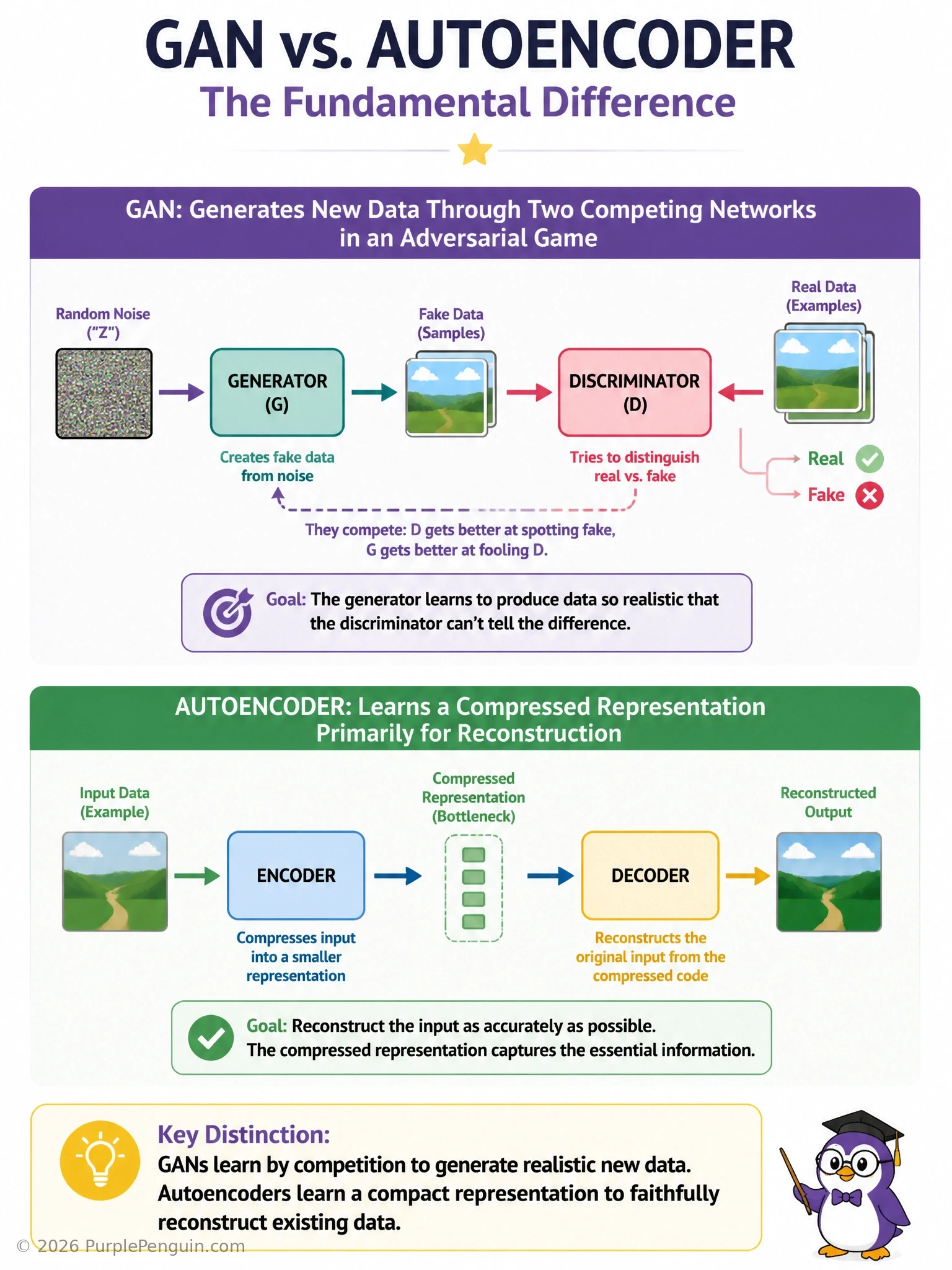
The core difference comes down to mechanism and purpose. A GAN pits two networks against each other, a generator trying to produce convincing fake samples, and a discriminator trying to catch the fakes, and through that adversarial back-and-forth, the generator gets progressively better at producing realistic, novel data from scratch. An autoencoder, on the other hand, has no adversary at all, it's just an encoder squeezing input down to a compact latent code and a decoder reconstructing it back out, trained to minimize reconstruction error against the original input. So GANs are built to generate new, realistic samples, while vanilla autoencoders are built to compress and faithfully reconstruct existing data, generation is really a side benefit in variants like VAEs, not the core objective. Both can train without labels, using unsupervised or self-supervised objectives, so the labeling claim is wrong, and both are commonly applied to images and other data types, and autoencoders absolutely have a decoder, that's half the architecture.
Full explanation below image
Full Explanation
Generative Adversarial Networks (GANs) and autoencoders are both frequently discussed in the context of generative modeling, but they achieve fundamentally different objectives through fundamentally different mechanisms. A GAN consists of two separate networks, a generator and a discriminator, trained simultaneously in an adversarial, minimax game: the generator takes random noise as input and attempts to produce synthetic samples realistic enough to fool the discriminator, while the discriminator is trained to distinguish real samples from the training data against the generator's fake samples. Through this competitive dynamic, the generator is pushed to produce increasingly realistic and diverse samples that resemble the true data distribution, and crucially, a trained GAN generator can produce entirely novel samples from random noise inputs, without ever needing a specific input to reconstruct. An autoencoder, by contrast, consists of an encoder and a decoder with no adversarial component: the encoder compresses an input into a lower-dimensional latent representation, and the decoder reconstructs an approximation of that same specific input from the latent code, with the training objective being to minimize reconstruction error (such as mean squared error) between the original input and its reconstruction. While variants like Variational Autoencoders (VAEs) impose additional structure on the latent space to support sampling new data points and thus can be used generatively, the vanilla autoencoder's primary purpose is representation learning and reconstruction of the specific inputs it's given, not generating novel, realistic samples from scratch the way a GAN's generator is explicitly trained to do.
The labeled-data distractor is incorrect because both GANs and autoencoders are typically trained without labels, in an unsupervised or self-supervised fashion; GANs learn from a training set of real (unlabeled) examples to distinguish real from generated, and autoencoders learn by using each input as its own reconstruction target, requiring no external labels either. The data-type-restriction distractor is incorrect because both GANs and autoencoders are general architectural patterns applicable to a wide variety of data types, images, audio, tabular data, text embeddings, and more; neither is inherently restricted to only one data modality. The no-decoder distractor is incorrect because a decoder is, by definition, an essential half of any standard autoencoder architecture; without a decoder to reconstruct the input from the latent representation, there would be no way to compute a reconstruction loss or train the encoder at all, so this claim fundamentally misdescribes the autoencoder architecture.
A helpful memory aid: think of a GAN as a forger versus a detective locked in an ongoing contest, producing increasingly convincing brand-new forgeries, while an autoencoder is more like a photocopier that first shrinks a document down to essential details and then tries to reprint it as faithfully as possible, reconstruction of what it was shown, not invention of something new.