A team training a robotic arm to perform complex manipulation tasks first has it practice on simplified, easier versions of the task before gradually introducing full-complexity scenarios. What training strategy is this?
Select an answer to reveal the explanation.
Short Explanation and Infographic
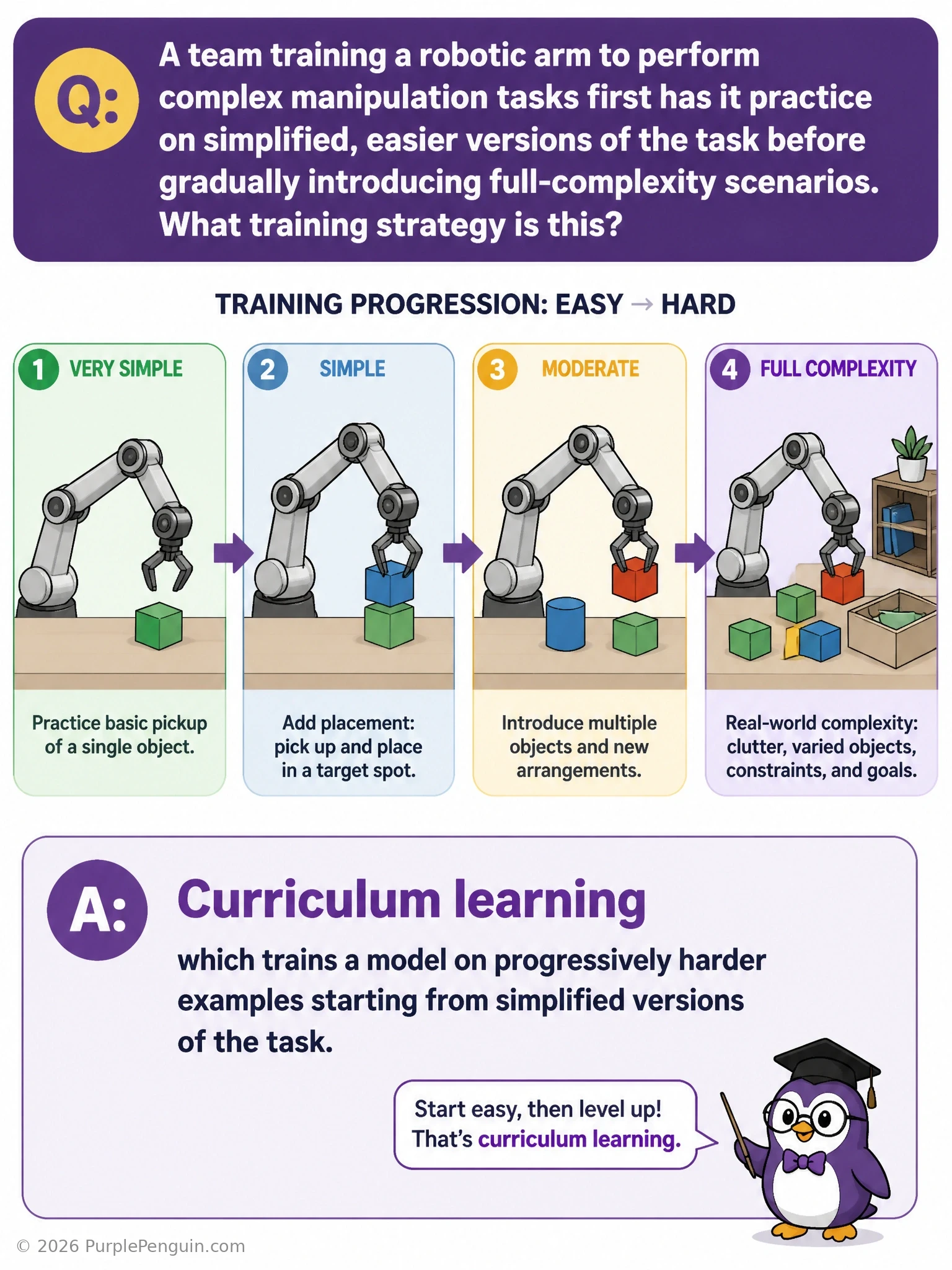
This is curriculum learning, and the name says it all, it's structuring training like a school curriculum, easy material first, harder material later. By starting the robotic arm on simplified versions of the manipulation task, it can build up basic competence and useful representations before being thrown into the full complexity, which tends to speed up convergence and often leads to a better final policy than throwing the hardest examples at it from step one. Transfer learning is a different idea, reusing weights learned on a separate, often unrelated task as a starting point, not about ordering task difficulty within the same training process. Adversarial training is about robustness to intentionally crafted tricky or perturbed inputs, a security and robustness concern, not a difficulty progression. And early stopping is just a regularization technique for when to stop training, unrelated to how task difficulty is sequenced.
Full explanation below image
Full Explanation
Curriculum learning is a training strategy inspired by how humans and animals often learn best, progressing from simple concepts or tasks to more complex ones in a structured, incremental sequence, rather than being exposed to the full difficulty and complexity of a problem from the very first training example. In the context of the robotic arm example, this might mean starting training on simplified manipulation scenarios, such as larger, easier-to-grasp objects, fewer obstacles, or more forgiving success criteria, before gradually introducing smaller objects, more obstacles, tighter tolerances, or more complex multi-step tasks as the model's competence improves. The underlying motivation is that early training on overly difficult examples can lead to poor gradient signals, slow convergence, or the model getting stuck in bad local optima, whereas an easy-to-hard progression can smooth the loss landscape the model encounters over the course of training, often resulting in faster convergence and, in some cases, better final performance than training on a fixed, undifferentiated mix of difficulties from the start. Curriculum learning has been applied across both supervised learning and reinforcement learning settings, and is particularly popular in robotics and game-playing agents, where task difficulty can often be explicitly controlled or parameterized.
The transfer-learning distractor is incorrect because transfer learning refers to reusing a model (or its learned weights/representations) that was originally trained on a different, often unrelated source task or dataset, as a starting point for a new target task, typically to leverage previously learned general features and reduce the amount of data or training needed on the new task; it does not inherently involve structuring the difficulty progression of examples within a single training curriculum. The adversarial-training distractor is incorrect because adversarial training involves deliberately exposing a model during training to adversarial examples, inputs specifically perturbed (often imperceptibly to humans) to try to cause misclassification or poor performance, with the goal of improving robustness against such attacks; this is a robustness and security-oriented technique, unrelated to organizing training examples from easy to hard. The early-stopping distractor is incorrect because early stopping is a regularization technique that monitors validation performance during training and halts the training process once that performance stops improving (or begins to degrade), preventing overfitting; it is a stopping criterion, not a strategy for sequencing or structuring the difficulty of training examples.
A helpful memory aid: curriculum learning treats a model like a student progressing through a well-designed course, algebra before calculus, so to speak, deliberately easing the model into full task complexity rather than throwing it into the deep end from lesson one.