Which characteristic is most central to defining reinforcement learning as a distinct machine learning paradigm?
Select an answer to reveal the explanation.
Short Explanation and Infographic
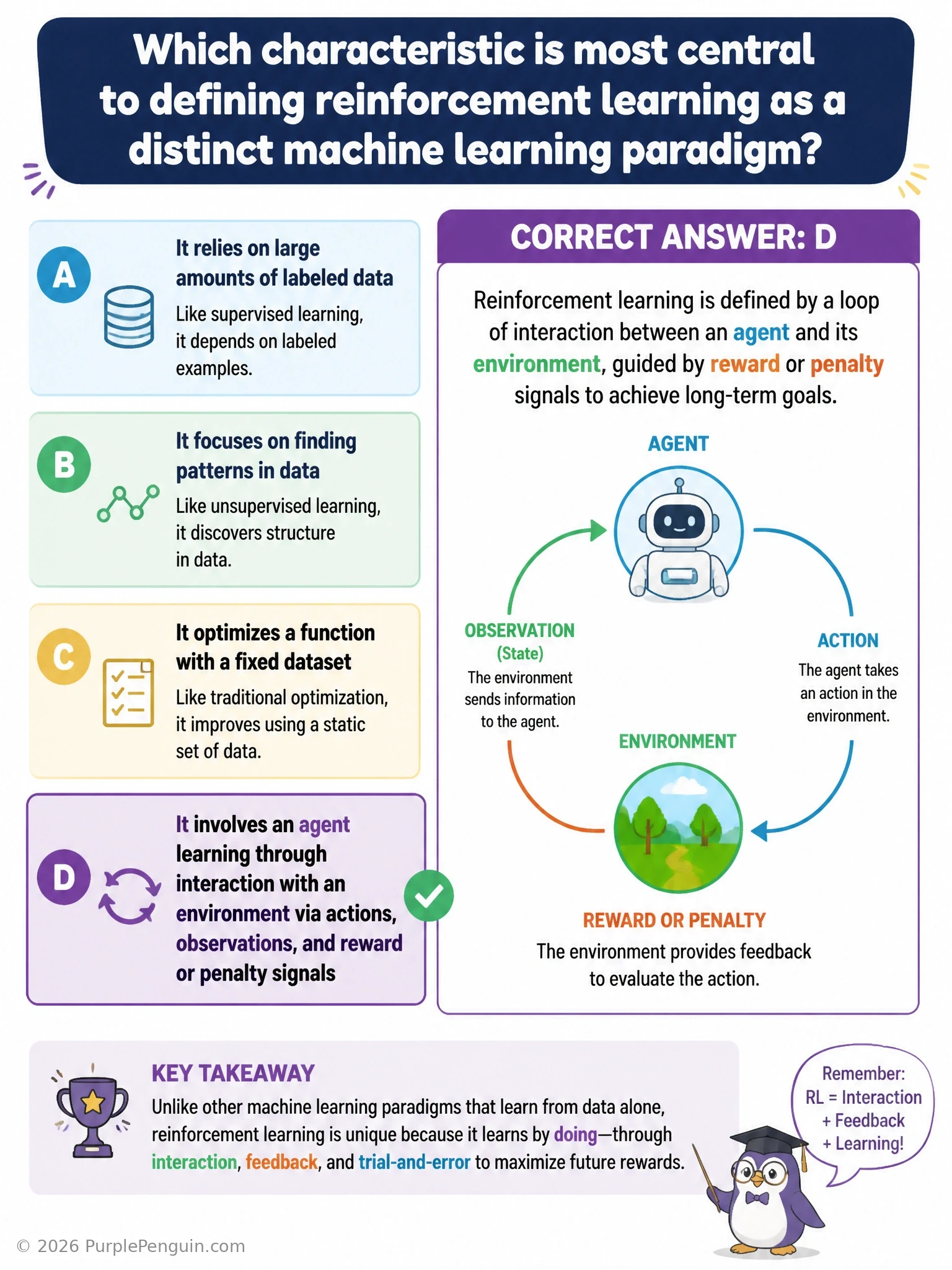
What sets reinforcement learning apart from the other machine learning paradigms is this interactive loop: an agent takes actions in an environment, observes what happens, and gets a reward or penalty signal telling it how well that action worked out. There's no answer key handed to it upfront, it has to discover good behavior through trial and error, guided only by that feedback signal, and its goal is to maximize cumulative reward over time. Needing a large labeled dataset prepared in advance describes supervised learning instead. Clustering unlabeled data into groups describes unsupervised learning, again a different paradigm entirely. And compressing data into a lower-dimensional latent space describes representation learning techniques like autoencoders or PCA, not the reward-driven, sequential-decision-making core of RL.
Full explanation below image
Full Explanation
Reinforcement learning is distinguished from other machine learning paradigms primarily by its core interactive loop: an agent situated within an environment takes actions, transitions between states, and receives scalar reward (or penalty) signals as feedback on the quality of those actions, with the overarching objective of learning a policy that maximizes expected cumulative reward over time. Crucially, the agent is not given explicit correct answers for every situation it encounters; instead, it must discover effective behavior through a process of exploration (trying new actions to discover their consequences) and exploitation (leveraging known good actions to maximize reward), balancing this tradeoff as it accumulates experience. This sequential, feedback-driven, trial-and-error structure, often formalized as a Markov Decision Process, is what fundamentally separates reinforcement learning from supervised and unsupervised learning.
The distractor describing a requirement for a large labeled dataset of correct input-output pairs prepared in advance is incorrect because that describes supervised learning, where a model is trained to approximate a mapping from inputs to known, ground-truth labels; reinforcement learning explicitly does not require pre-labeled correct actions for every state, since the agent must discover good actions itself through interaction and delayed reward feedback, which is often sparse or noisy rather than a direct label. The distractor describing clustering unlabeled data points into groups based on similarity is incorrect because that describes unsupervised learning, specifically clustering algorithms like k-means or hierarchical clustering, which seek to discover latent groupings or structure in data with no labels and no notion of an agent, action, or reward at all. The distractor describing compression of high-dimensional data into a lower-dimensional latent space is incorrect because that describes representation learning or dimensionality reduction techniques, such as autoencoders, PCA, or t-SNE, which aim to find compact, information-preserving representations of static data; while these techniques can sometimes be used as components within a larger RL system (for example, to compress high-dimensional state observations), the compression objective itself is not what defines reinforcement learning as a paradigm.
A helpful way to remember the distinction: supervised learning learns from an answer key, unsupervised learning finds structure with no key, and reinforcement learning learns from consequences, that is, it learns by acting, observing outcomes, and adjusting behavior based on reward signals accumulated through ongoing interaction with an environment, which is precisely why RL is often summarized as 'learning by trial and error to maximize reward.'