A team has trained a GAN to generate synthetic faces and wants to judge how realistic the output images are. Since there's no simple accuracy metric like in classification, what is a common, practical way to evaluate GAN output quality?
Select an answer to reveal the explanation.
Short Explanation and Infographic
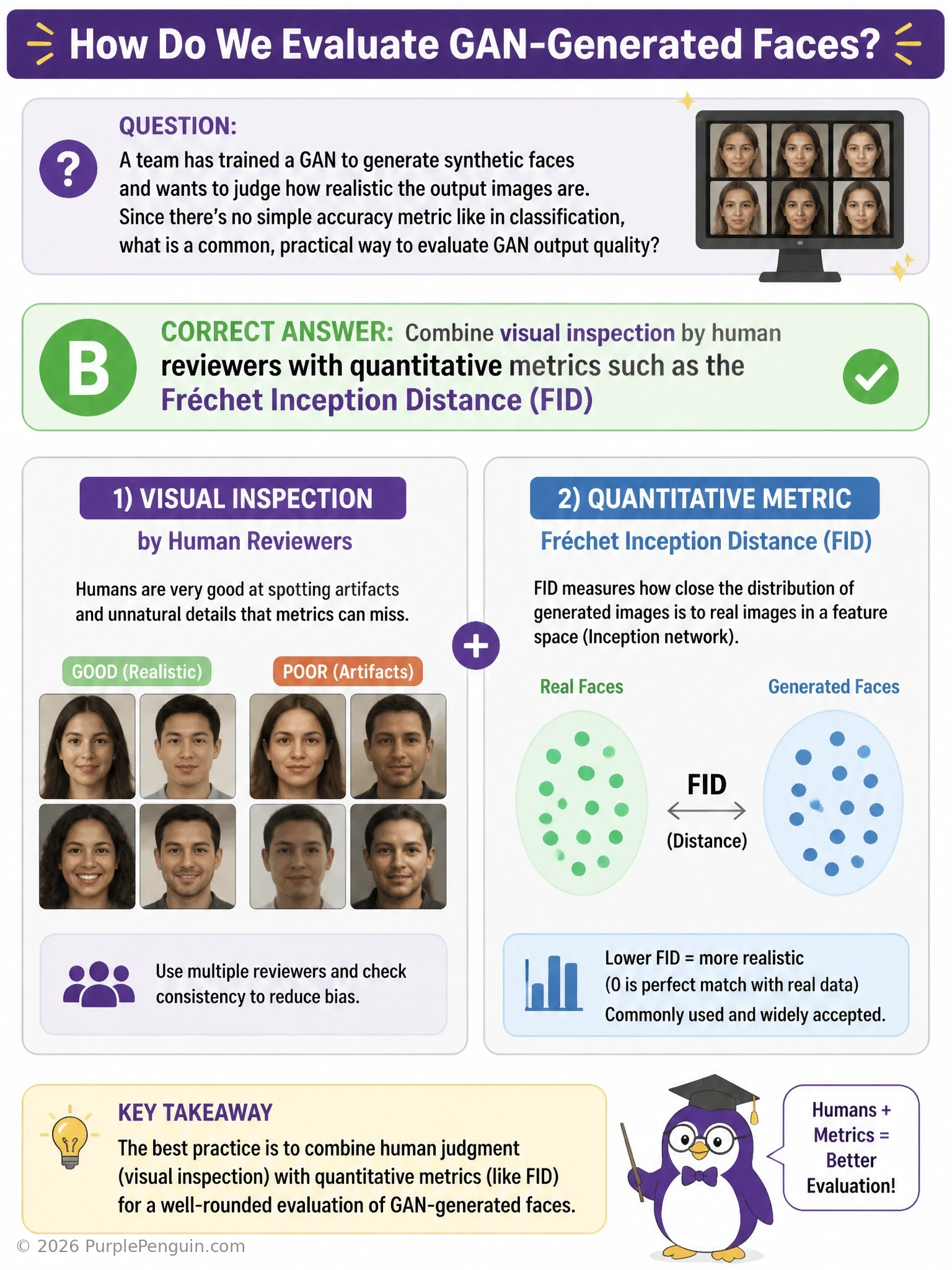
Evaluating GANs is trickier than evaluating a classifier, because there's no ground-truth label to check against, you're judging realism and diversity. In practice, teams do both: humans eyeball a batch of generated images to catch obvious artifacts or mode collapse, and they also compute a quantitative metric like Fréchet Inception Distance, which compares the statistics of real and generated image features extracted from a pretrained network, lower FID means the generated distribution looks closer to the real one. The discriminator's loss alone is a bad ruler for quality, it just reflects a moving adversarial target, not perceptual realism. R-squared on raw pixel values doesn't capture perceptual quality either. And the generator's training loss is famously unreliable as a quality signal in GANs, it can bounce around even as visual quality improves.
Full explanation below image
Full Explanation
Evaluating generative adversarial networks presents a unique challenge because, unlike supervised classification tasks with clear ground-truth labels, there is no single correct output to compare against; the goal is to judge how realistic, diverse, and high-quality the generated samples are relative to the true data distribution. In practice, GAN evaluation typically combines qualitative and quantitative approaches. Qualitatively, human reviewers visually inspect batches of generated samples to spot artifacts, blurriness, or mode collapse (where the generator produces only a limited variety of outputs). Quantitatively, metrics such as the Fréchet Inception Distance (FID) are widely used: FID passes both real and generated images through a pretrained Inception network, extracts high-level feature representations, models each set of features as a multivariate Gaussian, and computes the distance between these two Gaussians. A lower FID indicates that the generated image distribution is statistically closer to the real image distribution in this feature space, correlating reasonably well with human judgments of realism and diversity. Other metrics, like Inception Score, are sometimes used alongside FID, but FID has become something of a de facto standard due to its better sensitivity to both quality and diversity.
The discriminator cross-entropy loss distractor is incorrect because the discriminator's loss reflects an adversarial, constantly shifting target as the generator improves; a low discriminator loss might simply mean the discriminator has become very good at distinguishing samples, not that the generator's outputs are realistic, and GAN losses in general are notoriously unreliable as standalone indicators of sample quality due to the adversarial min-max dynamic. The R-squared-on-pixel-intensities distractor is incorrect because directly comparing raw pixel values statistically ignores perceptual and structural realism; two images can have very different pixel-level statistics yet look equally realistic to a human, or have similar pixel statistics yet look completely different perceptually, making pixel-level correlation a poor proxy for generative quality. The generator-training-loss distractor is incorrect because, in the adversarial training setup, the generator's loss value does not monotonically correlate with output quality; it is common for generator loss to fluctuate or even increase while the visual quality of generated samples is actually improving, since the loss is relative to an evolving discriminator rather than an absolute quality benchmark.
A good memory aid: judge a GAN the way you'd judge a forger's paintings, look at them yourself, and also measure statistically how closely their style matches the real collection, rather than trusting a single internal training number to tell the whole story.