What fundamental relationship does the Bellman equation express in reinforcement learning?
Select an answer to reveal the explanation.
Short Explanation and Infographic
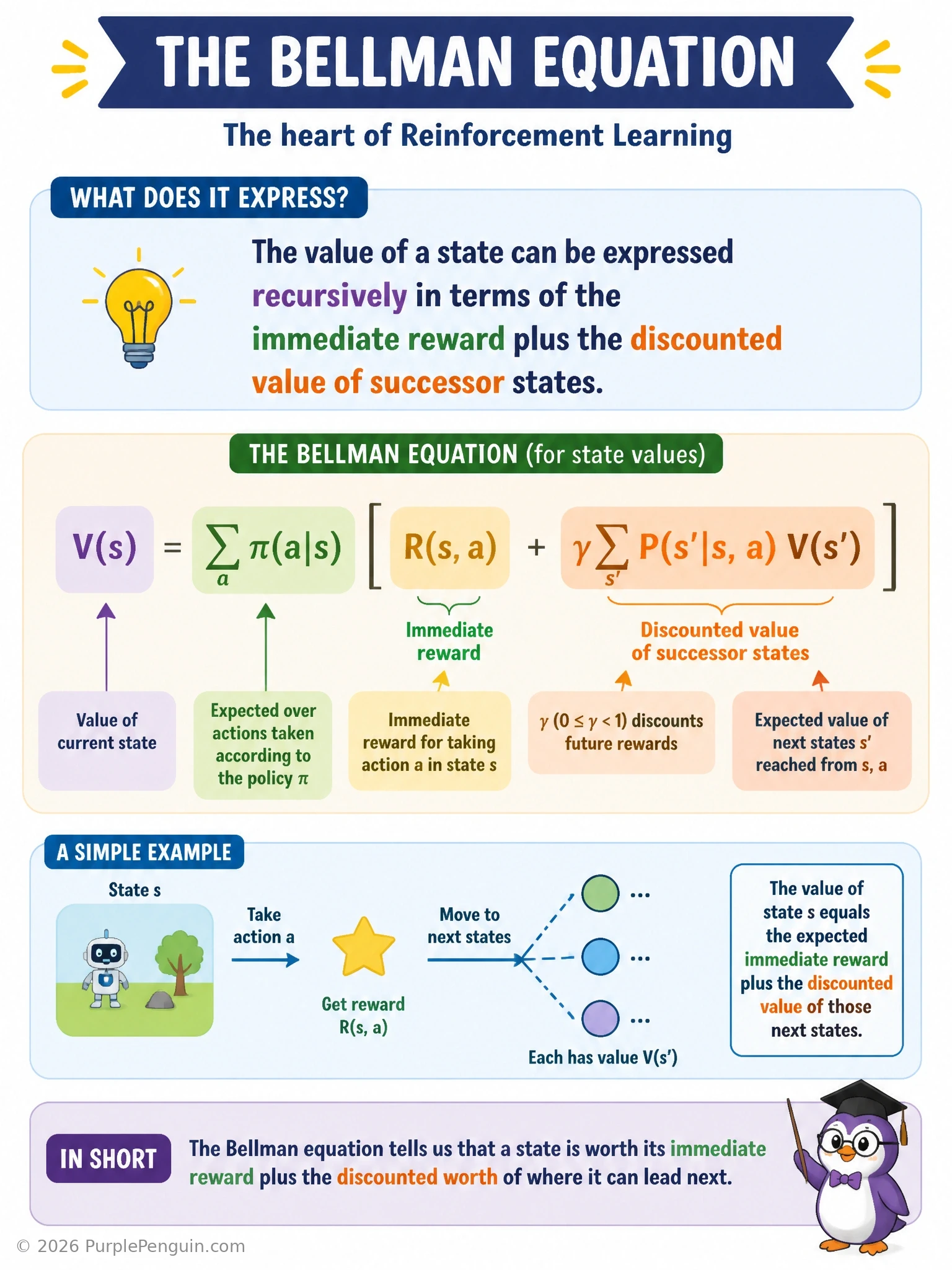
The Bellman equation is really just a recursive definition of value: how good is this state? Well, it's the reward you get right now plus a discounted estimate of how good things look from wherever you end up next. That recursive relationship, current value tied to future value, is the backbone of pretty much every value-based RL algorithm, including Q-learning and dynamic programming approaches. It's not about gradient clipping, that's an unrelated optimization stability trick. It's not a rule about sizing your network's hidden layers, architecture choices like that are engineering decisions, not something the Bellman equation dictates. And it's not about decaying your exploration rate either, that's part of your exploration strategy (like epsilon-greedy scheduling), a totally separate concern from how state values are recursively defined.
Full explanation below image
Full Explanation
The Bellman equation is a foundational recursive relationship in reinforcement learning and dynamic programming that expresses the value of being in a given state (or taking a given action in a state) in terms of the immediate reward received plus the discounted expected value of whatever state follows. Formally, for a state-value function under a policy, V(s) equals the expected immediate reward plus the discount factor gamma multiplied by the expected value of the successor state, V(s'). An analogous action-value version defines Q(s,a) in terms of the immediate reward plus the discounted maximum (or expected, depending on the algorithm) Q-value of the next state-action pair. This recursive decomposition is what makes it possible to compute or approximate value functions without having to simulate every possible full trajectory to the end of an episode; instead, values can be updated using one-step lookahead and bootstrapping, which underlies algorithms such as value iteration, policy iteration, Q-learning, and temporal-difference learning.
The gradient-clipping distractor is incorrect because clipping gradients to a maximum norm is a general deep learning optimization technique used to prevent exploding gradients during training of any neural network, entirely unrelated to how state or action values are recursively related to each other; it is an engineering safeguard, not a theoretical relationship about value functions. The hidden-unit-sizing distractor is incorrect because the number of hidden units in a function approximator is an architectural design choice made by the practitioner based on the complexity of the problem and computational budget, not a principle derived from or dictated by the Bellman equation, which is a mathematical relationship independent of any particular network architecture. The exploration-decay distractor is incorrect because scheduling how the exploration rate (such as epsilon in epsilon-greedy action selection) decreases over training is part of the exploration-exploitation strategy, a separate design decision about how the agent balances trying new actions versus exploiting known good ones, and has no direct bearing on the recursive mathematical structure the Bellman equation describes.
A useful memory aid: think of the Bellman equation as a chain letter for value, each state's worth is passed down recursively from 'reward now' plus a discounted echo of 'value later,' and virtually every value-based RL algorithm is, at its core, a method for solving or approximating this recursive relationship.