For an image classification task, an engineer compares a convolutional neural network (CNN) against a plain fully connected feedforward network (FFNN) fed the flattened pixel values. What is the main architectural difference that makes the CNN better suited to images?
Select an answer to reveal the explanation.
Short Explanation and Infographic
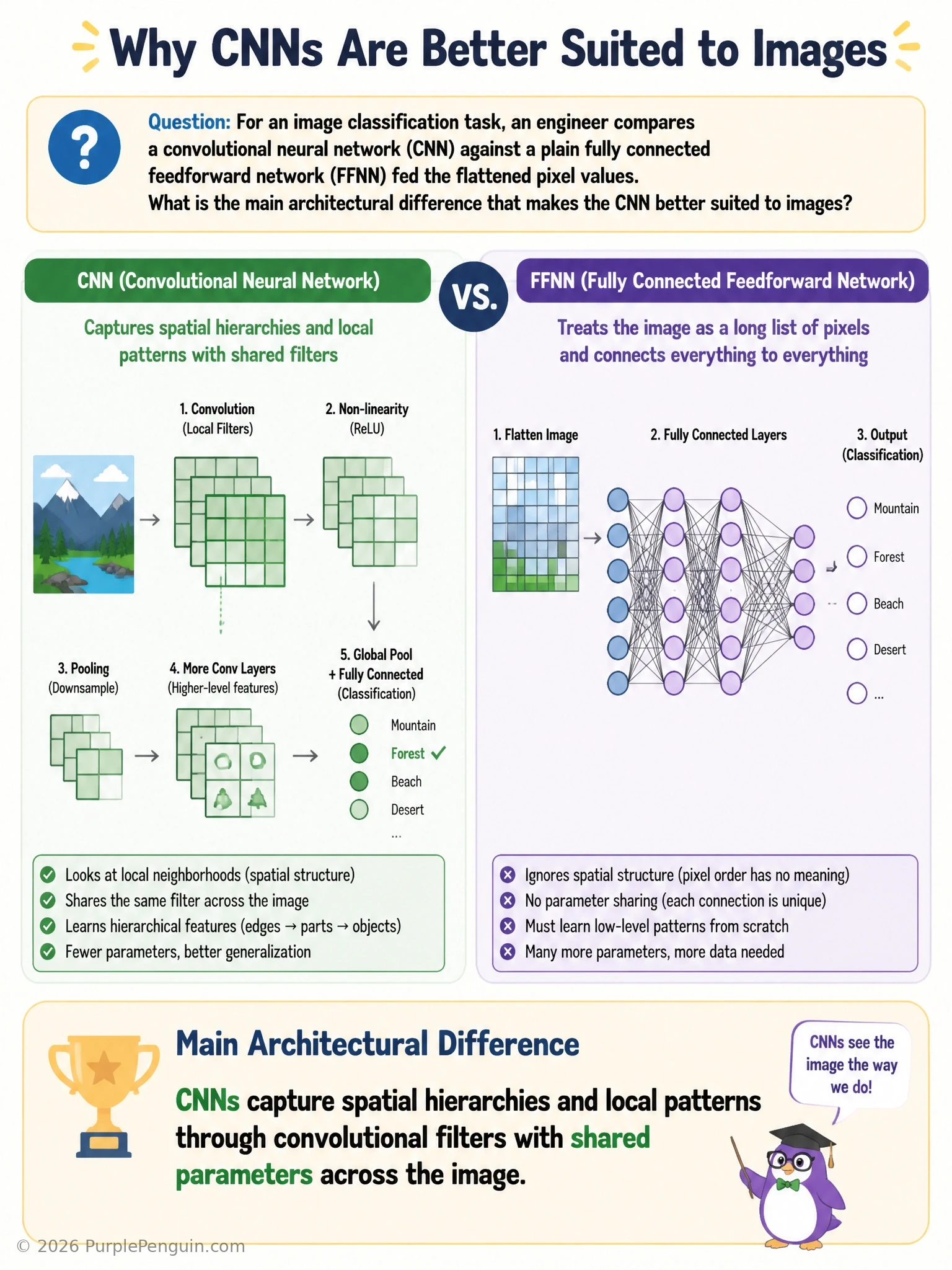
The big win for CNNs on images comes down to two connected ideas: local receptive fields and parameter sharing. A convolutional filter slides across the whole image using the same small set of weights everywhere, so it learns to detect a feature, like an edge or a texture, regardless of where it shows up, and stacking these layers builds up a hierarchy from simple edges to shapes to whole objects. A plain FFNN, by contrast, flattens the image into one long vector and treats every pixel position with its own independent set of weights, throwing away the spatial relationships between neighboring pixels entirely, and needing vastly more parameters to boot. It's not about learning rate, that's a hyperparameter choice unrelated to architecture. It's not just 'more layers,' depth alone doesn't explain it. And CNNs absolutely still use backpropagation and gradients, they don't replace it with hand-crafted rules.
Full explanation below image
Full Explanation
The key architectural distinction that makes convolutional neural networks well-suited to image data, compared to a plain fully connected feedforward network operating on flattened pixels, is the combination of local receptive fields and parameter sharing, which together allow CNNs to exploit the spatial structure inherent in images. A convolutional filter is a small set of learnable weights that slides (convolves) across the entire spatial extent of the input, applying the exact same weights at every position. This means the network learns to detect a specific pattern, such as an edge, corner, or texture, once, and can then recognize that same pattern anywhere it appears in the image, a property known as translation invariance. Stacking multiple convolutional layers builds a hierarchy of increasingly abstract and complex features: early layers detect simple edges and colors, middle layers combine these into textures and parts, and deeper layers assemble whole object representations. A fully connected feedforward network, by contrast, flattens the image into a single vector and connects every input pixel to every neuron in the next layer with independently learned weights, discarding the 2D spatial relationships between neighboring pixels and requiring an enormous number of parameters that scales poorly with image size, while also lacking any built-in notion of translation invariance.
The learning-rate distractor is incorrect because the learning rate is a training hyperparameter governing the step size of weight updates during optimization, a choice made independently of whether the underlying architecture is convolutional or fully connected; it does not define or explain the structural advantage of CNNs for image data. The 'more total layers' distractor is incorrect because CNNs are not inherently deeper than FFNNs by definition; depth is a separate design choice, and a CNN's advantage comes from the nature of its operations (local, shared-weight convolutions) rather than simply having a greater layer count, which by itself does not confer spatial awareness. The rule-based-feature-extraction distractor is incorrect because CNNs are still trained end-to-end via standard backpropagation and gradient descent, learning their convolutional filter weights directly from data just like any other neural network; they do not substitute a hand-engineered or rule-based feature extraction pipeline in place of gradient-based learning, which was the older, pre-deep-learning approach to computer vision.
A helpful memory aid: CNNs are built around the assumption that 'a cat's ear looks like a cat's ear no matter where it appears in the frame,' and parameter sharing plus local connectivity is precisely the architectural choice that encodes and exploits that assumption efficiently, unlike a plain FFNN which must relearn every spatial pattern independently at every possible pixel location.