In a reinforcement learning setup for a warehouse robot that picks and moves boxes, what role does the reward function serve?
Select an answer to reveal the explanation.
Short Explanation and Infographic
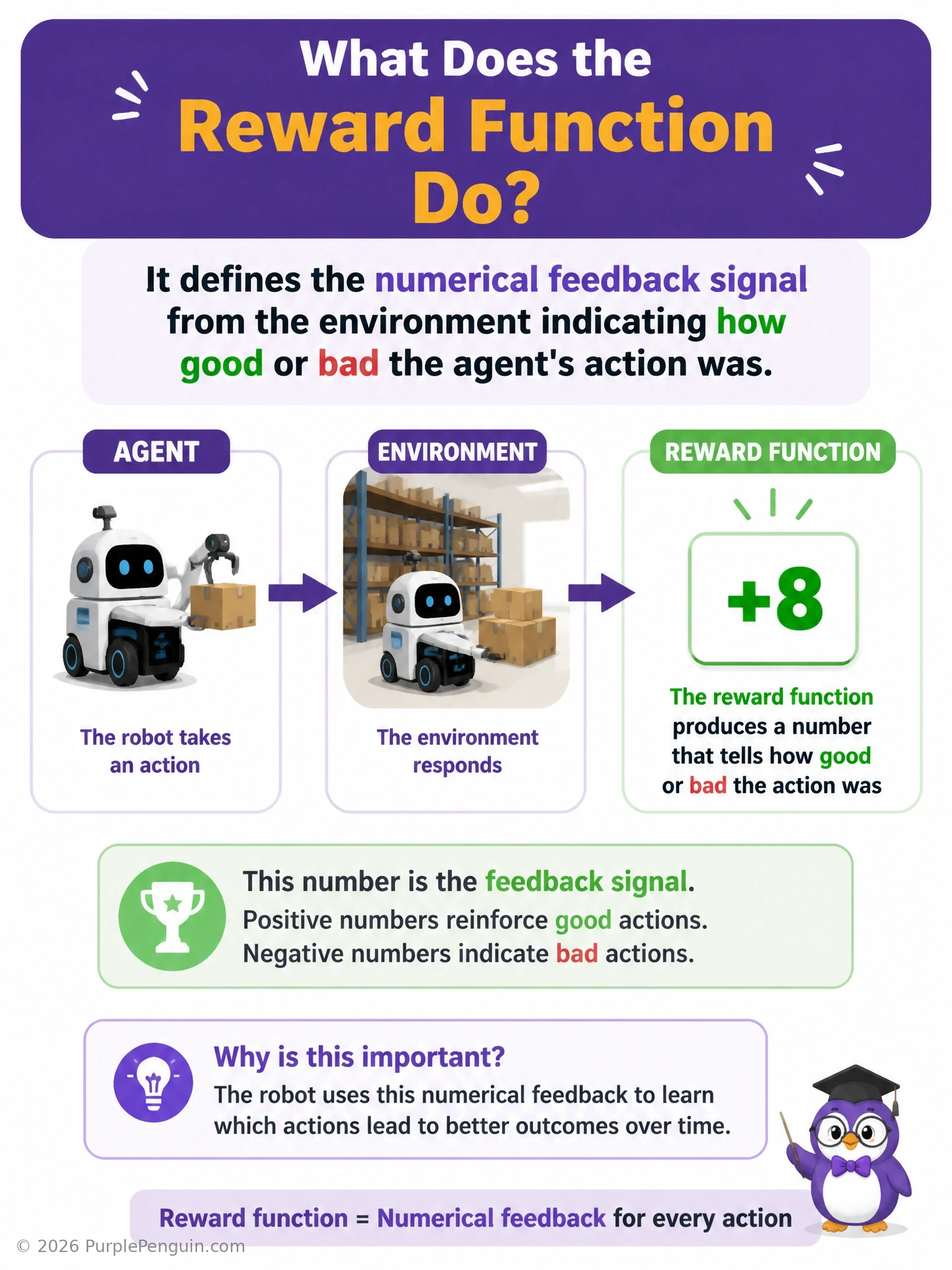
The reward function is the environment's way of grading the agent, plain and simple. Every time the warehouse robot takes an action, like grabbing a box or moving to a shelf, the reward function spits out a number saying how good or bad that move was, say, positive for a successful pick, negative for dropping a box or wasting time. The agent's whole job is to learn a policy that racks up as much cumulative reward as possible. It's not a memory log of visited states, that's more like a replay buffer or the state-history itself. It's not a fixed action script, RL is specifically about the agent figuring out its own action sequence rather than being told one. And it's not the backprop gradient calculation, that's a separate piece of the training machinery used to update network weights once you already have a loss signal derived from rewards.
Full explanation below image
Full Explanation
The reward function is a core component of the reinforcement learning framework, formally defined within a Markov Decision Process as a function that maps a state (and often the action taken and the resulting next state) to a scalar numerical value. This value represents immediate feedback from the environment about the desirability of the agent's most recent action, with positive rewards reinforcing behaviors that move the agent toward its goal and negative rewards (penalties) discouraging undesirable behaviors, such as inefficiency, collisions, or task failures. The agent's overarching objective in reinforcement learning is to learn a policy that maximizes the expected cumulative (often discounted) sum of these rewards over time, not just the immediate reward from a single action, which is why reward design has such a large downstream effect on the behavior the agent ultimately learns.
The distractor describing a stored history of visited states is incorrect because that describes the agent's trajectory, episode log, or in some algorithms, an experience replay buffer, none of which is the reward function itself; the reward function produces a feedback signal at each step, it does not serve as a data structure archiving past states. The distractor describing a fixed sequence of required actions is incorrect because prescribing an exact action sequence describes a hard-coded policy or a scripted controller, which defeats the purpose of reinforcement learning; RL is specifically designed for settings where the optimal sequence of actions is not known in advance and must be discovered by the agent through trial, error, and reward feedback. The distractor describing gradient computation for backpropagation is incorrect because gradient computation is a mechanism belonging to the optimization process used to update a function approximator's parameters (such as a neural network representing a policy or value function); while reward signals often factor into constructing a loss function from which gradients are derived (as in policy-gradient methods), the reward function itself is a property of the environment/task definition, not a piece of the differentiation machinery.
A helpful way to remember this: the reward function is the environment's voice, telling the agent, one action at a time, 'that was good' or 'that was bad,' and everything else in the RL pipeline, whether it's a Q-table, a policy network, or a value function, exists to help the agent turn that stream of local feedback into long-term, reward-maximizing behavior.