In a typical CNN architecture, what role does the fully connected layer play after the convolutional and pooling layers?
Select an answer to reveal the explanation.
Short Explanation and Infographic
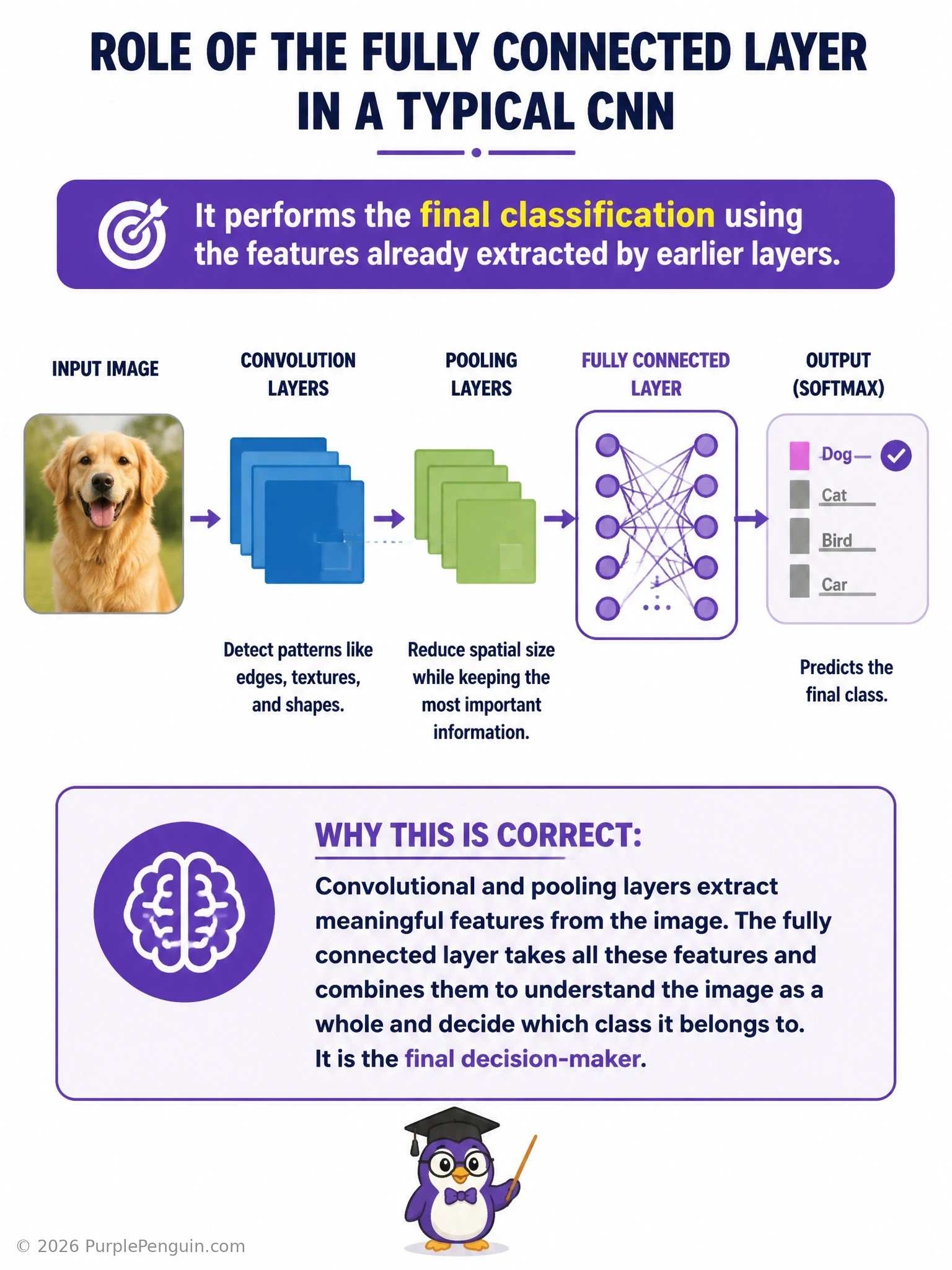
By the time data reaches the fully connected layers, all the heavy lifting of feature extraction is basically done — the convolutional and pooling layers have already turned the raw image into a rich set of high-level features. The fully connected layer's job at that point is to take those extracted features, flattened into a vector, and make the final call: which class does this input belong to? That's it — perform the final classification using the features already extracted by earlier layers. Extracting low-level edges and textures directly from pixels is the convolutional layers' job, way earlier in the pipeline. Downsampling feature maps is what pooling layers do, not fully connected layers. And randomly augmenting training images is a data-preprocessing/augmentation step that happens before the image even enters the network — it's not something any internal layer does.
Full explanation below image
Full Explanation
In a typical convolutional neural network architecture designed for image classification, the convolutional and pooling layers form the feature-extraction backbone: convolutional layers apply learned filters to detect increasingly complex patterns (from simple edges in early layers to complex object parts in deeper layers), while pooling layers progressively downsample the resulting feature maps to reduce spatial dimensions and computational cost while retaining the most salient information. After this feature-extraction pipeline, the resulting feature maps are typically flattened into a single vector and passed into one or more fully connected (dense) layers, whose role is to take these already-extracted, high-level features and perform the final classification task — mapping the feature vector to a probability distribution over the target classes, usually via a softmax activation on the final output layer. The fully connected layers essentially learn the decision boundary in the high-level feature space that the convolutional backbone has produced, combining information from across the entire feature map (rather than local receptive fields) to make a holistic prediction. Extracting low-level edge and texture features directly from raw pixels is explicitly the role of the earliest convolutional layers, not the fully connected layers, which operate only after this feature extraction has already occurred and typically work with abstract, high-level feature representations rather than raw pixel data. Downsampling feature maps to reduce spatial dimensions is the specific role of pooling layers (max pooling or average pooling), which are interspersed with convolutional layers throughout the feature-extraction portion of the network; fully connected layers do not perform any spatial downsampling operation, since by the time data reaches them, it has already been flattened into a non-spatial vector. Randomly augmenting training images to increase dataset diversity describes data augmentation, a preprocessing technique (such as random crops, flips, or rotations) applied to input images before or during training to improve generalization; this occurs entirely outside the network's internal layer computations and is not a function performed by any layer within the CNN itself, including the fully connected layers. Understanding the fully connected layer's role as the final classification stage — built on top of, and dependent on, the feature representations already produced by the convolutional and pooling layers — is essential to understanding the overall division of labor within a standard CNN architecture.