Which of the following is a common real-world application of reinforcement learning?
Select an answer to reveal the explanation.
Short Explanation and Infographic
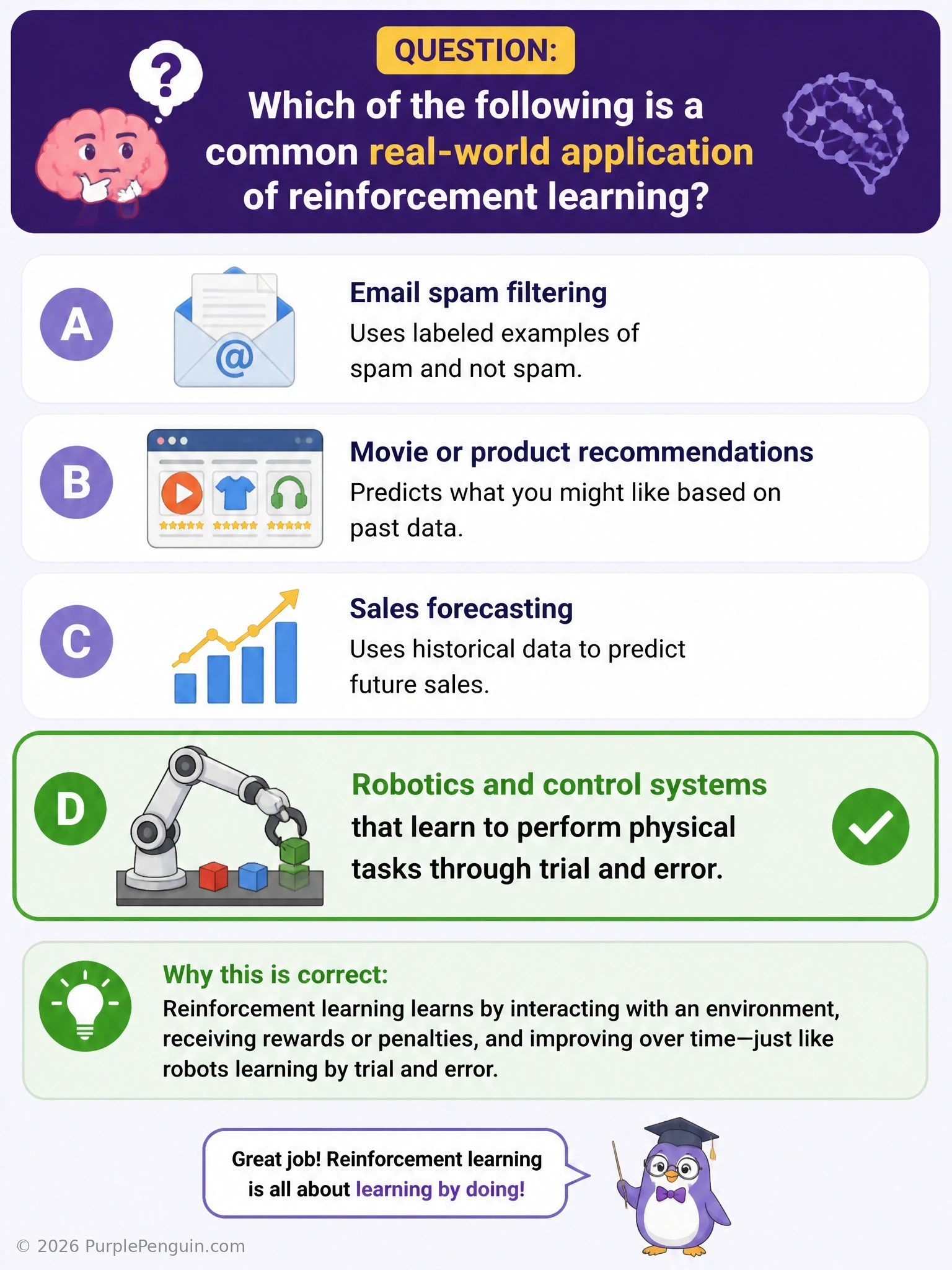
Look for the pattern that screams RL: a sequence of decisions, made over time, in a physical or simulated environment, where getting it right (or wrong) has consequences that show up later. That's exactly what happens in robotics and control systems — a robotic arm learning to grasp objects, or a legged robot learning to walk, is constantly acting, observing the result, and adjusting based on reward. That's textbook RL. Clustering unlabeled tickets is an unsupervised learning task, no sequential decisions or rewards involved. Translating a fixed batch of documents is a supervised or sequence-to-sequence NLP task — it's a one-shot mapping problem, not a decision-and-reward loop. And classifying a static image as cat or dog is straight-up supervised classification, no interaction with an environment at all.
Full explanation below image
Full Explanation
Reinforcement learning is particularly well suited to problems that involve sequential decision-making in an interactive environment, where an agent must learn through trial and error, guided by a reward signal, rather than from a fixed set of labeled examples. Robotics and control systems are among the most common and successful real-world application domains for RL: a robotic arm learning to grasp and manipulate objects, a legged robot learning to walk or run, or an autonomous drone learning to stabilize and navigate all involve an agent taking continuous or discrete actions, observing the resulting state of the physical (or simulated) system, and receiving reward signals (such as successfully completing a task, minimizing energy use, or avoiding falls) that guide the agent toward better control policies over time. This maps naturally onto the RL framework's core structure of states, actions, and rewards, and RL techniques (including policy-gradient methods and actor-critic algorithms) have produced notable successes in simulated and real robotic control tasks. Sorting a list of unlabeled customer support tickets into topic clusters describes an unsupervised learning task — likely using clustering algorithms or topic modeling on static, pre-existing text data — with no sequential interaction, actions, or reward signal involved, making it fundamentally different from an RL problem. Translating a static batch of documents from one fixed language pair describes a supervised, typically sequence-to-sequence NLP task, where a model is trained on paired source-target sentences to minimize a translation loss; this is a one-shot mapping problem applied to a fixed batch of existing text, not a sequential decision process requiring trial-and-error interaction with an environment and delayed reward. Detecting whether a static image contains a cat or a dog is a canonical supervised image classification task, trained on labeled image-label pairs with a straightforward feedforward or convolutional architecture; there is no environment to interact with, no sequence of actions, and no reward signal, so it does not fit the reinforcement learning paradigm at all. Robotics and control remain a defining and widely cited application area for reinforcement learning precisely because these tasks naturally involve an agent that must learn to act correctly over time within a dynamic environment, receiving feedback through consequences rather than explicit labels.