What is the main role of the discriminator in a Generative Adversarial Network (GAN)?
Select an answer to reveal the explanation.
Short Explanation and Infographic
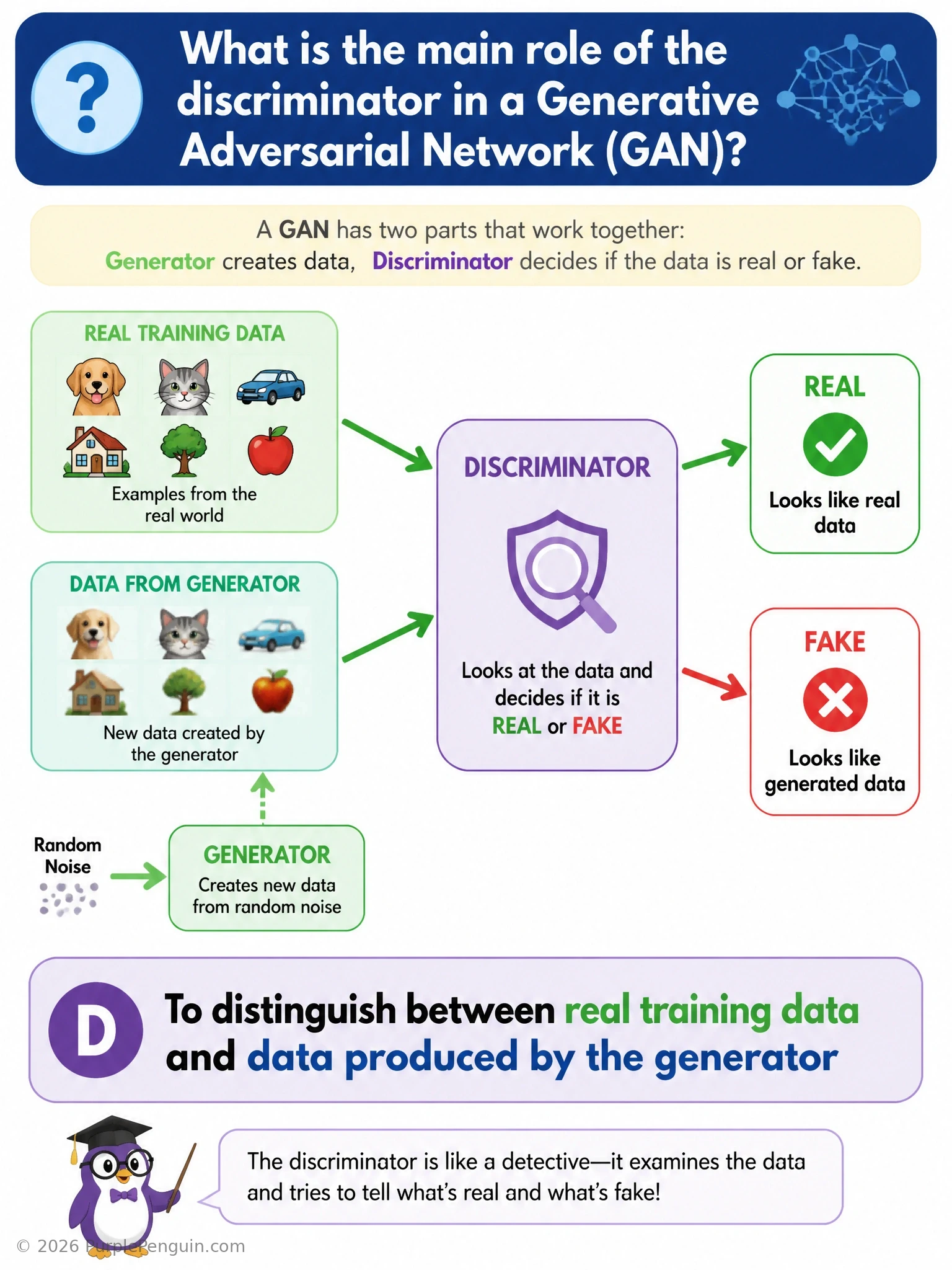
A GAN is basically two networks locked in competition, and each one has a very specific job. The generator's job is to create fakes. The discriminator's job is the opposite: it's the judge, looking at a sample and deciding, 'is this real training data, or something the generator cooked up?' That's the whole role — distinguish between real training data and generator-produced data. Generating new synthetic samples is literally the generator's job, not the discriminator's — don't flip those two. Compressing input into a latent code is what an encoder does, in an autoencoder or VAE, a different architecture entirely with a different goal. And selecting an agent's next action is reinforcement learning vocabulary — that's the policy's job in an RL system, nothing to do with GANs.
Full explanation below image
Full Explanation
In a Generative Adversarial Network, the architecture consists of two competing neural networks trained simultaneously: the generator, which attempts to produce synthetic data samples resembling the real training data, and the discriminator, whose main role is to distinguish between real samples drawn from the actual training dataset and fake samples produced by the generator. The discriminator is typically trained as a binary classifier, outputting a probability that a given input is 'real' versus 'fake,' and its training objective is to maximize its classification accuracy on this real-versus-generated distinction. This creates the adversarial dynamic at the heart of GAN training: as the discriminator improves at telling real from fake, it provides a stronger and more informative gradient signal that pushes the generator to produce increasingly realistic samples in order to keep fooling it, and this back-and-forth competition (formalized as a minimax game) ideally converges toward a generator capable of producing samples indistinguishable from real data, at which point the discriminator's accuracy approaches chance level. Generating new synthetic samples that resemble the training data is explicitly the generator's role, not the discriminator's; conflating the two networks' responsibilities is a common point of confusion, but they perform opposite functions — one creates, the other judges. Compressing input data into a lower-dimensional latent code describes the encoder component of an autoencoder or variational autoencoder, an entirely different generative architecture that does not involve an adversarial real-versus-fake classification game; while some hybrid architectures do combine autoencoder and GAN ideas, the standard discriminator in a vanilla GAN performs classification, not encoding or compression. Selecting which action an agent should take at each time step describes the policy's role within a reinforcement learning framework, a distinct machine learning paradigm centered on sequential decision-making and reward maximization; this concept has no direct correspondence to the discriminator's classification task within a GAN's adversarial training setup. Correctly identifying the discriminator's role as a real-versus-fake classifier — distinct from the generator's data-synthesis role, an autoencoder's compression role, and an RL policy's action-selection role — is fundamental to understanding how adversarial training drives a GAN's generator toward producing increasingly realistic synthetic data.