How does reinforcement learning fundamentally differ from unsupervised learning?
Select an answer to reveal the explanation.
Short Explanation and Infographic
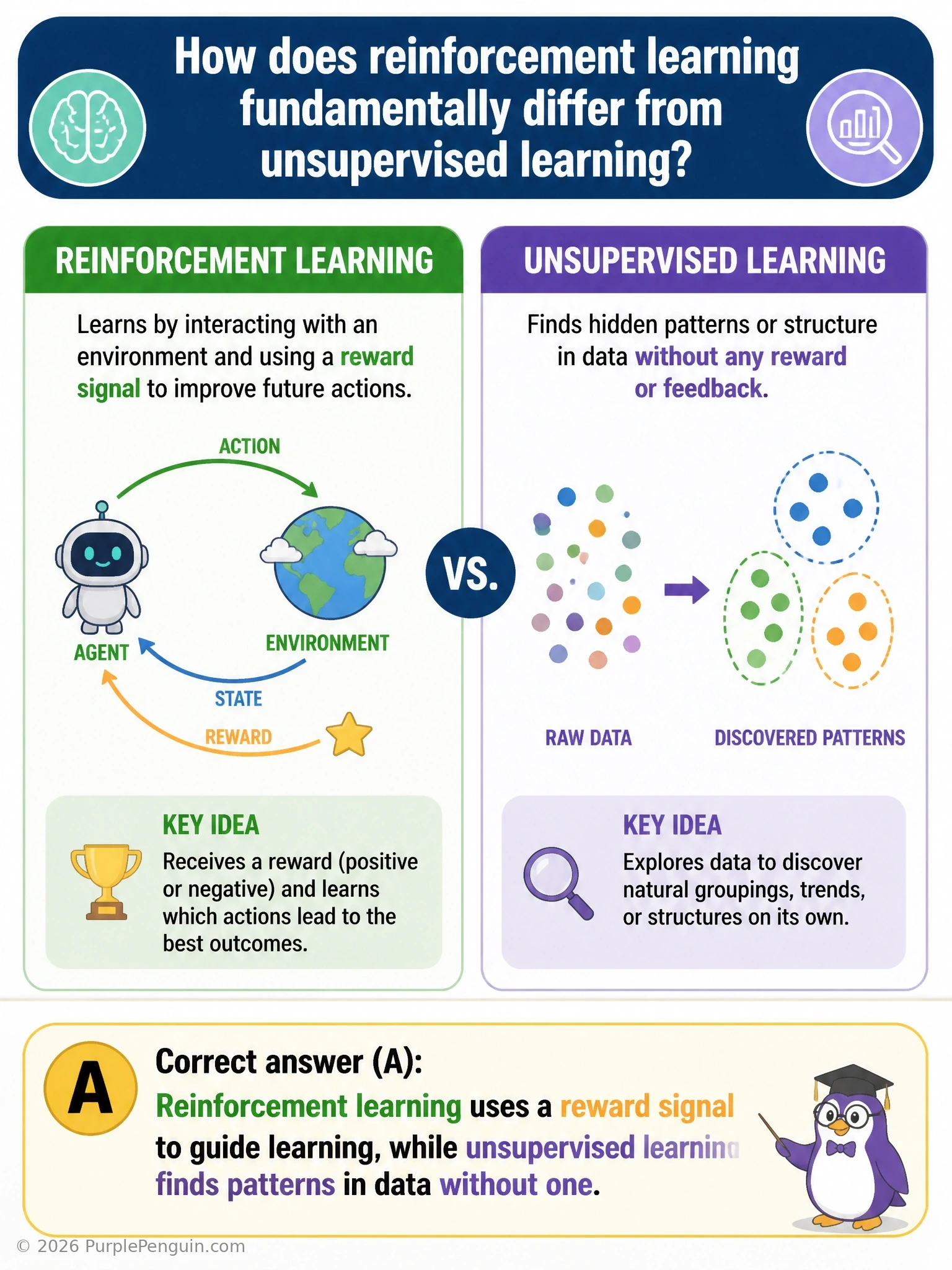
Both of these skip labeled data, which is exactly why people mix them up. But they're solving different problems. Unsupervised learning just looks at a static pile of data and tries to find structure in it — clusters, compressed representations, that sort of thing — with no feedback signal telling it whether it did a good job. Reinforcement learning is dynamic: an agent takes actions in an environment and gets a reward signal telling it how well those actions worked, and it uses that signal to improve over time. That's the real difference: RL uses a reward signal to guide learning, while unsupervised learning finds patterns without one. It's not unsupervised learning that needs an interacting agent — that's backwards, that's RL's defining trait. RL doesn't need fully labeled datasets — that's supervised learning's requirement, not RL's. And unsupervised learning absolutely can be done with neural networks — autoencoders and clustering-oriented deep models are common examples.
Full explanation below image
Full Explanation
The fundamental distinction between reinforcement learning and unsupervised learning lies in the presence and use of a reward signal and the interactive, sequential nature of the learning process. Reinforcement learning involves an agent that interacts with an environment over a sequence of time steps, taking actions and receiving a scalar reward signal that indicates how good or bad the outcome of each action was; the agent's objective is to learn a policy that maximizes cumulative reward over time, which requires reasoning about delayed consequences and the sequential structure of decision-making. Unsupervised learning, by contrast, typically operates on a static dataset without any reward or interactive environment; its goal is to discover underlying structure, patterns, or representations in the data itself — such as clustering similar data points together, reducing dimensionality, or learning a generative model of the data distribution — using only the intrinsic properties of the data, with no external feedback signal analogous to reward guiding the discovery process. Both paradigms share the property of not requiring explicit labeled input-output pairs (unlike supervised learning), which is likely why they are sometimes conflated, but the presence of a reward signal driving sequential decision optimization is unique to reinforcement learning and absent from unsupervised learning. The first distractor, claiming unsupervised learning requires an agent interacting with an environment over time, reverses the actual relationship — this interactive, temporally extended structure is a defining characteristic of reinforcement learning, not unsupervised learning, which typically processes data that already exists rather than data generated through ongoing interaction. The second distractor, claiming reinforcement learning always requires fully labeled datasets, is incorrect and describes supervised learning's requirement instead; RL explicitly does not require labeled 'correct action' data, learning instead from reward feedback obtained through interaction, which is one of RL's key advantages in domains where labeling the correct action for every state is impractical or impossible. The third distractor, claiming unsupervised learning cannot be implemented using neural networks, is factually false — autoencoders, deep clustering models, self-organizing maps implemented with neural structures, and generative models like GANs and VAEs are all common neural-network-based approaches to unsupervised learning tasks. Correctly identifying the reward signal and sequential agent-environment interaction as the defining features that separate reinforcement learning from unsupervised learning is essential to avoid conflating these two distinct machine learning paradigms.