A team wants to compress a large set of unlabeled images into compact representations and later reconstruct them, without using any labeled data. Which architecture is the standard choice?
Select an answer to reveal the explanation.
Short Explanation and Infographic
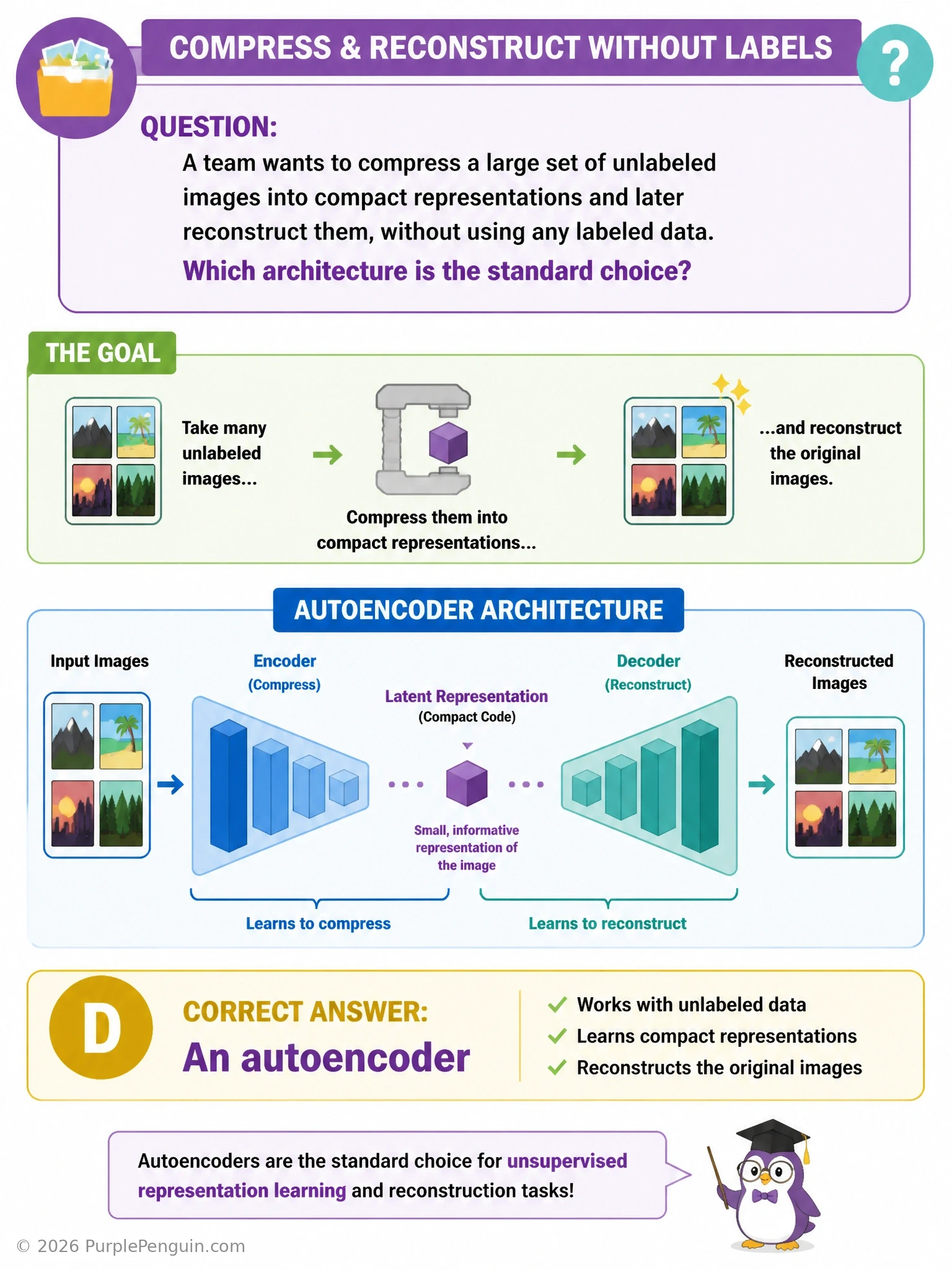
This is the textbook use case for an autoencoder. You've got an encoder that squeezes each image down into a small latent vector — that's your compression — and a decoder that takes that compact vector and rebuilds the original image from it — that's your reconstruction. The whole thing trains just by comparing its own output to its own input, no labels required, which is exactly what the task calls for. A GAN's discriminator is built to answer one narrow question, real or fake, and isn't designed for general compression and reconstruction. A supervised classification CNN needs labels to train on cross-entropy loss, and this task explicitly says there are none. And a Q-learning agent solves sequential decision problems with rewards — there's no notion of 'compress an image' inside that framework at all.
Full explanation below image
Full Explanation
For the task of compressing unlabeled images into compact representations and later reconstructing them, the standard deep learning architecture is the autoencoder. An autoencoder consists of two parts: an encoder network that maps a high-dimensional input (such as an image) down to a lower-dimensional latent representation (the 'bottleneck'), and a decoder network that takes that compressed representation and attempts to reconstruct the original input as closely as possible. The entire model is trained end-to-end using a reconstruction loss (commonly mean squared error or binary cross-entropy comparing input pixels to reconstructed output pixels), which requires no labels whatsoever — the input itself serves as its own training target, making this a fully unsupervised (or more precisely, self-supervised) learning setup. Because the bottleneck forces the network to learn a compact, information-dense representation of the input in order to minimize reconstruction error, the encoder's output naturally serves as a compressed version of the original image, and the decoder can regenerate an approximation of the original from that compressed code — precisely matching the described requirement. A discriminator network from a GAN is trained solely to classify inputs as real or generated (fake), a binary classification objective with an entirely different purpose; it is not designed with an encoder-decoder structure for compressing and reconstructing arbitrary input data and would not naturally serve this compression/reconstruction role. A supervised image classification CNN requires labeled examples to compute a supervised loss (such as cross-entropy against ground-truth class labels); since the scenario explicitly specifies an absence of labeled data, this approach cannot be directly applied without first obtaining external labels, making it unsuitable for the stated unsupervised compression task. A Q-learning agent is designed to learn value estimates for actions in a sequential decision-making environment governed by states, actions, and rewards; there is no natural way to frame static image compression and reconstruction as a Markov Decision Process, so this architecture does not address the described problem at all. The autoencoder's unsupervised, self-referential training objective — reconstructing its own input through a compressed bottleneck — is precisely why it remains the standard architecture for unsupervised compression and reconstruction tasks across images, audio, and other high-dimensional data.