In Q-learning, what does the Q-value Q(s, a) represent?
Select an answer to reveal the explanation.
Short Explanation and Infographic
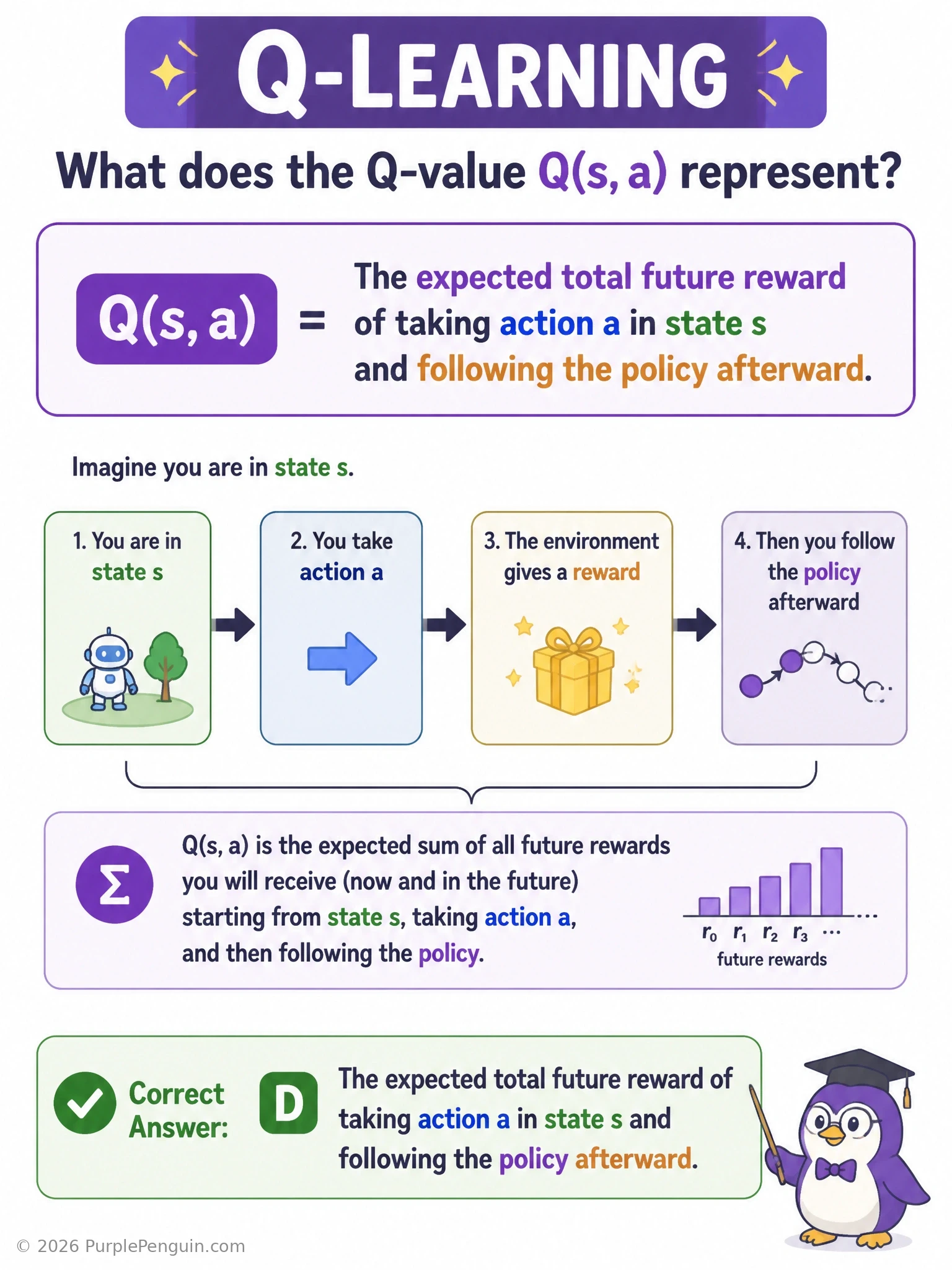
Don't confuse the Q-value with just the reward you get right now — it's bigger picture than that. Q(s, a) is asking: 'if I take this action right now in this state, and then keep playing smart from here on out, how much total reward can I expect to rack up, discounted for the future?' That's it: the expected total future reward of taking action a in state s and following the policy afterward. It's not just the immediate reward — that's only one small piece feeding into the Q-value, not the whole thing. It's not a probability of correctness either — Q-learning isn't classification, there's no 'correct label' concept here. And it's definitely not a visit counter — how many times you've tried an action might influence exploration strategies like UCB, but that count itself isn't what the Q-value represents.
Full explanation below image
Full Explanation
In Q-learning and value-based reinforcement learning more broadly, the Q-value, written Q(s, a), represents the expected cumulative (discounted) future reward an agent can obtain by taking action a while in state s, and then continuing to act according to a given policy (typically the optimal policy, in the case of the optimal Q-function Q*) thereafter. Formally, it captures not just the immediate reward from the current action but the entire expected return over the remaining trajectory, discounted by a factor gamma that weights near-term rewards more heavily than distant ones. This is precisely why Q-learning uses a bootstrapped update rule (the Bellman equation) that combines the immediate reward with the discounted estimate of the best Q-value achievable from the next state, allowing the Q-function to represent long-term value rather than just a single-step payoff. Once learned accurately, the optimal policy can be derived simply by choosing, in each state, the action with the highest Q-value — this is the foundation of how Q-learning solves control problems. The first distractor, the immediate reward received the moment action a is taken, describes only the reward signal r(s,a) itself, which is just one term used in computing the Q-value update, not the full quantity the Q-value represents; conflating the two ignores the entire future-reward component that makes Q-learning useful for long-horizon decision-making. The second distractor, the probability that action a is the correct label for state s, imports supervised-learning/classification vocabulary ('correct label') into a context where it does not apply; Q-learning does not operate on labeled 'correct actions,' and Q-values are real-valued reward estimates, not classification probabilities. The third distractor, the number of times action a has been selected during training, describes a visitation count, which some exploration strategies (like upper-confidence-bound exploration or count-based exploration bonuses) use to encourage trying under-explored actions, but this count is a separate bookkeeping quantity from the Q-value itself, which represents expected return, not visitation frequency. Correctly understanding the Q-value as an estimate of long-term expected return, not just an immediate reward or an unrelated statistic, is essential to understanding how Q-learning, and value-based reinforcement learning generally, derives its policies.