What is the main goal of transfer learning in deep learning?
Select an answer to reveal the explanation.
Short Explanation and Infographic
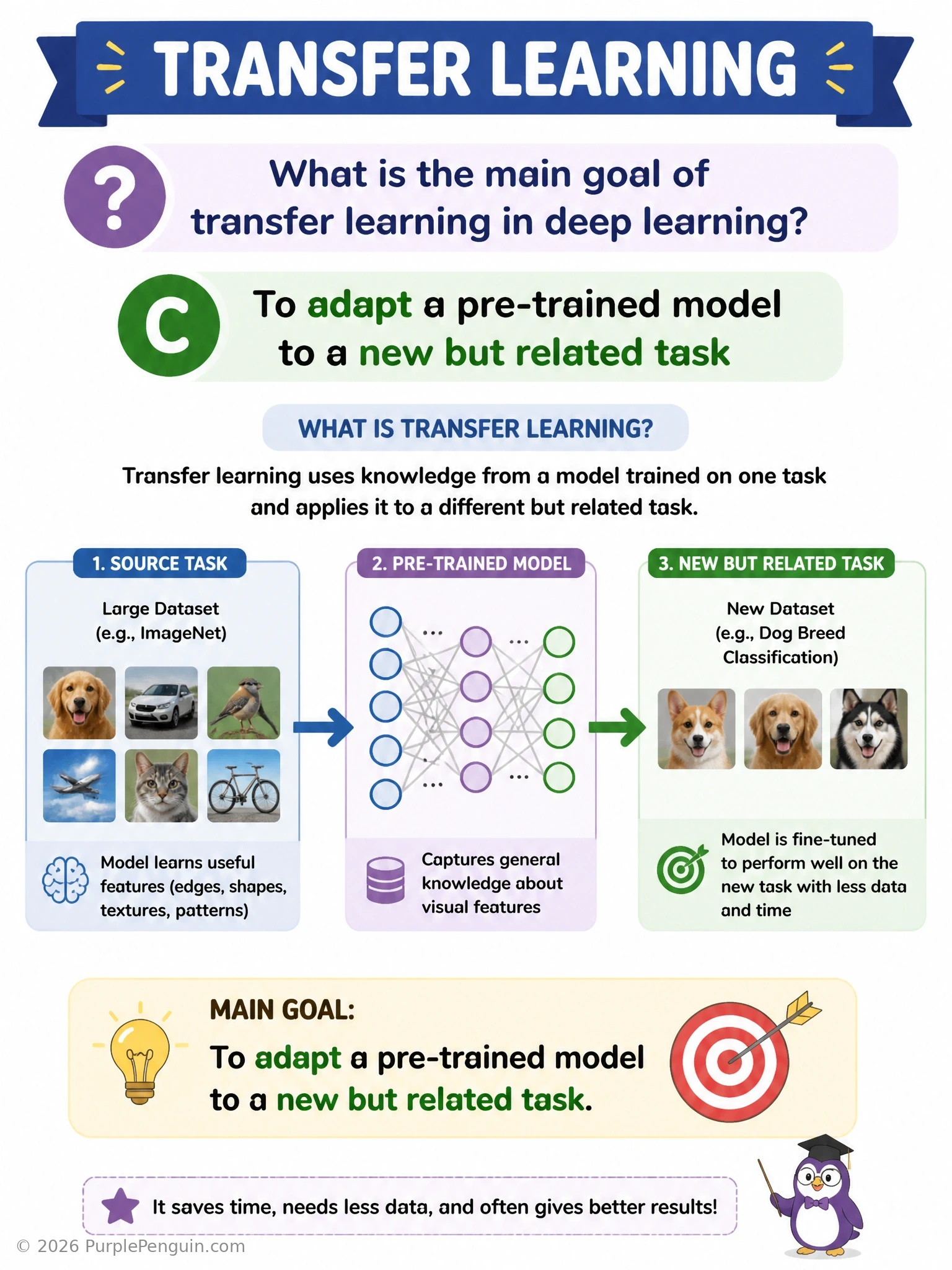
Transfer learning is all about not reinventing the wheel. You've got a model that already learned useful, general features on some big dataset — think a CNN trained on millions of ImageNet photos — and instead of starting from zero on your new, often smaller, task, you take that pre-trained model and adapt it: maybe fine-tune the whole thing, maybe just retrain the last few layers. The goal is simple: adapt a pre-trained model to a new but related task. Training completely from scratch every time is actually the opposite of what transfer learning is trying to avoid — that's slow and often needs way more data than you have. Compressing a model's file size is a separate concern, usually called model compression, quantization, or pruning — not what transfer learning is about. And generating synthetic labels for unlabeled data is more of a semi-supervised or self-supervised learning concept, a different tool for a different problem.
Full explanation below image
Full Explanation
Transfer learning is a deep learning technique whose main goal is to take a model already trained on one task (often a large, general dataset such as ImageNet for vision or a massive text corpus for NLP) and adapt it to perform well on a new, but related, task, typically one with a smaller amount of task-specific labeled data. The intuition is that the features learned by the pre-trained model — such as edge detectors, textures, and shape representations in early CNN layers, or general syntactic and semantic language patterns in NLP models — are broadly useful and transferable across related tasks, so reusing them saves substantial training time, computational resources, and labeled data compared to training a new model from scratch. In practice, transfer learning is implemented either by fine-tuning the entire pre-trained network's weights on the new task's data (usually with a lower learning rate) or by freezing most of the pre-trained layers and only training a new task-specific head (e.g., a new final classification layer), depending on how similar the new task is and how much new data is available. Training a brand-new model completely from scratch for every new task describes the opposite approach, one that transfer learning is specifically designed to avoid, since training from scratch is typically far more data-hungry and computationally expensive, and often yields worse results when task-specific data is limited. Compressing a trained model's weights into a smaller file size for deployment describes model compression techniques such as pruning, quantization, or knowledge distillation, which address deployment efficiency and inference speed/size concerns; while these techniques can be applied to models regardless of whether they were transfer-learned, compression is a distinct goal from adapting knowledge across tasks. Generating synthetic labels for an entirely unlabeled dataset describes self-supervised or semi-supervised learning techniques (such as pseudo-labeling or contrastive pretraining objectives), which address the problem of learning useful representations or labels without full supervision; this is a related but different concept from transfer learning, which specifically involves reusing knowledge from one already-trained model on a new task, and does not inherently involve generating labels for other unlabeled data. Recognizing transfer learning's core value proposition — leveraging pre-trained representations to accelerate learning on a new but related task with less data — is essential for understanding why it has become a standard practice in modern deep learning workflows, from computer vision to large language model fine-tuning.