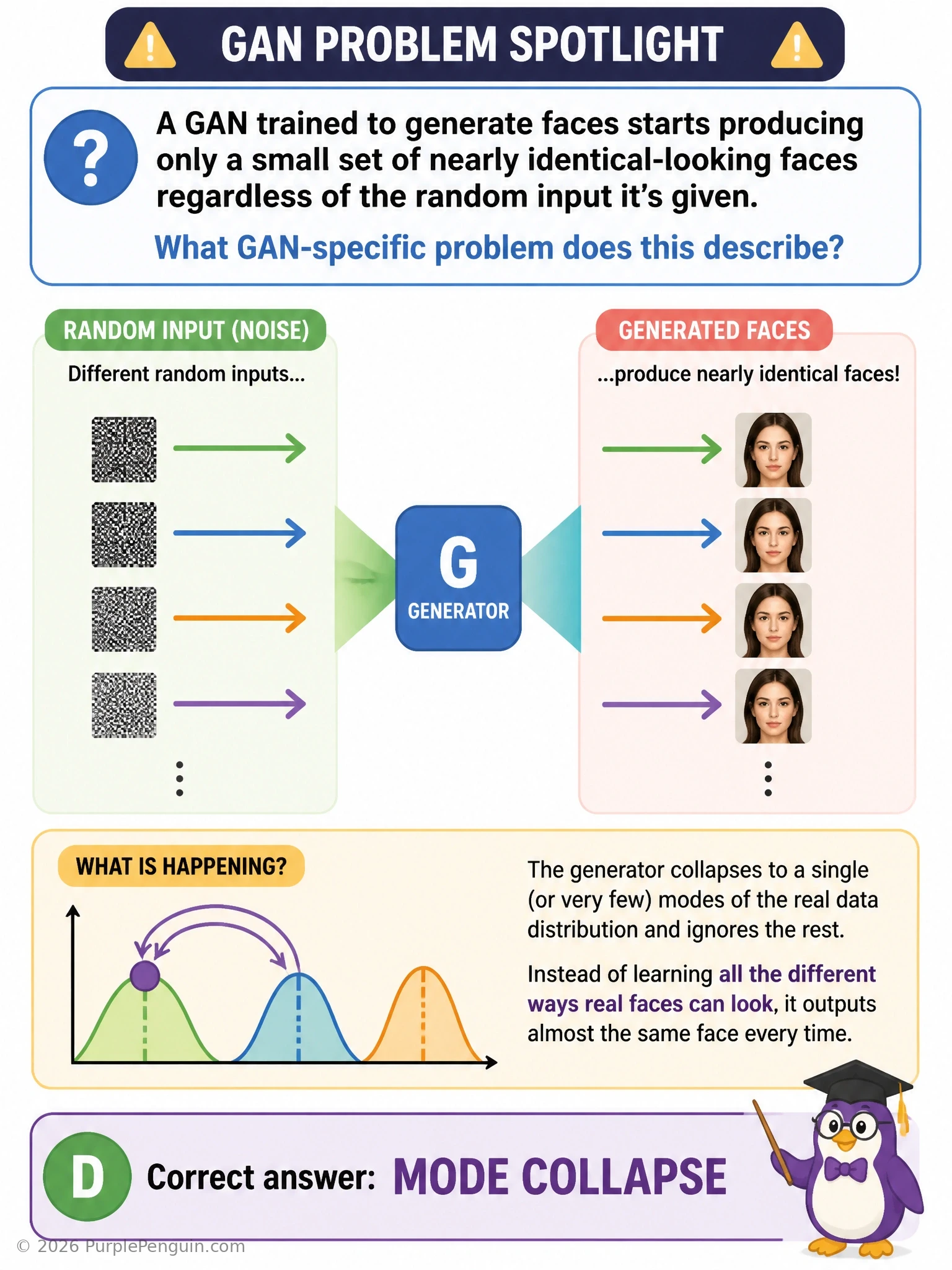
A GAN trained to generate faces starts producing only a small set of nearly identical-looking faces regardless of the random input it's given. What GAN-specific problem does this describe?
Select an answer to reveal the explanation.
Short Explanation and Infographic
Same story every time this happens: the generator found a narrow set of outputs that consistently fool the discriminator, and it just camps out there instead of covering the full diversity of real faces it's supposed to be learning to produce. That's mode collapse — the generator collapses onto a limited number of modes of the true data distribution and stops exploring the rest. Exploding gradients is a numerical-stability issue where gradients blow up in magnitude during training, usually associated with deep or recurrent networks — it causes unstable, erratic training, not repetitive-but-stable output. Underfitting from insufficient capacity would show up as generally poor, blurry, low-quality output across the board, not a narrow repeated set of otherwise decent-looking faces. And label leakage is a data-contamination issue relevant to supervised learning where test information leaks into training — it has nothing to do with a GAN generator's output diversity.
Full explanation below image
Full Explanation
This scenario describes mode collapse, a well-documented failure mode specific to Generative Adversarial Network training. Mode collapse occurs when the generator discovers a small subset of outputs (or in extreme cases, a single output) that reliably deceives the current discriminator, and because the adversarial minimax objective does not explicitly reward output diversity, the generator has little incentive to continue exploring the rest of the true data distribution once it has found these 'safe' outputs. The result is exactly as described: regardless of the variation in the input noise vector z, the generator produces a narrow set of nearly identical samples, failing to capture the full diversity present in the real training data (in this case, the wide variety of real human faces). This is considered a core training instability of the original GAN formulation and has motivated numerous mitigations, including minibatch discrimination, unrolled GANs, feature matching, and alternative formulations such as Wasserstein GAN, which provide more stable gradients and better coverage of the data distribution. Exploding gradients describes a distinct numerical instability where gradient magnitudes grow uncontrollably during backpropagation, typically associated with deep or recurrent architectures and often mitigated with gradient clipping; this produces erratic, diverging training behavior rather than the specific symptom of a narrow, repetitive but stable set of generated outputs, so it does not match the described scenario. Underfitting due to insufficient model capacity would manifest as generally poor-quality, unrealistic, or blurry generated samples across the board because the model lacks the representational power to capture the data distribution at all, rather than the more specific symptom of confidently producing a small number of realistic-looking but repetitive samples — the described scenario specifically involves lack of diversity, not lack of quality. Label leakage refers to a data-contamination problem in supervised learning pipelines where information from the target labels (or test set) inadvertently influences training, leading to misleadingly optimistic performance metrics; this concept is not applicable to a GAN's unsupervised generator-discriminator training dynamic and has no established relationship to output diversity collapse. Recognizing mode collapse and distinguishing it from other training pathologies like exploding gradients or general underfitting is essential for correctly diagnosing GAN training issues.