A data science team has a large collection of unlabeled images and wants a deep learning model to help group similar images together. Which type of model is commonly used for this?
Select an answer to reveal the explanation.
Short Explanation and Infographic
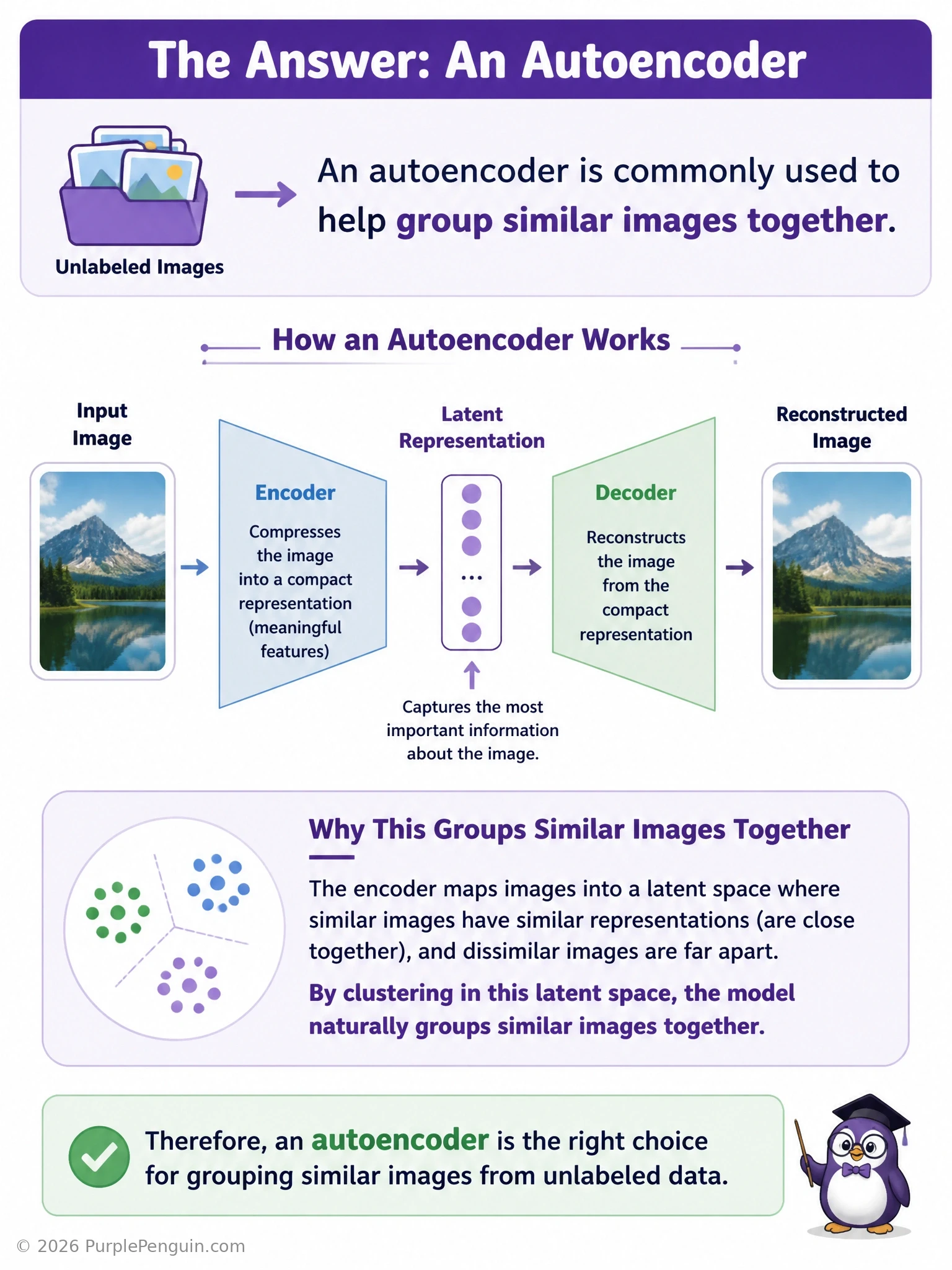
No labels means you can't just throw a standard supervised classifier at this — cross-entropy loss needs ground-truth class labels, and you don't have any. What you can do is train an autoencoder to compress each image down into a compact latent representation, and then run a clustering algorithm like k-means on those learned embeddings, since similar images tend to land near each other in that latent space. That's the standard unsupervised play here. A discriminator alone is just a binary real/fake classifier from GAN training — not built for general-purpose clustering. A supervised CNN needs labels it doesn't have. And a policy-gradient RL agent is solving a totally different kind of problem — sequential decision-making with rewards, not grouping static unlabeled images.
Full explanation below image
Full Explanation
When faced with a large set of unlabeled images that need to be grouped by similarity, a common deep learning approach is to use an autoencoder to learn a compact, informative latent representation of each image in a purely unsupervised manner. The autoencoder consists of an encoder that compresses each input image into a lower-dimensional latent vector and a decoder that attempts to reconstruct the original image from that vector; training minimizes reconstruction error, requiring no class labels at all. Once trained, the latent vectors (embeddings) produced by the encoder tend to place visually or semantically similar images closer together in the latent space, which makes them well suited as input features to a conventional clustering algorithm such as k-means, DBSCAN, or hierarchical clustering — this overall approach is often called deep clustering or autoencoder-based clustering, and variants exist that jointly optimize reconstruction and clustering objectives together. A discriminator network trained only to output real-or-fake labels is a component specific to GAN training, whose sole purpose is binary classification of real versus generated samples during adversarial training; it is not designed to produce general-purpose embeddings for arbitrary image similarity grouping, and using it for clustering unlabeled, non-adversarial image data would be a misapplication of its intended function. A supervised CNN trained with cross-entropy loss on class labels fundamentally requires labeled data to compute its loss function; since the premise here explicitly states the images are unlabeled, this approach is not applicable without first obtaining labels through some other means (such as manual annotation), which defeats the purpose of an unsupervised clustering solution. A policy-gradient reinforcement learning agent is designed to learn a sequence of actions that maximize cumulative reward in an interactive environment; it has no natural formulation for offline, static image grouping, since there is no environment, action space, or reward function inherent to the task of clustering a fixed image dataset. The autoencoder's ability to learn useful, compressed, unsupervised representations directly from raw data — without any labels — is exactly why it remains a go-to architecture for unsupervised tasks like clustering, anomaly detection, and dimensionality reduction.