What is the main role of the convolutional layer in a CNN?
Select an answer to reveal the explanation.
Short Explanation and Infographic
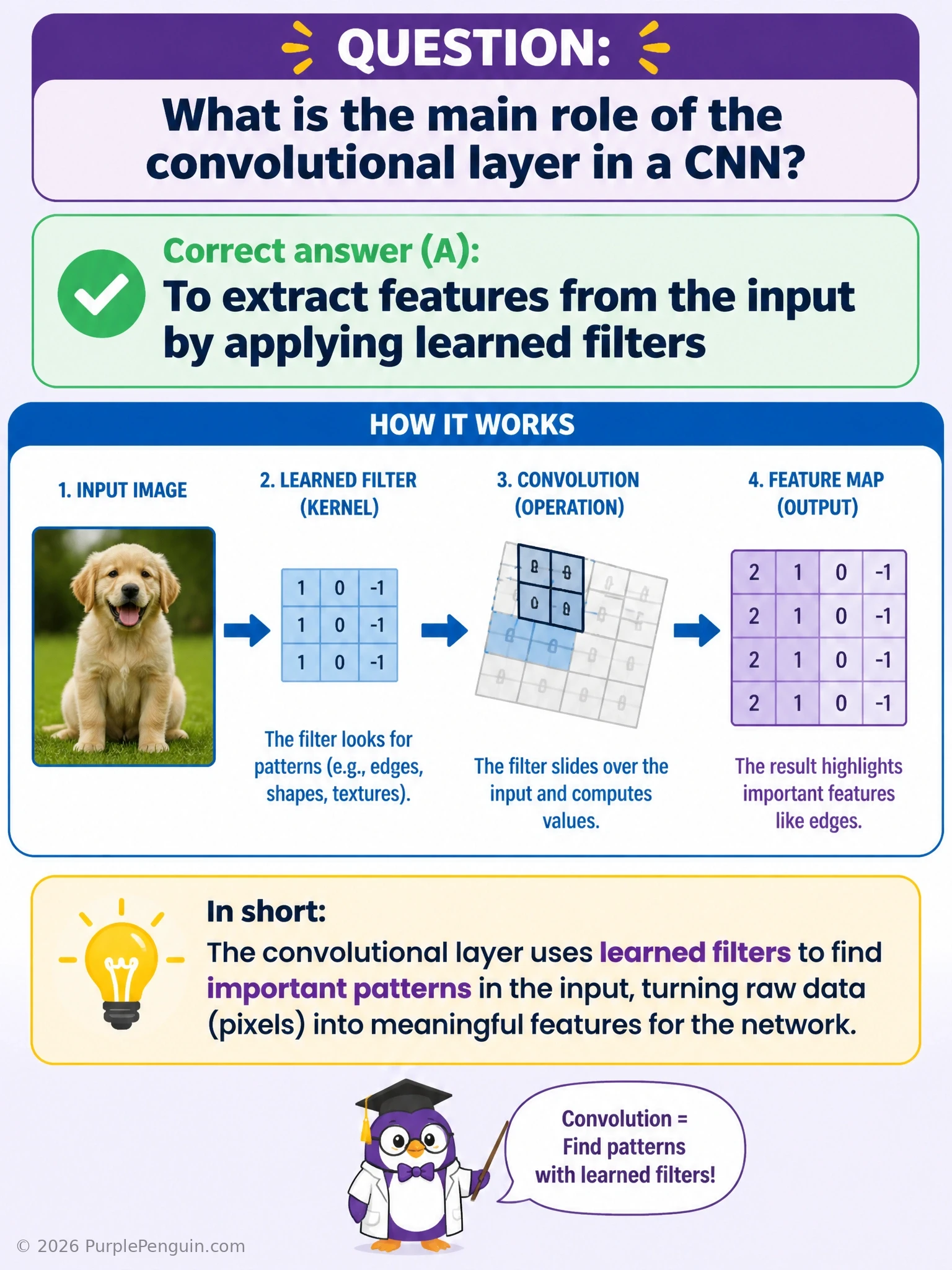
The convolutional layer is where all the actual feature detection happens. It slides small learned filters across the input, and each filter lights up when it finds the pattern it's tuned for — an edge, a curve, a texture, and in deeper layers, more complex shapes built from those simpler ones. So its main role is straightforward: extract features from the input. Randomly dropping neurons is dropout, a totally separate regularization trick, not something the conv layer itself does. Normalizing pixel values into a fixed range is a preprocessing step (or batch normalization, if it's mid-network) — again, not the conv layer's job. And flattening the feature map into a vector is something that typically happens later, right before it's handed off to fully connected layers for classification — the conv layer's output is still a spatial feature map, not a flattened vector.
Full explanation below image
Full Explanation
The convolutional layer is the fundamental building block of a convolutional neural network, and its primary role is to extract features from the input data by applying a set of learnable filters (kernels) that slide across the input via the convolution operation. Each filter is trained to detect a specific pattern — early layers typically learn to detect simple, low-level features such as edges, corners, or color gradients, while deeper layers combine these into progressively more complex, higher-level features such as textures, shapes, or object parts. The output of a convolutional layer is a set of feature maps, each representing the spatial response of one learned filter across the input, and because the same filter weights are applied at every spatial location (parameter sharing), the layer can detect a given feature regardless of where it appears in the image. The first distractor, randomly dropping a fraction of neurons during training, describes dropout, a regularization technique applied as a separate layer (or operation) specifically to reduce overfitting by preventing co-adaptation of neurons; dropout is unrelated to feature extraction and is not a defining function of the convolutional layer itself. The second distractor, normalizing pixel values to a fixed range, describes a data preprocessing step (such as min-max scaling or standardization) typically performed before training, or alternatively describes batch normalization, a separate layer type inserted to stabilize and speed up training by normalizing activations; neither of these is the convolutional layer's core purpose, which is feature detection via learned filters, not value normalization. The third distractor, flattening the multi-dimensional feature map into a single vector, describes the flatten operation that typically occurs later in a CNN architecture, just before the fully connected (dense) layers that perform final classification; this reshaping step is distinct from and happens after the convolutional (and pooling) layers have done their feature-extraction work, and is not something the convolutional layer itself performs. Understanding that the convolutional layer's defining role is learned, spatially-shared feature extraction is foundational to understanding why CNNs are effective for image-based tasks and how their hierarchical feature learning differs from fully connected architectures.