For an image classification task, why is max pooling often preferred over average pooling?
Select an answer to reveal the explanation.
Short Explanation and Infographic
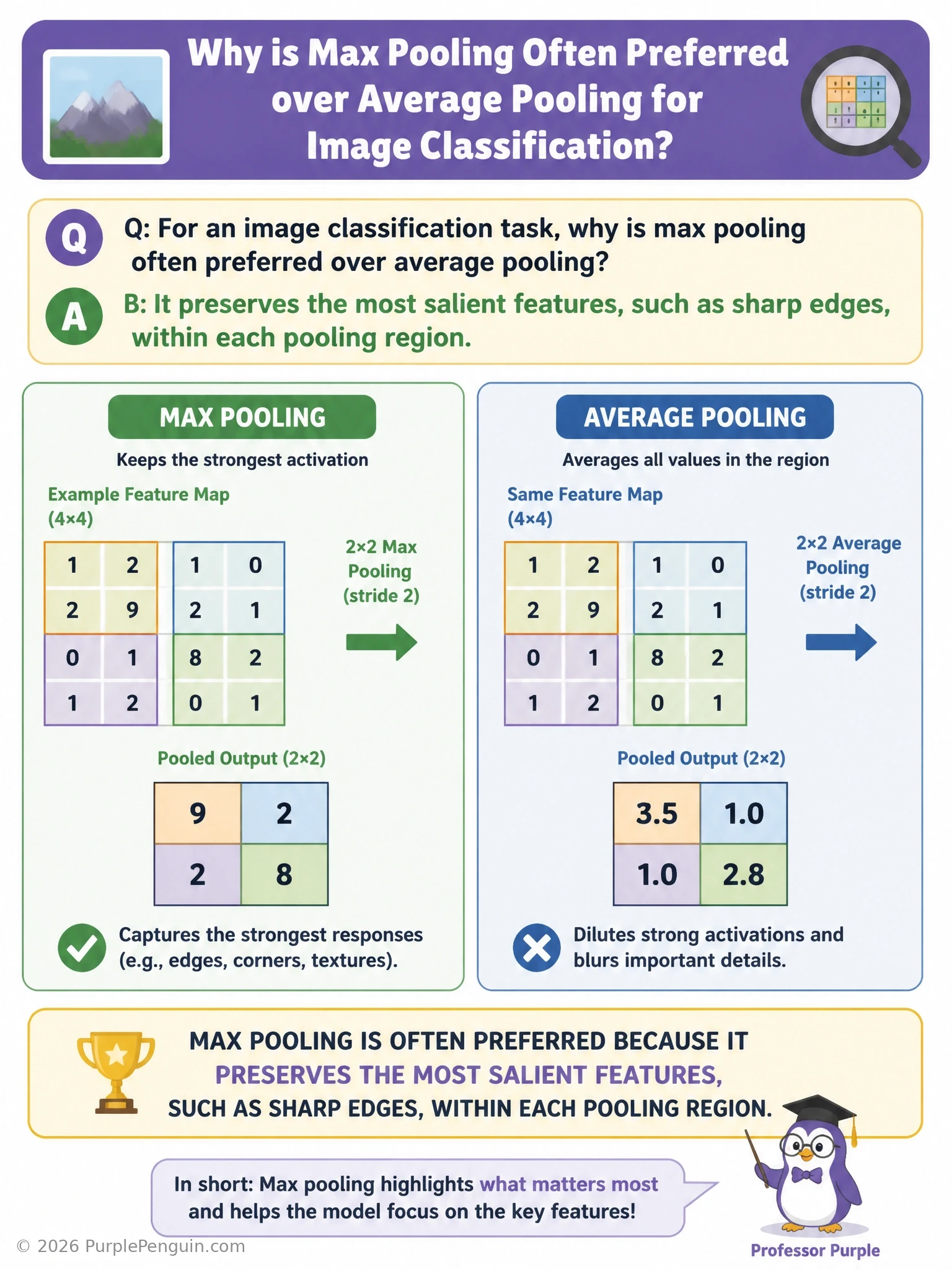
Here's the intuition: in each little patch the pooling window looks at, max pooling just grabs the strongest activation — the loudest signal, like a sharp edge or a strong texture response — and throws away the rest. That tends to keep the features that actually matter for telling classes apart. Average pooling, on the other hand, blends everything in the patch together, which can water down a strong, distinctive activation by mixing it with weaker neighboring values. So the real reason max pooling often wins for classification: it preserves the most salient features, like sharp edges, within each region. It doesn't increase spatial dimensions — pooling of any kind downsamples, it doesn't upsample. It doesn't remove the need for conv layers — pooling and convolution are complementary, not substitutes. And no pooling method 'guarantees' no overfitting; that's just not how any single architectural choice works.
Full explanation below image
Full Explanation
Max pooling and average pooling are both downsampling operations applied after convolutional layers to reduce the spatial dimensions of feature maps while retaining important information, but they differ in how they summarize each pooling window. Max pooling takes the maximum activation value within each local region, which tends to preserve the strongest, most salient responses — such as a sharp edge, a corner, or a strongly activated texture pattern — since these high-activation signals are exactly what survive the max operation. This makes max pooling particularly effective for classification tasks, where the presence of a strong, distinctive feature (rather than its average intensity across a neighborhood) is often what is most informative for distinguishing between classes. Average pooling, by contrast, computes the mean of all values in the pooling window, which can dilute a strong localized activation by averaging it together with lower, less informative neighboring values, potentially smoothing out or weakening the very signal that would have been most useful for classification. Max pooling also introduces a degree of translation invariance to small shifts, similar to how strong features remain detected even if their exact position within the pooling window varies slightly. The first distractor, increasing spatial dimensions, is incorrect because pooling operations (max or average) are inherently downsampling operations that reduce, not increase, the height and width of feature maps; any spatial upsampling would instead require operations like transposed convolutions or interpolation, which are unrelated to pooling's purpose. The second distractor, eliminating the need for convolutional layers, misunderstands the relationship between pooling and convolution: pooling layers are typically interspersed with convolutional layers to progressively downsample feature maps while convolutional layers continue extracting features at each resolution; pooling does not replace or remove the need for convolution. The third distractor, guaranteeing no overfitting, is an overstatement no single architectural component can deliver; overfitting depends on many factors including model capacity, dataset size, regularization, and training procedure, and no pooling strategy alone provides such a guarantee. While average pooling remains useful in certain contexts (such as global average pooling before a final classification layer, which reduces parameters and can improve generalization), max pooling's tendency to retain the strongest local activations is the standard reasoning for preferring it in intermediate layers of classification-focused CNNs.