In an actor-critic reinforcement learning algorithm, what is the goal of the actor component?
Select an answer to reveal the explanation.
Short Explanation and Infographic
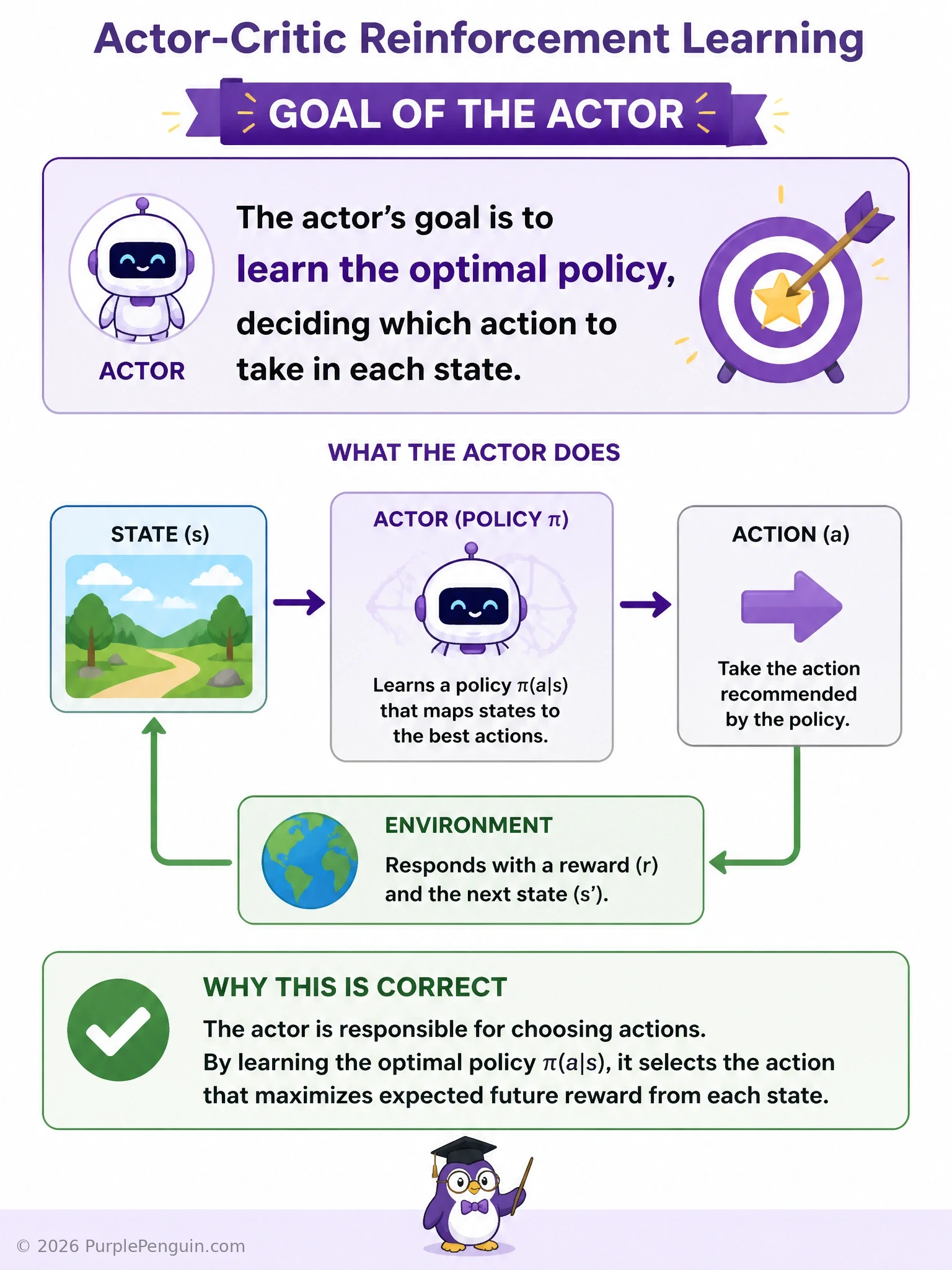
In actor-critic, think of it like a two-person team: the actor is the one actually making the moves, and the critic is the one watching and giving feedback. The actor's job, specifically, is to learn the optimal policy — deciding which action to take given the current state — and it updates that policy using guidance from the critic. Estimating the value function is the critic's job, not the actor's; don't mix those two up. Generating synthetic rewards isn't a thing either — rewards come from the environment, full stop, in standard RL. And discriminating between real and generated samples is a GAN concept, borrowed vocabulary that has nothing to do with actor-critic RL.
Full explanation below image
Full Explanation
Actor-critic methods combine the strengths of policy-based and value-based reinforcement learning by using two separate (though often jointly trained) components: the actor and the critic. The actor is the policy component — it is parameterized (commonly by a neural network) and its goal is to learn the optimal policy, meaning it decides, given the current state, which action to take (or outputs a probability distribution over actions in the stochastic case). The actor is updated using a policy-gradient-style update, but instead of relying solely on raw returns (which can be high-variance, as in vanilla REINFORCE), it uses feedback from the critic to reduce variance and provide a more informative and stable learning signal. The critic, by contrast, estimates a value function — typically the state-value function V(s) or the action-value function Q(s,a), or an advantage function — which quantifies how good the current state (or state-action pair) is under the current policy; this value estimate is what the actor uses to judge whether its chosen actions were better or worse than expected. Estimating the value function to judge how good a state is describes the critic's role, not the actor's, so attributing this to the actor is a direct role reversal and one of the most common points of confusion for newcomers to actor-critic methods. Generating synthetic reward signals when the environment provides none is not a function of the actor (or of any part of a standard actor-critic algorithm); reward signals are supplied externally by the environment, and if rewards are sparse, this is typically addressed with reward shaping or intrinsic motivation techniques, not by fabricating rewards within the actor. Discriminating between real and generated training samples describes the discriminator's role in a Generative Adversarial Network, a distinct architecture from reinforcement learning entirely, and has no functional overlap with the actor's role of action selection. Correctly distinguishing the actor's role (policy/action selection) from the critic's role (value estimation/evaluation) is essential to understanding how actor-critic algorithms like A2C, A3C, DDPG, and PPO are structured and trained.