What is the main strength of reinforcement learning compared with supervised learning?
Select an answer to reveal the explanation.
Short Explanation and Infographic
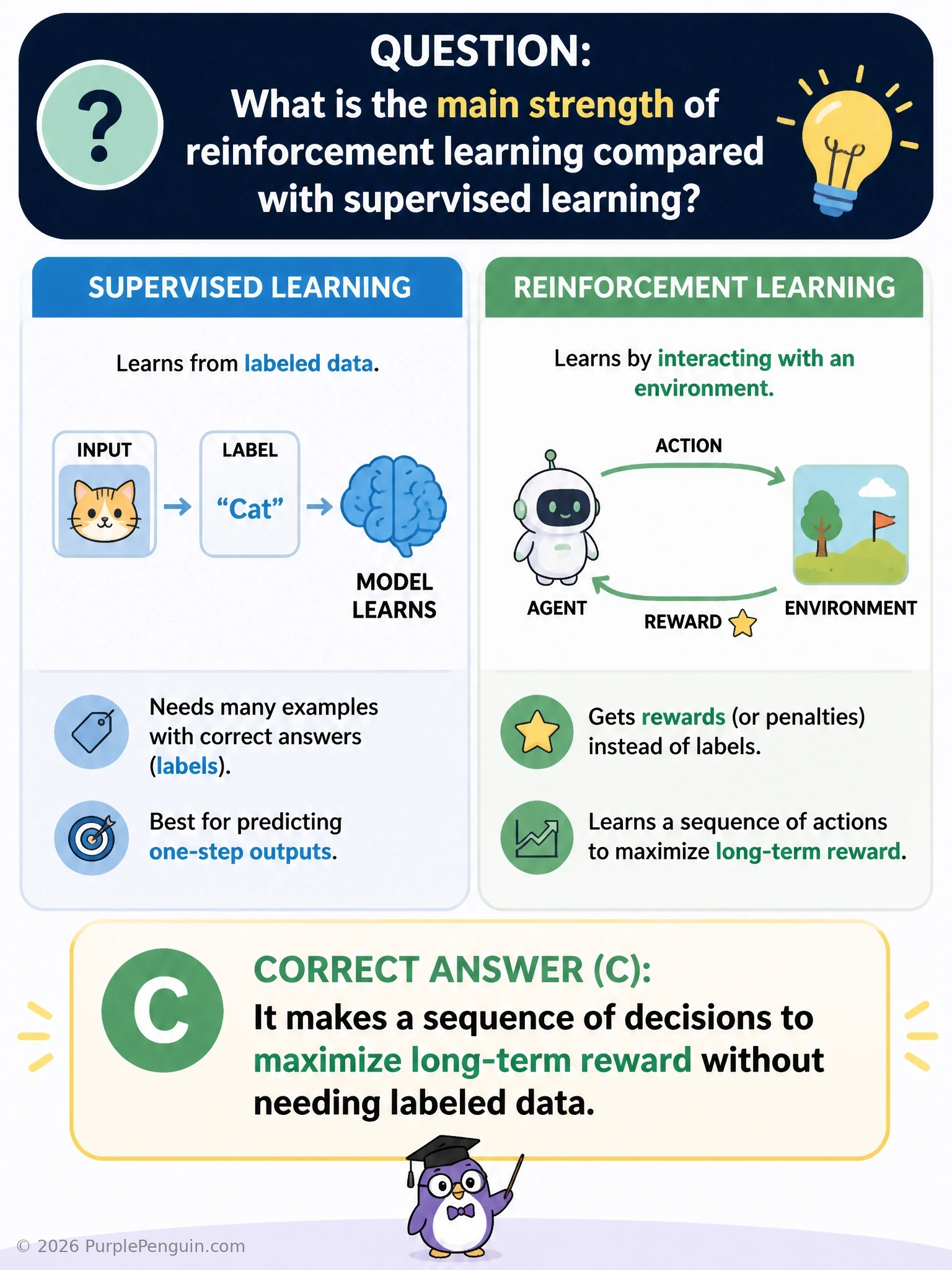
The big selling point of RL is that nobody has to sit there labeling 'correct action' for every possible situation. Instead, the agent just acts, gets a reward signal back, and figures out over time which sequences of decisions lead to the best long-run payoff. That's the strength: making a sequence of decisions to maximize long-term reward without labeled data. Supervised learning flips that — it absolutely needs labeled examples, so saying RL 'requires a large hand-labeled dataset' actually describes the thing RL is trying to avoid. There's no guarantee of a global optimum in one pass either — RL usually takes lots of trial and error, sometimes millions of episodes. And RL is actually built for sequential, dynamic decision-making, the opposite of being limited to static datasets.
Full explanation below image
Full Explanation
Reinforcement learning's defining strength is its ability to learn a sequence of decisions — a policy — that maximizes cumulative long-term reward through trial-and-error interaction with an environment, without requiring a labeled dataset of 'correct' actions for every state. This makes RL particularly well suited to problems where the optimal action isn't known in advance or is difficult for a human to specify, but where a scalar reward signal (win/lose a game, energy saved, distance traveled safely) can be defined, and where decisions made now affect future states and rewards (the credit-assignment and sequential-decision nature of the problem). This stands in contrast to supervised learning, which requires a labeled training set mapping inputs directly to correct outputs and does not inherently model the sequential, delayed-consequence nature of decision-making. The first distractor, requiring a large hand-labeled dataset before training, describes supervised learning's dependency, not reinforcement learning's — RL instead relies on reward signals gathered through interaction, which is precisely why RL is valuable in domains where labeled data is scarce, expensive, or impossible to obtain (e.g., robotic control, game-playing, resource allocation). The second distractor, guaranteeing a globally optimal solution in a single training pass, misrepresents how RL algorithms actually behave; RL typically requires extensive exploration across many episodes, is prone to local optima or exploration-exploitation trade-off challenges, and provides no inherent guarantee of global optimality, especially in complex, high-dimensional, or continuous environments. The third distractor, working only on static, non-sequential datasets, is essentially the opposite of RL's design purpose — RL is explicitly built for sequential decision problems modeled as Markov Decision Processes, where actions influence future states and reward, unlike static, i.i.d. datasets typically used in standard supervised learning. Recognizing this trade-off — RL's independence from labeled 'correct answers' paired with its focus on long-horizon, reward-driven decision sequences — is central to knowing when to reach for RL over supervised approaches.