In the standard reinforcement learning framework, who or what is the 'agent'?
Select an answer to reveal the explanation.
Short Explanation and Infographic
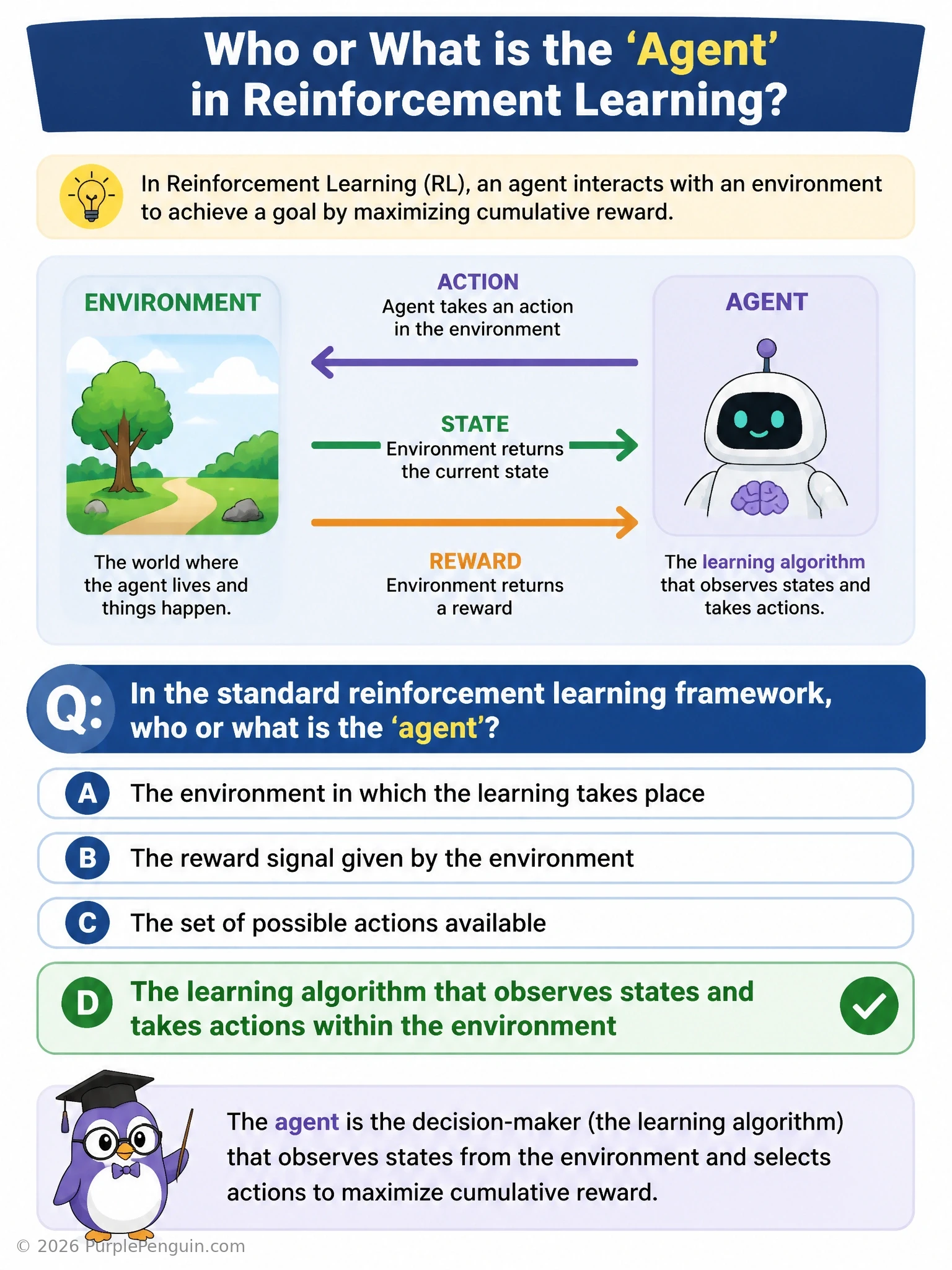
Simple way to remember it: if it's the one making decisions, it's the agent. The agent is the learning algorithm — a robot, a game-playing bot, a trading system, whatever — that watches the current state, picks an action based on its policy, and gets a reward back for it. That's the agent: the learning algorithm that observes states and takes actions within the environment. It's not the environment — that's the outside world reacting to the agent, a totally separate role. It's not a labeled dataset either — RL doesn't hand the agent a table of pre-computed 'right answers' before training; it learns through interaction. And it's not an evaluation metric — a score you compute after training is just a way to measure how well the agent did, not the agent itself.
Full explanation below image
Full Explanation
In the standard reinforcement learning formulation, the agent is the decision-making entity — the learning algorithm or controller — that perceives the current state of its surroundings, selects an action according to its policy, and receives feedback in the form of a reward and a new state from the environment. The agent's objective is to learn, through repeated interaction, a policy that maximizes expected cumulative reward over time. Concretely, the agent could be implemented as a neural network (e.g., a deep Q-network or a policy network), a tabular algorithm for small discrete problems, or any other learnable decision-making system, but conceptually it is always the 'actor' in the RL loop, distinct from the 'world' it acts within. The environment, by contrast, is everything external to the agent: it defines the state space, executes the consequences of the agent's actions, and returns the resulting state and reward — this is the opposite role from the agent's, and confusing the two is one of the most common early misunderstandings in RL. A dataset of labeled state-action pairs used before training describes something closer to supervised pretraining, imitation learning, or behavior cloning setups, none of which constitute the definition of the agent itself; the agent is the learner/actor, not a static dataset, and standard RL does not require such labels at all, learning instead purely from reward feedback gathered through interaction with the environment. A metric used to score the final trained model after deployment describes an evaluation criterion (such as average return, success rate, or task completion time), which is used to assess how well an agent's learned policy performs, but this metric is a measurement tool applied to the agent's behavior, not the agent itself. Correctly identifying the agent as the acting, learning, decision-making component — separate from the environment it inhabits, any pre-existing data, and any post-hoc evaluation metric — is foundational vocabulary for describing any reinforcement learning system or algorithm.