What is the main purpose of a variational autoencoder (VAE)?
Select an answer to reveal the explanation.
Short Explanation and Infographic
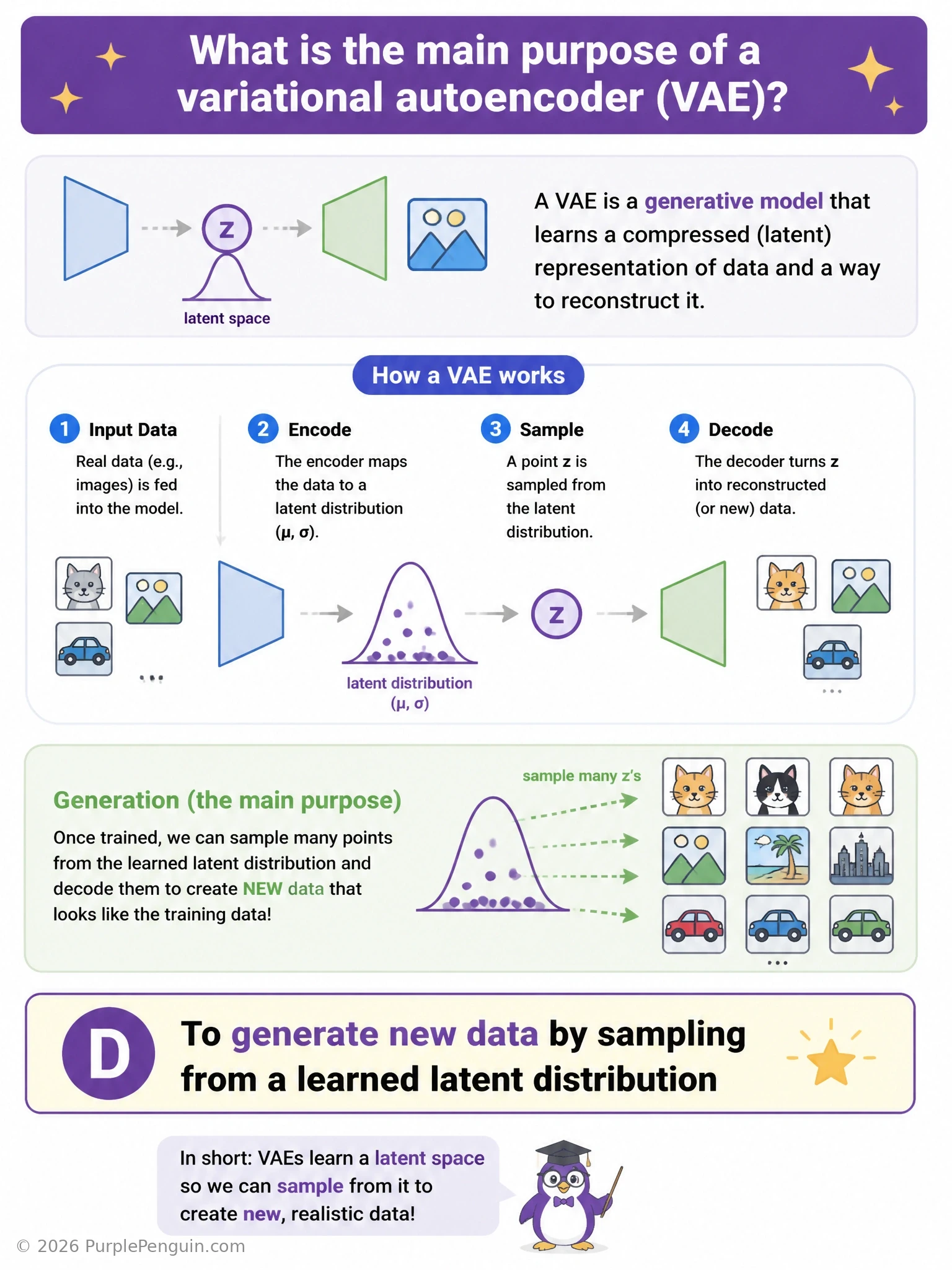
A VAE's whole game is generation, not classification. It learns to squeeze data down into a smooth, continuous latent space shaped like a nice distribution — usually Gaussian — and because that space is continuous and well-behaved, you can grab a fresh random point from it, run it through the decoder, and get a brand-new, plausible piece of data you never actually saw in training. That's it: generate new data by sampling from a learned latent distribution. It's not a classifier — no labeled categories involved. It's not built for lossless compression either — VAEs are lossy and probabilistic by design, trading exactness for a usable, continuous latent space. And it's not an adversarial-example detector; that's a security/robustness task that lives in a totally different corner of deep learning.
Full explanation below image
Full Explanation
A variational autoencoder is a generative model built from an encoder network that maps input data to parameters (mean and variance) of a probability distribution in a latent space, and a decoder network that reconstructs or generates data from samples drawn from that latent distribution. Unlike a standard (vanilla) autoencoder, which learns a deterministic, often irregular latent code purely for reconstruction, a VAE is trained with a loss that combines a reconstruction term with a KL-divergence regularization term pushing the latent distribution toward a known prior (typically a standard normal distribution). This regularization makes the latent space continuous and well-structured, so that sampling any point from the prior and passing it through the decoder yields a plausible, novel data sample rather than noise — this is precisely what makes VAEs useful as generative models capable of producing new images, audio, or other data resembling the training distribution. Classifying images into fixed labeled categories describes a supervised discriminative task typically solved with a CNN and a softmax output layer; while a VAE's encoder produces useful learned representations that could feed a downstream classifier, classification itself is not the VAE's defining purpose, and a standard VAE does not require or produce class labels. Losslessly compressing video files is a domain of classical or specialized lossless compression algorithms and codecs; autoencoders, including VAEs, actually perform lossy compression as a side effect of their bottleneck architecture, and video codec engineering involves many additional considerations (motion compensation, entropy coding) that a VAE alone does not address, making this an incorrect characterization of a VAE's main goal. Detecting adversarial examples is a robustness and security-oriented task, sometimes tackled using various models including autoencoder-based reconstruction error thresholds as one possible technique among many, but this is a specialized application rather than the primary, defining purpose of the variational autoencoder architecture, which is fundamentally about learning a generative model with a structured latent space. The VAE's core contribution to deep learning is precisely this: a principled, probabilistic way to learn latent representations from which new, coherent samples can be generated.