A reinforcement learning engineer describes their algorithm as 'off-policy.' What does that mean?
Select an answer to reveal the explanation.
Short Explanation and Infographic
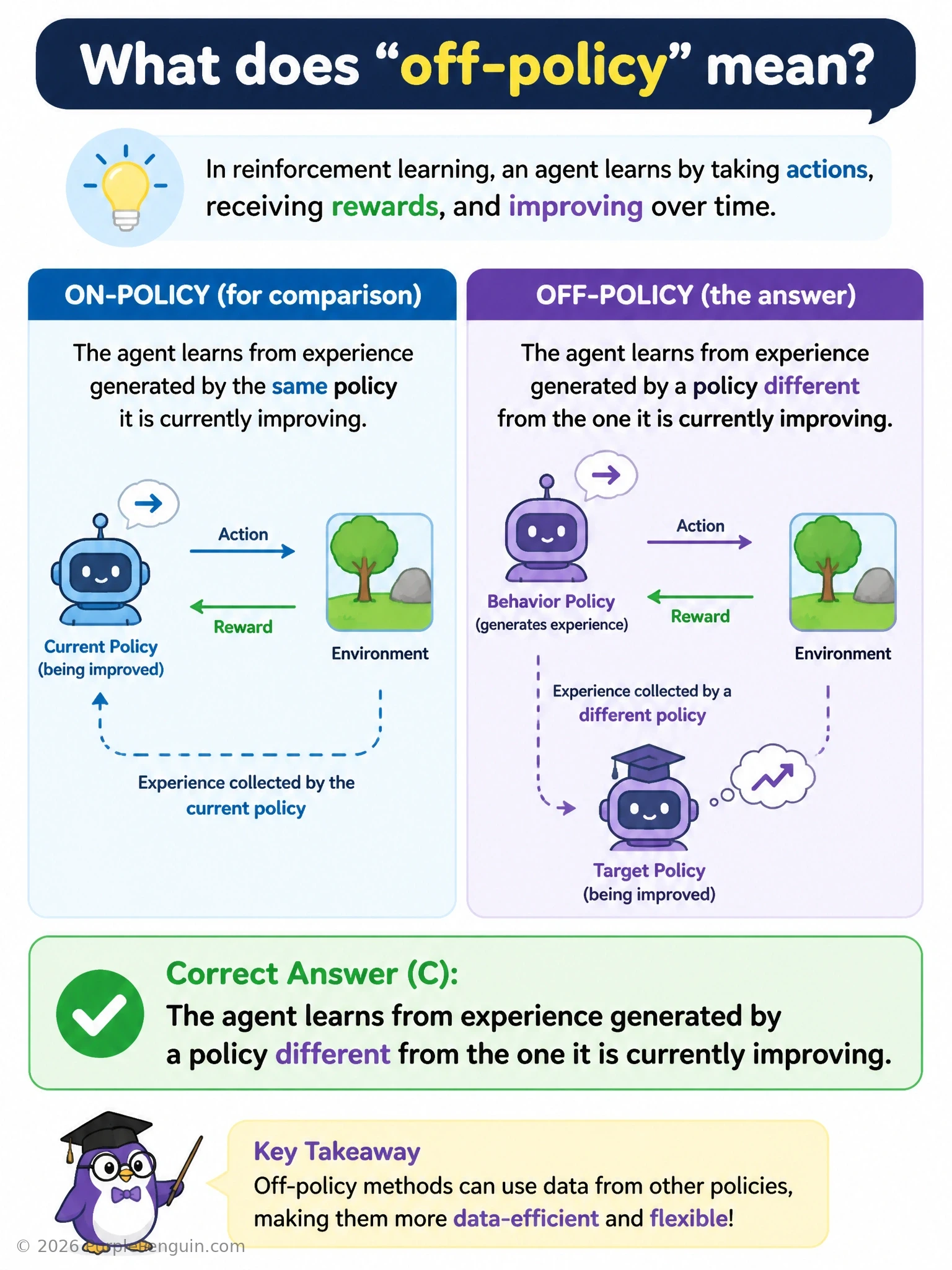
Off-policy just means there's a split between the policy doing the acting and the policy being learned. Think Q-learning: the agent might be exploring with some noisy, exploratory behavior policy, but it's actually learning the value of the greedy target policy at the same time — learning from experience generated by a policy different from the one it's currently improving. That's the whole trick, and it's why off-policy methods can reuse old experience sitting in a replay buffer instead of tossing it after one use. It has nothing to do with simulated versus real environments — that's a sim-to-real question, totally separate. It's not about skipping the reward signal, since every RL method needs rewards to learn anything. And it's definitely not a frozen, never-updated policy — the policy being evaluated and improved is very much changing, just not the same one collecting the data.
Full explanation below image
Full Explanation
Off-policy learning refers to algorithms in which the policy used to generate experience (the behavior policy) is different from the policy being evaluated or improved (the target policy). The canonical example is Q-learning: the agent might act using an exploratory epsilon-greedy behavior policy, generating state-action-reward-next-state transitions, while the Q-value update itself bootstraps toward the value of the greedy (target) policy regardless of which action the behavior policy actually took. This decoupling is what allows off-policy methods to reuse past experience stored in a replay buffer, learn from demonstrations generated by another agent or human, or learn about multiple target policies from a single stream of behavior data. On-policy methods, by contrast (such as SARSA or vanilla policy gradient/REINFORCE), require that the data used for updates come from the current policy being improved, meaning older experience typically cannot be reused once the policy changes. The first distractor, learning exclusively in a simulated environment, describes a sim-to-real or simulation-based training setup, which is an orthogonal engineering choice about where experience comes from (simulation vs. real world), not about the relationship between behavior and target policies. The second distractor, updating value estimates without using a reward signal, is not accurate for any standard RL algorithm — reward is the fundamental learning signal in every RL method, on-policy or off-policy, and no meaningful value or policy update can occur without it. The third distractor, a fixed policy that never updates, would describe something more like pure policy evaluation or a frozen behavior policy used only for data collection, but that is not what 'off-policy' means as a category — the target policy is actively being learned and improved, just not identical to the one generating the data. Recognizing the behavior-versus-target policy distinction is essential for understanding why techniques like experience replay (used in DQN) are valid only in an off-policy setting.