What is the main role of the environment in a reinforcement learning setup?
Select an answer to reveal the explanation.
Short Explanation and Infographic
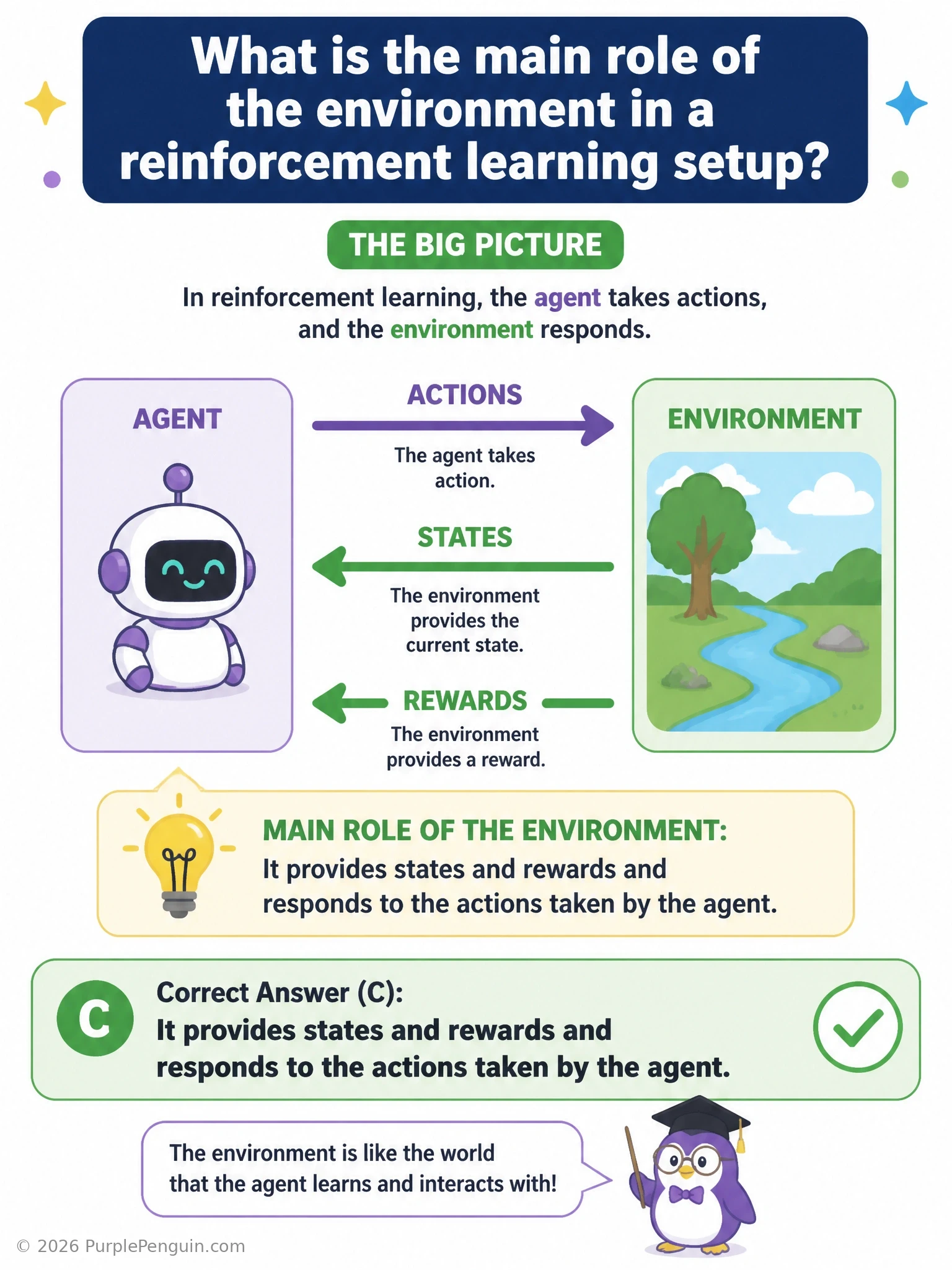
Flip the RL loop around in your head: the agent acts, and something has to react. That something is the environment. It's the world the agent lives in — it hands the agent a state, the agent picks an action, and the environment responds with a new state plus a reward telling the agent how that action worked out. So the environment's job is simple to say and central to everything: provide states and rewards and respond to the agent's actions. It doesn't store the agent's network weights — that's the agent's own internal machinery. It doesn't pick the agent's actions — that's the policy's job, not the environment's. And it doesn't compute gradients for updating the policy — that's a training-algorithm detail happening inside the agent, not something the environment does.
Full explanation below image
Full Explanation
In the standard reinforcement learning framework, typically modeled as a Markov Decision Process, the environment is everything external to the agent that the agent interacts with. At each time step, the environment provides the agent with an observation of the current state, the agent selects and executes an action based on that state (via its policy), and the environment then transitions to a new state and returns a reward signal reflecting the immediate consequence of that action. This state-action-reward-next-state cycle repeats, and the environment's dynamics (its transition function and reward function) define the problem the agent is trying to solve, whether that environment is a physical robot's surroundings, a video game, a financial market simulator, or a queuing system. The first distractor, storing the neural network weights used by the agent's policy, describes the agent's own internal state and parameters, which belong to the agent (or its policy/value function approximators), not to the environment; the environment has no concept of the agent's internal representation. The second distractor, selecting which action the agent should take, is precisely the opposite of the environment's role — action selection is the defining function of the policy, which resides within the agent, while the environment only reacts to whatever action the agent has already chosen. The third distractor, computing the gradient used to update the agent's policy parameters, describes a component of the learning algorithm (e.g., backpropagation through a policy network, or a Q-learning update rule), which is computed by the agent's training procedure using rewards and states received from the environment — the environment itself has no role in gradient computation; it merely supplies the raw states and rewards that make such computation possible. Clearly separating agent responsibilities (perceiving, deciding, learning) from environment responsibilities (state transitions, reward generation) is foundational to correctly reasoning about any RL algorithm or system diagram.