In a reinforcement learning system, what role does the policy play?
Select an answer to reveal the explanation.
Short Explanation and Infographic
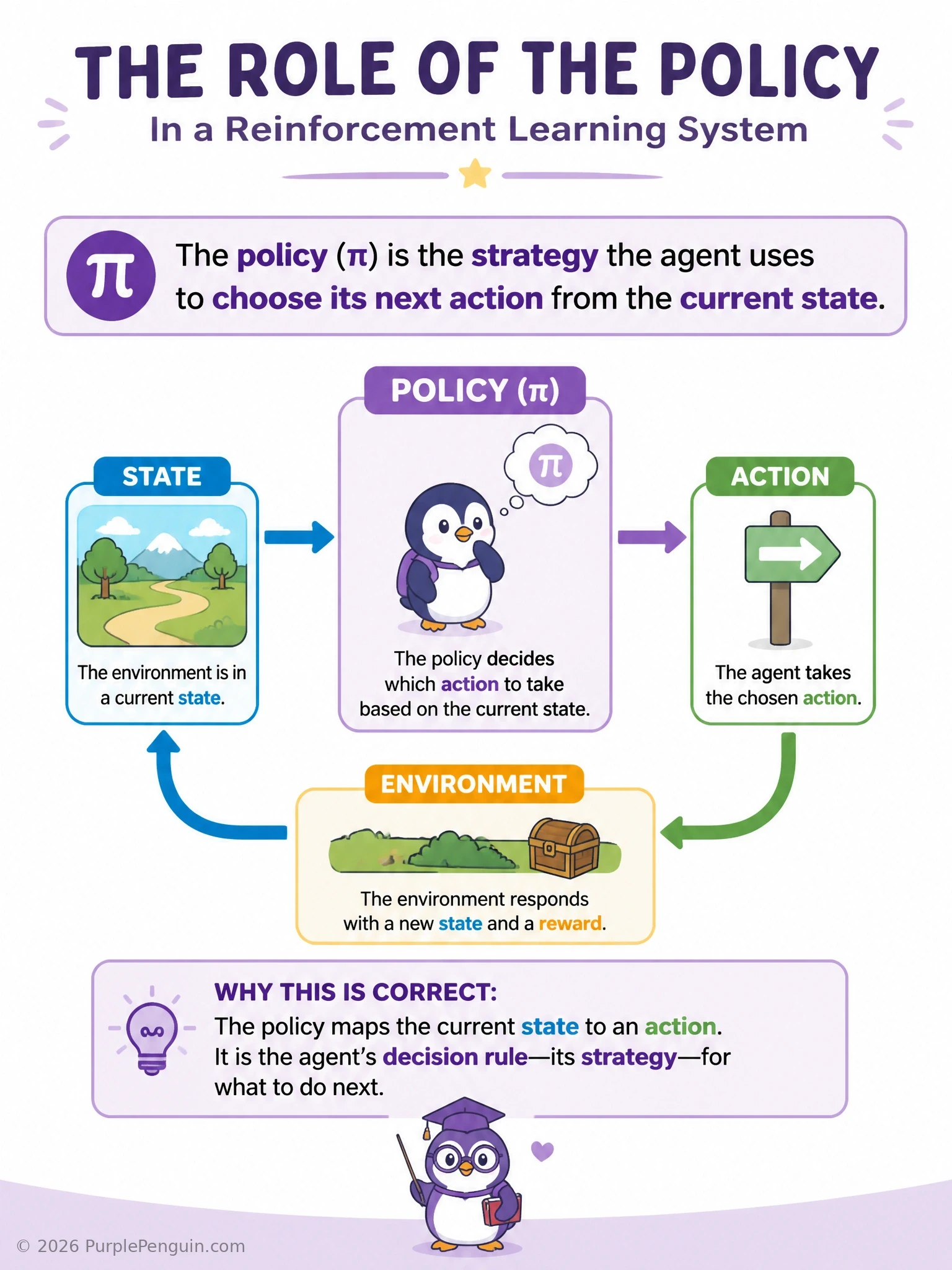
The policy is basically the agent's playbook. Given whatever state it's currently in, the policy is the rule — deterministic or probabilistic — that says 'here's the action to take next.' That's it: the strategy the agent uses to choose its next action from the current state. It's not a running log of rewards (that's just bookkeeping, not decision-making). It's not generating fake states to pad out training (that's more of a generative-model or data-augmentation idea, unrelated to RL's core loop). And it's definitely not comparing discriminator versus generator output — that phrase belongs to GANs, a completely different corner of deep learning. Keep the vocabulary straight: policy = decision rule, and that's the one thing you can't confuse it with.
Full explanation below image
Full Explanation
In reinforcement learning, the policy, often denoted π, is the core decision-making function that defines the agent's behavior: given the current state (or observation), the policy specifies which action the agent should take, either deterministically (a direct state-to-action mapping) or stochastically (a probability distribution over possible actions). The policy is what the agent is ultimately trying to learn and improve over the course of training, since a better policy yields higher expected cumulative reward. Policies can be represented in various ways, from a simple lookup table in small discrete environments to a deep neural network in complex, high-dimensional environments, and the entire RL training process — whether value-based, policy-based, or actor-critic — is aimed at converging toward an optimal or near-optimal policy. The first distractor, a historical log of every reward received, describes something closer to an experience buffer or reward history used for bookkeeping or replay (as in experience replay for off-policy algorithms), but this is not the policy itself; it is data that might be used to improve the policy, not the decision mechanism. The second distractor, generating synthetic states to augment the environment, describes a data-augmentation or model-based simulation technique, which is a separate concept (sometimes used in model-based RL to simulate rollouts), not the definition of a policy. The third distractor, measuring the difference between discriminator and generator outputs, is a description specific to Generative Adversarial Networks and has no direct relationship to reinforcement learning's policy concept, though the term is sometimes conflated by learners transitioning between generative and RL topics. Recognizing that the policy is fundamentally the agent's action-selection strategy — separate from value functions (which estimate how good states or actions are) and separate from the environment or reward mechanics — is foundational to understanding every RL algorithm family.