In NumPy terms commonly used to describe deep learning data, what distinguishes a vector from a scalar?
Select an answer to reveal the explanation.
Short Explanation and Infographic
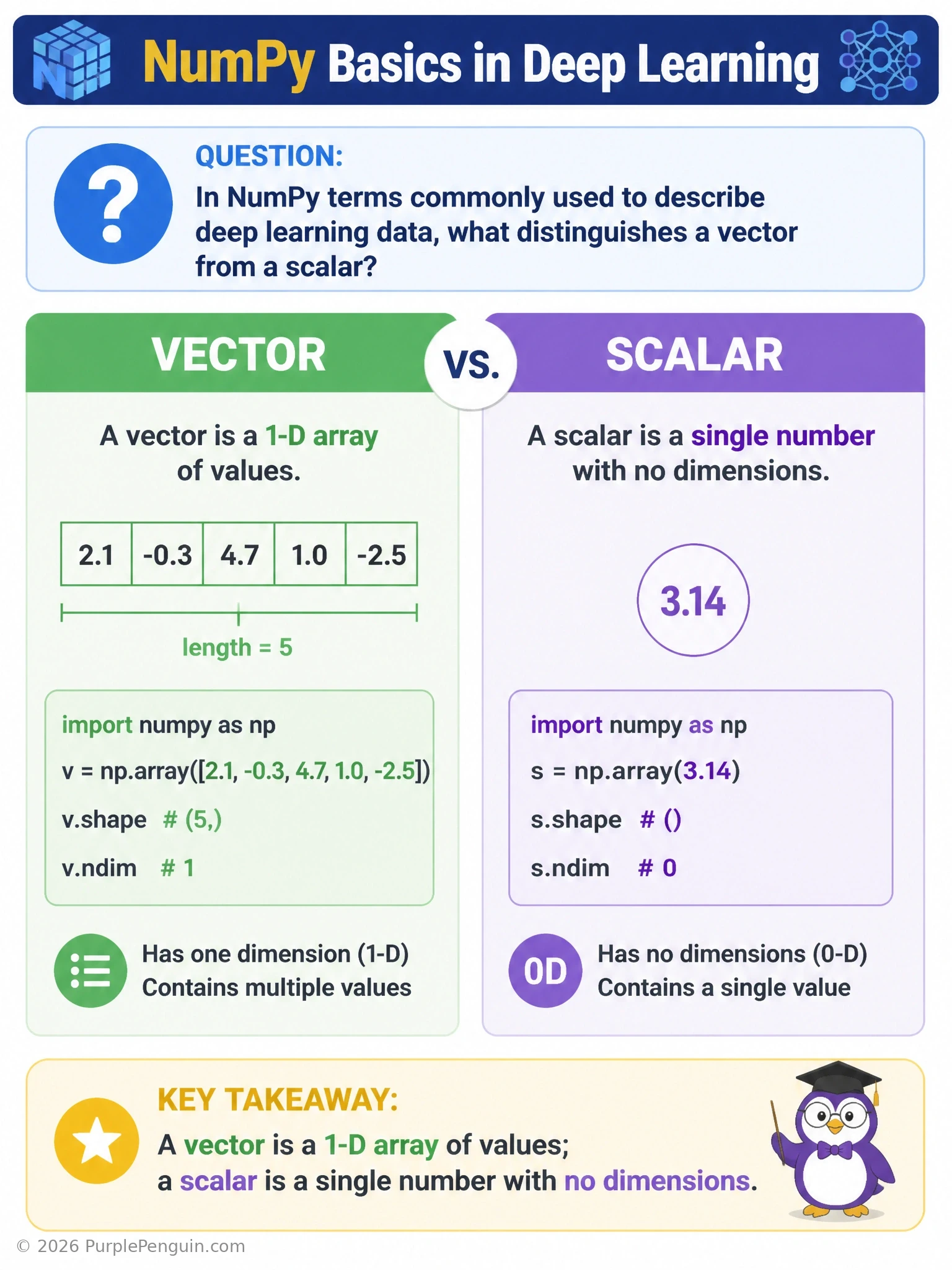
This one's straight out of the NumPy basics chapter. A scalar is just a single number — no brackets, no shape, no dimensions, like the number 7 sitting by itself. A vector is a 1-D array: a list of numbers with one axis, like np.array([1, 2, 3]), which has a shape like (3,). That's the whole distinction, so 'vector is 1-D, scalar is a single number' is correct. It's got nothing to do with integers versus floats — both scalars and vectors can hold either. Size in memory isn't the distinguishing factor either; a scalar is almost always smaller since a vector holds multiple values. And they're definitely not the same thing — a scalar has zero dimensions, a vector has exactly one, which matters a lot once you start doing matrix and tensor math.
Full explanation below image
Full Explanation
In NumPy, and in deep learning terminology generally, tensors are classified by their number of dimensions (also called rank or order). A scalar is a rank-0 tensor: a single numerical value with no axes at all, such as np.array(5), which has an empty shape (). A vector is a rank-1 tensor: a one-dimensional array of numbers arranged along a single axis, such as np.array([1, 2, 3]), which has a shape like (3,). The key distinguishing property is dimensionality — a scalar has zero dimensions and represents one value, while a vector has one dimension and represents an ordered sequence of values. Building on this, a matrix is a rank-2 tensor (rows and columns), and higher-rank tensors extend this to three or more dimensions, which is exactly the structure used to represent things like batches of RGB images.
The claim that a vector can only hold integers while a scalar holds floats is incorrect; both scalars and vectors in NumPy can be composed of any supported numeric dtype, including integers, floats, or even complex numbers. The data type (dtype) is an independent property from the dimensionality (shape/rank) of the array.
The claim that a scalar is always larger in memory than a vector is backwards in the typical case: a vector, by containing multiple elements, generally consumes more memory than a single scalar value of the same dtype, though this depends on the vector's length.
The claim that a vector and scalar are the same structure is false; they are distinguished precisely by rank/dimensionality, which affects how operations like broadcasting, indexing, and matrix multiplication behave on them.
Understanding this scalar-vector-matrix-tensor hierarchy is foundational because deep learning frameworks represent everything — inputs, weights, activations, gradients — as tensors of varying rank, and operations like dot products, matrix multiplication, and broadcasting all depend on knowing exactly how many dimensions each object has.